
SLIDESHOW: Which US Jobs Are Safe from AI?
A slideshow of 4 charts showing US jobs and AI disruption risk:
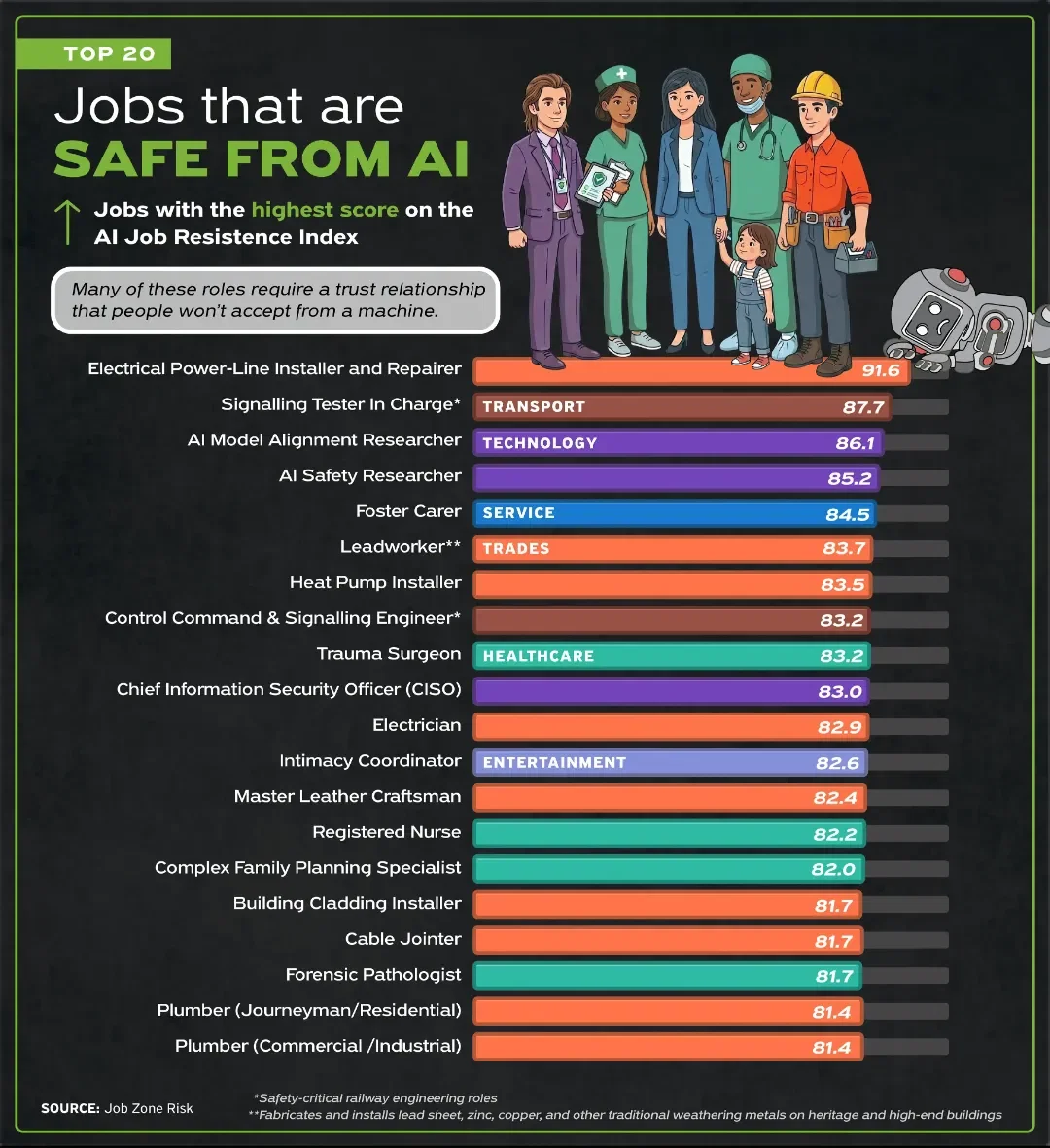
- Jobs Safe From AI: Which jobs are safest?
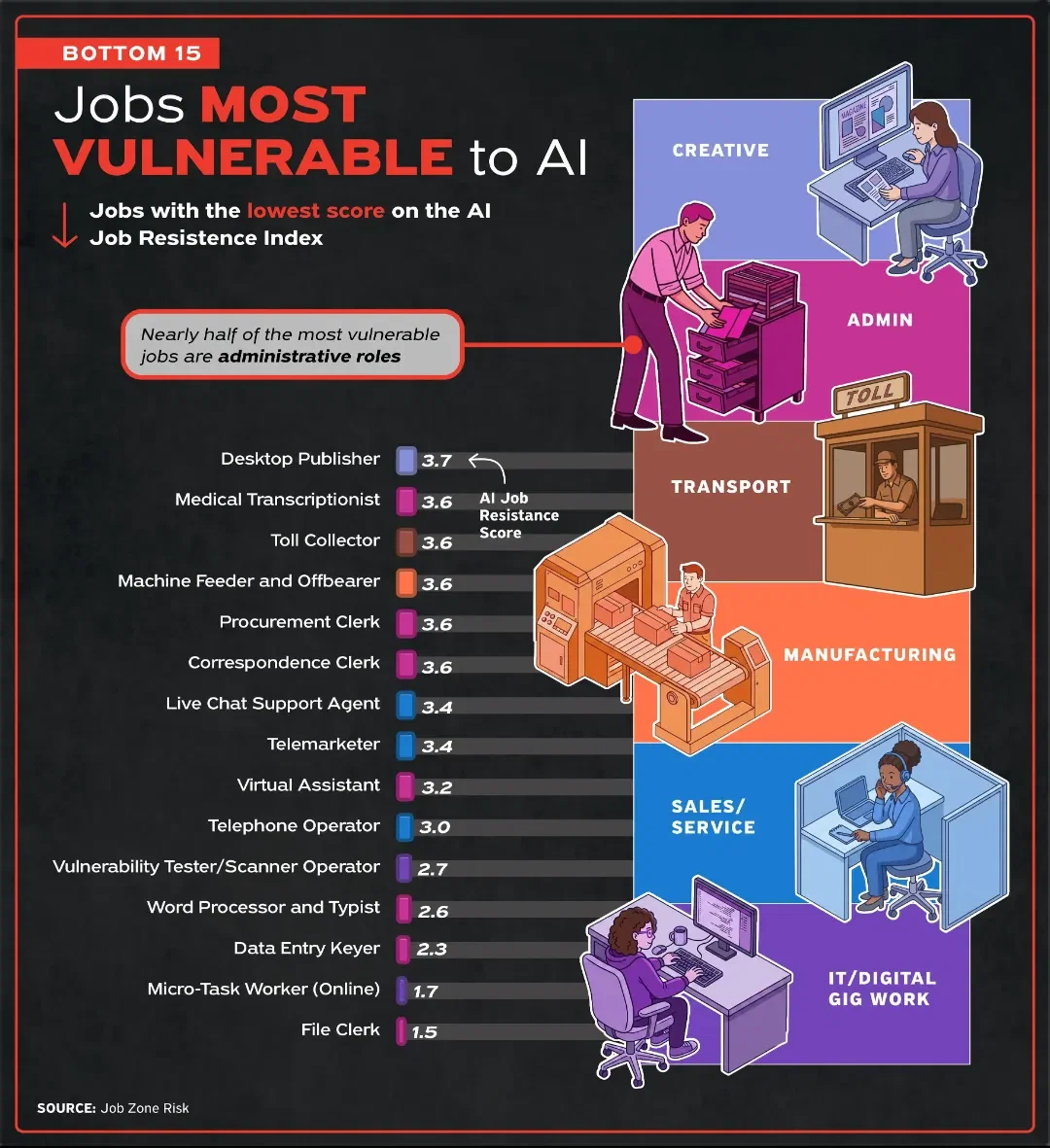
- Most Vulnerable Jobs: Which jobs aren't?
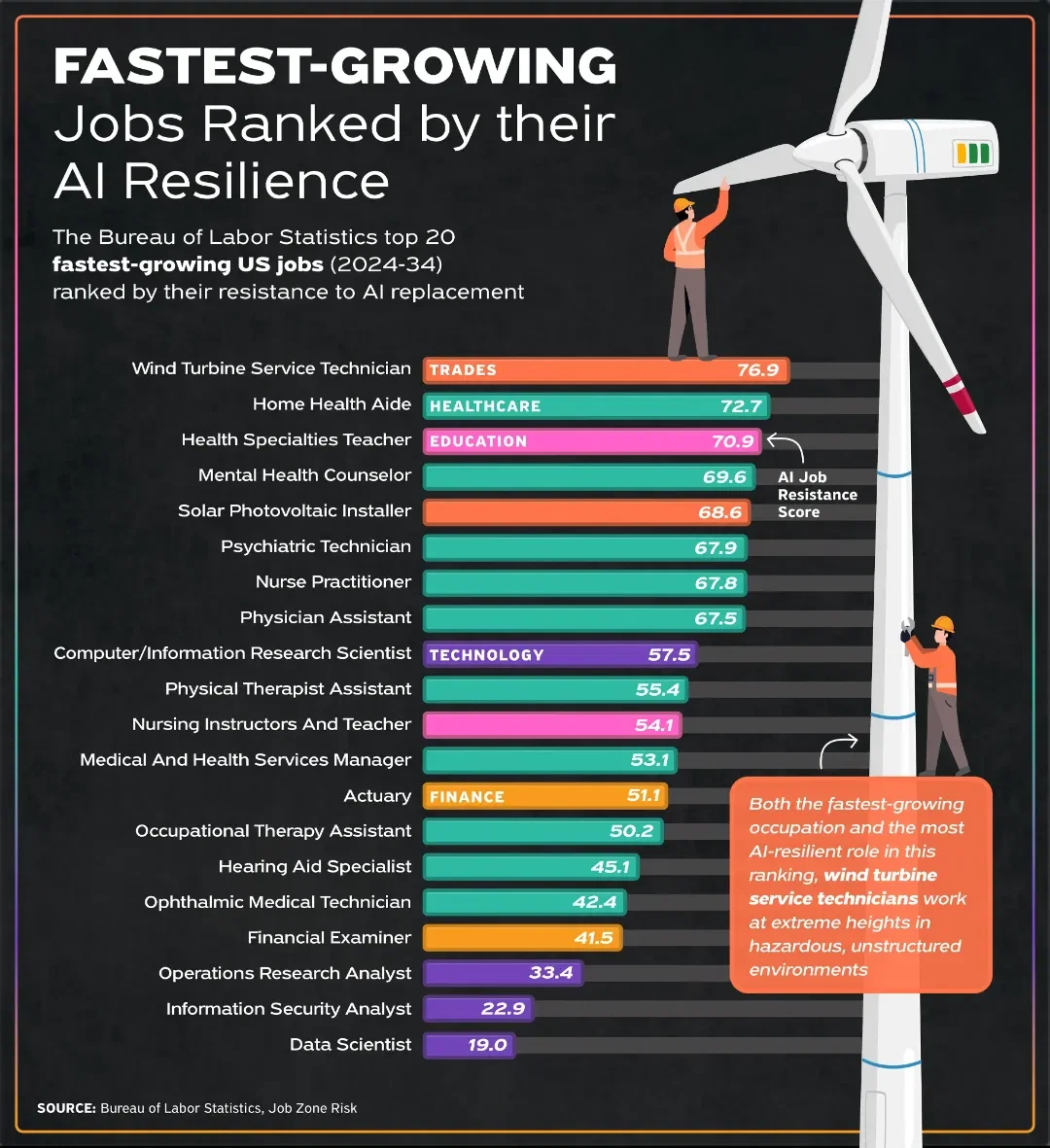
- Fastest-Growing Jobs: Does growth equal safety?
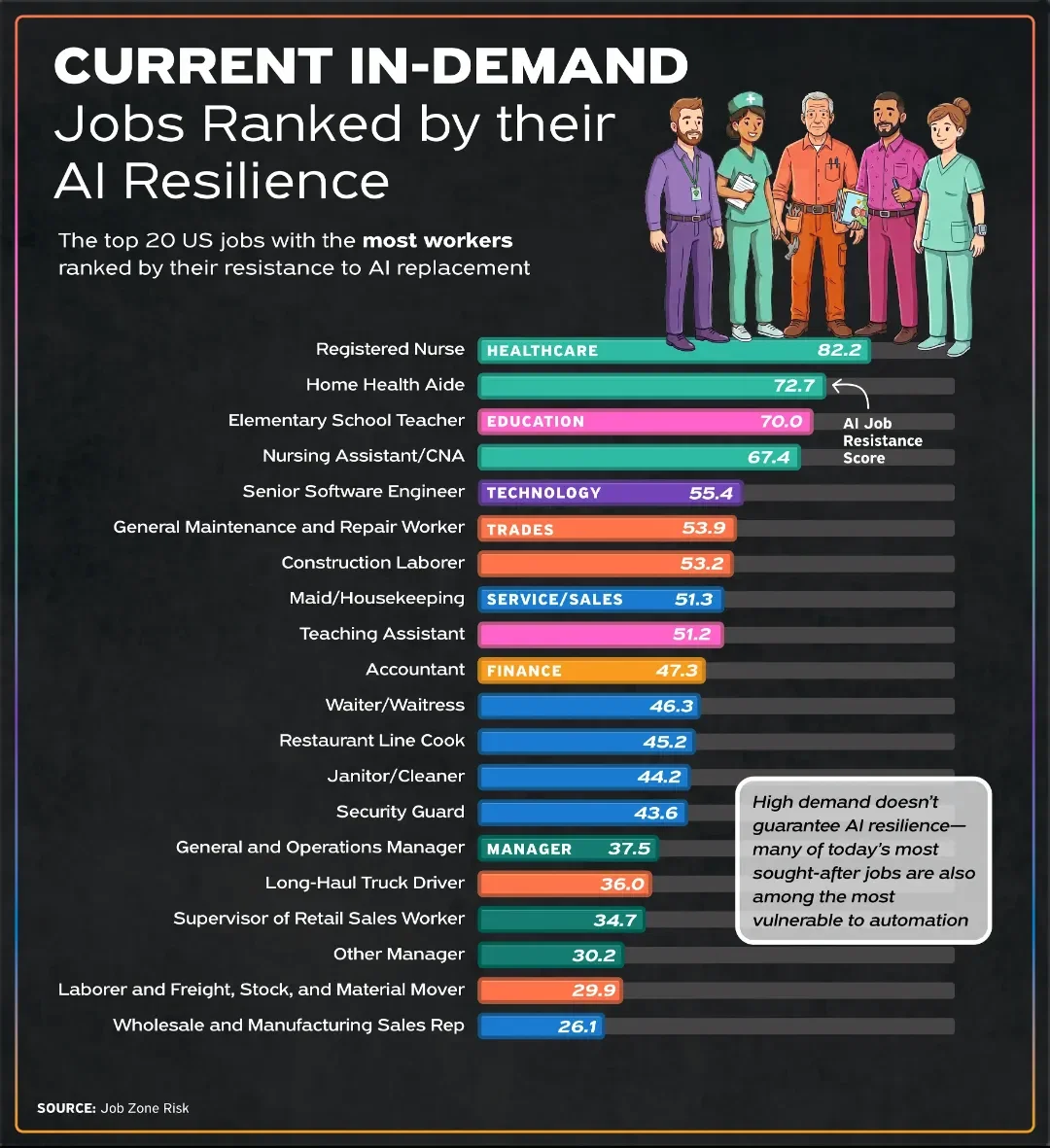
- Most In-Demand Jobs: Does popularity equal safety?
These four charts combine data from the US Bureau of Labor Statistics (BLS) and Job Zone Risk, a site that assigns BLS occupations a proprietary AI Job Resistance Index (AIJRI). The higher the number, the less vulnerable the job is to AI disruption.
Jobs are ranked by AI resilience across four perspectives: safest jobs overall, most vulnerable overall, fastest-growing, and currently in demand (largest US employment) as of July 2026.
A job's resilience depends on structural barriers to automation, including:
- physical human presence
- licensing and certification
- emotional trust and connection
- real-time decision-making in unpredictable environments
Occupations with multiple barriers are the most resilient, while those with few or none are the most exposed.
Jobs Safe From AI
These 20 occupations have the highest AIJRI scores, making them the least vulnerable to AI automation and displacement.
Common characteristics of these jobs include complex judgment, unpredictable work, persistent labor shortages, and regulatory or licensing requirements. AI may improve productivity, but it is unlikely to replace these workers.
The list is dominated by skilled trades, healthcare professionals, and AI safety researchers. Many require physical presence, hands-on expertise, or a trust relationship that people won’t accept from a machine. An entertainment job, “intimacy coordinator,” even appears on the list. This role relies on empathy, sensitivity, and discretion to safely choreograph delicate scenes involving intimacy and nudity.
Jobs Most Vulnerable to AI
These occupations fall squarely in the red zone and are already being disrupted by AI. Most involve routine, screen-based work centered on clerical, scheduling, customer support, or data processing tasks. They typically require little physical interaction, rely on repetitive workflows, and face few regulatory barriers to automation.
Although many of these jobs remain in demand today, Job Zone Risk estimates some could experience significant displacement within the next 4–5 years. Some may even disappear by 2030.
Fastest-Growing Jobs Ranked by AI Resilience
Using BLS projections for the fastest-growing occupations (2024–2034) published in August 2025, these jobs are re-ranked by their AI resilience scores.
Rapid growth does not necessarily mean protection from AI. Renewable energy technicians and healthcare occupations dominate the sweet spot of high-growth paired with high-resilience, while the three lowest-scoring occupations are all technology roles. As AI reshapes the tech industry, these occupations may evolve differently despite their strong employment outlook.
Current In-Demand Jobs Ranked by AI Resilience
In this ranking, the jobs with the most currently employed workers in the US are re-sorted by their AI resilience, using BLS data via Job Zone Risk. Today's most common jobs span the full spectrum of AI risk. Many service occupations—including restaurant staff, janitors, security guards, and retail workers—remain highly employed despite varying levels of exposure to automation.
Methodology: Job growth projections from the US Bureau of Labor Statistics (2024–2034). AI risk scores from JobZoneRisk.com. Occupations were matched using BLS Standard Occupational Classification (SOC) titles, with the closest equivalent JobZone occupation selected when an exact title was unavailable.