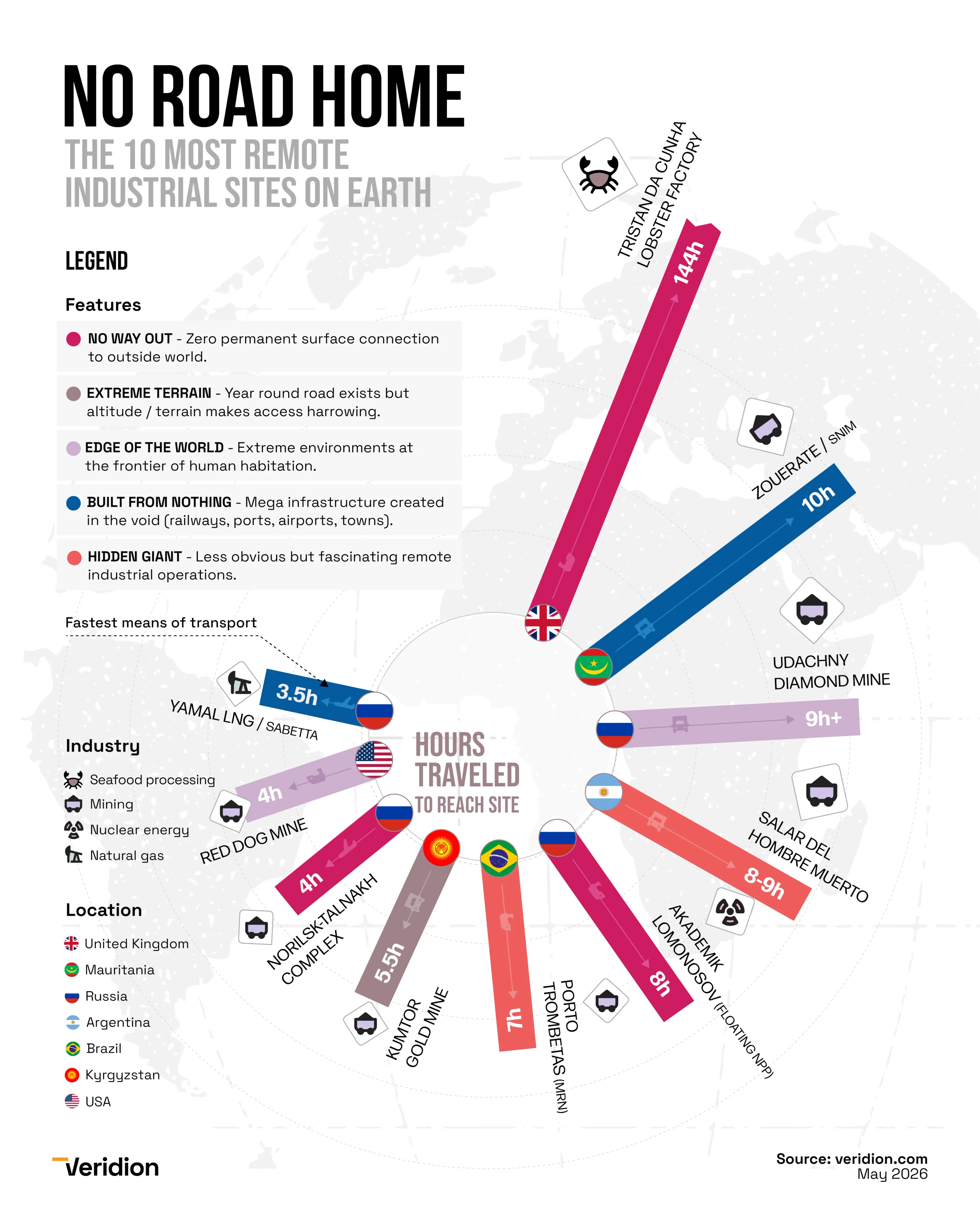
Reaching Tristan da Cunha takes six days by ship from Cape Town. There is no airport. There is no harbour: you land by small boat. On arrival, you find a commercial seafood factory. It employs nine people, processes rock lobster, and accounts for roughly 80% of the island's revenue.
It is the most remote industrial site on this map by a factor of 14. The next site on the list, Mauritania's Zouerate iron ore complex, is ten hours' drive from the nearest capital. The map ranks ten operations by hours of travel from their nearest functioning gateway: the closest airport with scheduled service, the nearest port with regular calls, or the nearest road-accessible city. In addition, the facilities are grouped by why they are hard to reach: no surface connection at all, mountain altitude, ice-bound seasonality, or terrain that had to be built from scratch.
By the numbers
- Travel times range from 3.5 to 144 hours. Tristan da Cunha is roughly 41× harder to reach than the fastest site on the list (Russia's Yamal LNG terminal), accessible by 3.5-hour charter from Moscow.
- Russia hosts 4 of the 10 sites: Norilsk-Talnakh, Akademik Lomonosov, Yamal LNG, and Udachny. All sit at or above the Arctic Circle.
- 7 of the 10 are mining or extraction operations: iron ore, diamonds, lithium, bauxite, gold, zinc/lead, and nickel/copper. Two are energy (one nuclear, one LNG); one is seafood.
- Three sites have zero permanent surface connection to the outside world: Tristan da Cunha, Norilsk-Talnakh, and the floating reactor Akademik Lomonosov.
- Workforce ranges from 9 people to ~80,000. Same map, opposite ends of the industrial human-scale.
Beyond the travel time
- Norilsk-Talnakh is an industrial city of 175,000 people with no road or rail to the rest of Russia. Locals call the rest of the country "the mainland." The complex produces roughly 1% of global sulphur dioxide pollution alongside a substantial share of the world's nickel, copper, palladium, and platinum.
- Akademik Lomonosov is the world's only floating nuclear power plant: two reactors mounted on a barge, towed 4,700 km through the Arctic from Murmansk. It powers gold mines in Chukotka and has a gym, pool, and bar for its 70-person crew.
- Zouerate's iron ore reaches the Atlantic by 700 km of railway. The ore trains are 2.5 km long, among the longest on Earth. Passengers ride for free on top of the cars. Inside the mines, everyone drives on the left.
- Yamal LNG was built from absolute nothing on permafrost at 71° N. A $27 billion terminal ships LNG through Arctic ice year-round using ice-class tankers on the Northern Sea Route.
- Salar del Hombre Muerto is where EV batteries begin. Lithium is extracted from a salt flat at 4,000 m altitude, 8–9 hours from the nearest airport through one of Earth's most desolate landscapes.
- Tristan da Cunha's island flag features two rock lobsters. The factory is the single largest employer on an island of 245 people.
Methodology and caveats
"Remoteness" here is measured as travel time from the nearest functioning gateway (the closest airport with scheduled service, the nearest port with regular calls, or the nearest road-accessible city) using the fastest realistic method (charter flight, helicopter, road, river ferry, or ship). It is not a pure distance ranking: Tristan da Cunha (~2,400 km from Cape Town) is closer in absolute terms than Sabetta (~3,500 km from Moscow) but vastly harder to reach because no airport exists and only a handful of ships visit the island each year. Workforce figures are direct on-site headcount and exclude wider extended populations; for industrial towns like Norilsk and Zouerate, the figure is the direct industrial workforce, not the surrounding settlement. The full underlying dataset covers twenty industrial operations across six tier categories; the ten shown here represent the most striking sites per tier.