
Tourism Asia Pacific 2025 YTD - Tokyo Takes the Lead as Regional Growth Masks Rising Fault Lines
Executive Summary & Key Takeaways - October 2025 YTD
Asia Pacific tourism has fully recovered — but the structure of demand has changed. By October 2025, the region surpassed pre-pandemic levels, with Tokyo overtaking Bangkok as the top destination, outbound China remaining as the most important origin market and Hokkaido emerging as the standout growth story. Beneath the headline growth, however, geopolitical tensions and uneven origin-market recoveries are reshaping where the next phase of growth will come from.
- Recovery achieved, but uneven: Asia Pacific international overnight arrivals reached 266 million by October 2025, up 7.3% YoY and 6% above 2019 levels, though growth remains below potential.
- Japan reshapes the leaderboard: Tokyo overtakes Bangkok to become the region’s top destination, supported by broad-based growth across Japanese cities.
- Thailand recalibrates: Bangkok, Pattaya, and Phuket remain among the region’s largest destinations, but all are on track to finish below 2024 record levels.
- Hokkaido stands out as a rare case of structural growth, recording nearly 30% year-on-year expansion on top of an already record-high 2024, signalling sustained demand rather than post-reopening recovery.
- China still matters: unlocking stronger Asia Pacific growth in 2026 will depend in large part on a sustained recovery in Chinese outbound travel. Chinese outbound travel is only 78% recovered, leaving an estimated 13 million missing trips in 2025 YTD.
- The next phase is about structure, not volume: Future performance will depend less on reopening and more on origin-market mix, geopolitics, and whether destinations have the policy and marketing agility to absorb demand displaced by geopolitical events - such as the surge of cancelled Chinese bookings to Japan in November.
Regional Overview
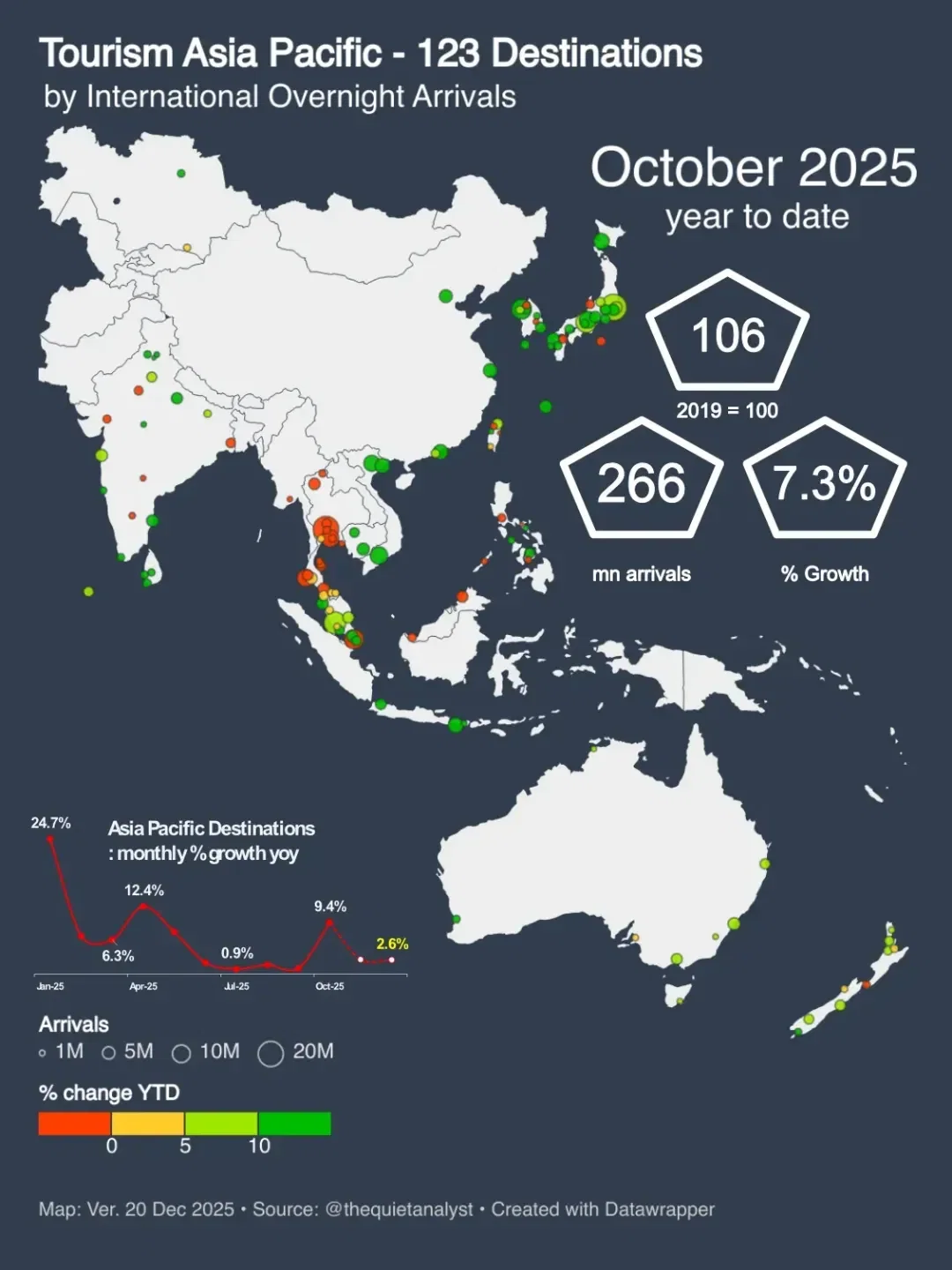
As of October 2025, 123 Asia Pacific destinations have generated a combined 266 million international overnight arrivals, representing 7.3% growth compared with the same ten-month period in 2024. Relative to pre-pandemic levels, the region is now operating at approximately 106% of 2019 volumes, marking a full recovery in aggregate terms.
Growth in the final two months of 2025 is expected to be subdued, reflecting heightened geopolitical tensions in the region, most notably between China and Japan, as well as Thailand and Cambodia.
For an interactive version of this map, please visit the substack version at https://thequietanalyst.substack.com/
The Top 20 Destinations of Asia Pacific
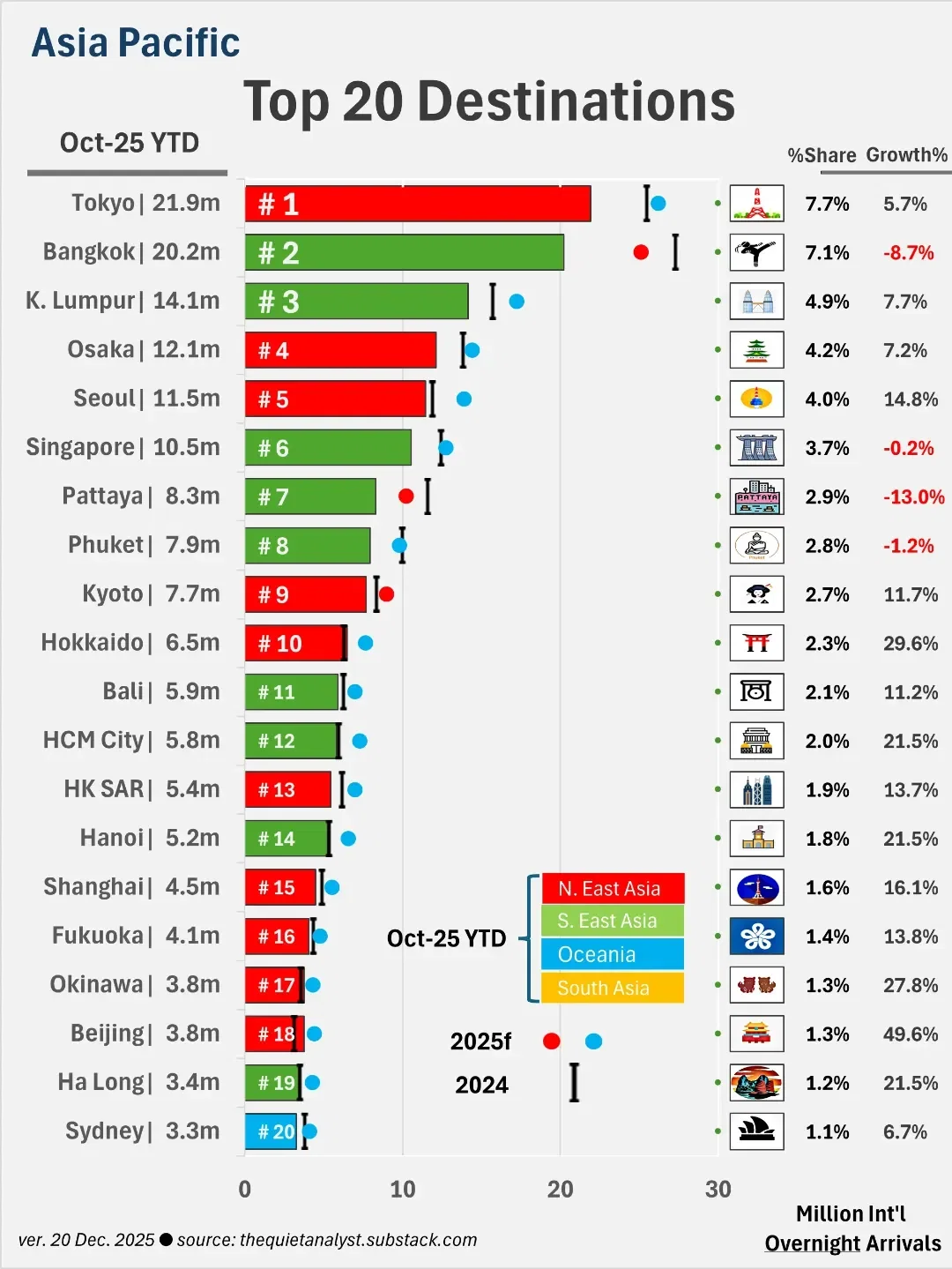
By October 2025 YTD, Tokyo has overtaken Bangkok, establishing an almost 2 million arrival lead over the Thai capital. Based on current trends, we estimate that this lead will persist through year-end, positioning Tokyo as the #1 tourism destination in Asia Pacific in 2025, overtaking the region’s long-standing leader.
However, even if Tokyo (#1, 21.9m) finishes 2025 at the top, it is likely to face headwinds in 2026, stemming from renewed geopolitical tensions with China that emerged in November 2025 and let to almost half a million cancelled Chinese bookings to visit Japan. Chinese tourists represent the largest single origin market for Japan’s major cities, accounting for approximately 20% of arrivals to Tokyo, 31% to Osaka, and 23% to Kyoto.
Thailand, meanwhile, is confronting its own challenges. Recent geopolitical tensions with Cambodia are expected to weigh on the Kingdom’s key destinations, including Bangkok (#2, 20.2m), Pattaya (#7, 8.3m), and Phuket (#8, 7.9m). We currently forecast that all three destinations will end 2025 below their record-setting 2024 arrival levels. In the accompanying graphic, destinations where 2025 estimated arrivals fall below 2024 actuals are highlighted with red circles.
The next four destinations in the rankings have all surpassed 10 million arrivals by October 2025 YTD:
- Kuala Lumpur (#3, 14.1m)
- Osaka (#4, 12.1m)
- Seoul (#5, 11.5m)
- Singapore (#6, 10.5m)
Based on current trajectories, the Top 20 destinations as of October are expected to retain their rankings through the full year.
In growth terms, Beijing (#18, +49.6%) and Hokkaido (#10, +29.6%) recorded the fastest year-on-year expansion. Beijing’s outsized growth reflects a low base effect, as Chinese destinations continue to lag the broader region due to their later reopening. Hokkaido stands out as the true growth leader, with nearly 30% growth achieved on top of an already record-high 2024, underscoring genuine demand expansion rather than catch-up recovery.
The Top 20 Origin Markets of Asia Pacific
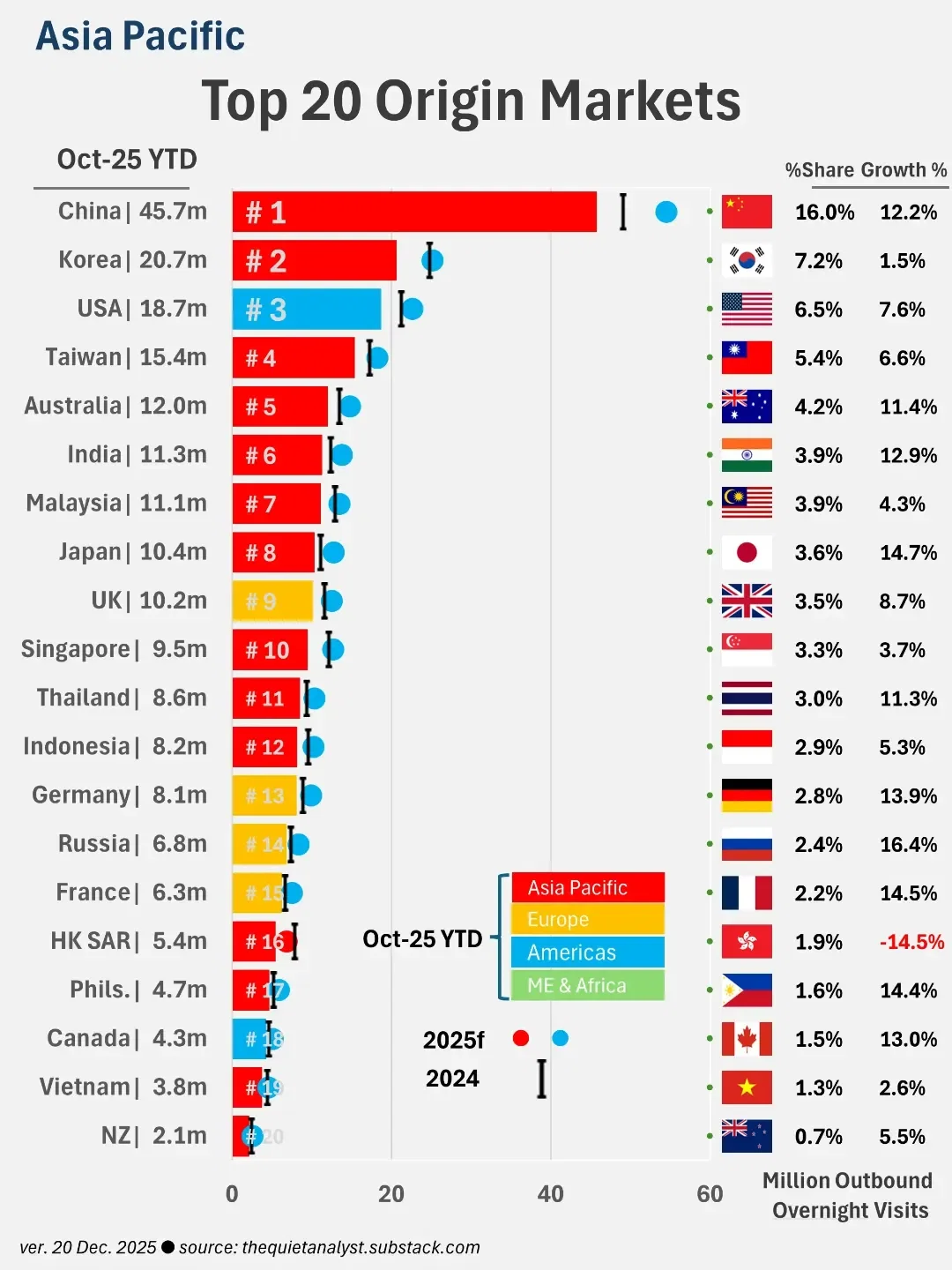
The Top 20 origin markets collectively generated 78% of the region’s 266 million international overnight arrivals during the first ten months of 2025.
China remains the largest origin market, contributing 45.7 million arrivals, exceeding the combined total of South Korea (#2, 20.7m) and the United States (#3, 18.7m). Fourteen of the Top 20 origin markets are within Asia Pacific, followed by four European markets and the United States.
Coming up Next...Tourism Europe 2025 YTD