
Where Data Tells the Story
© Voronoi 2026. All rights reserved.

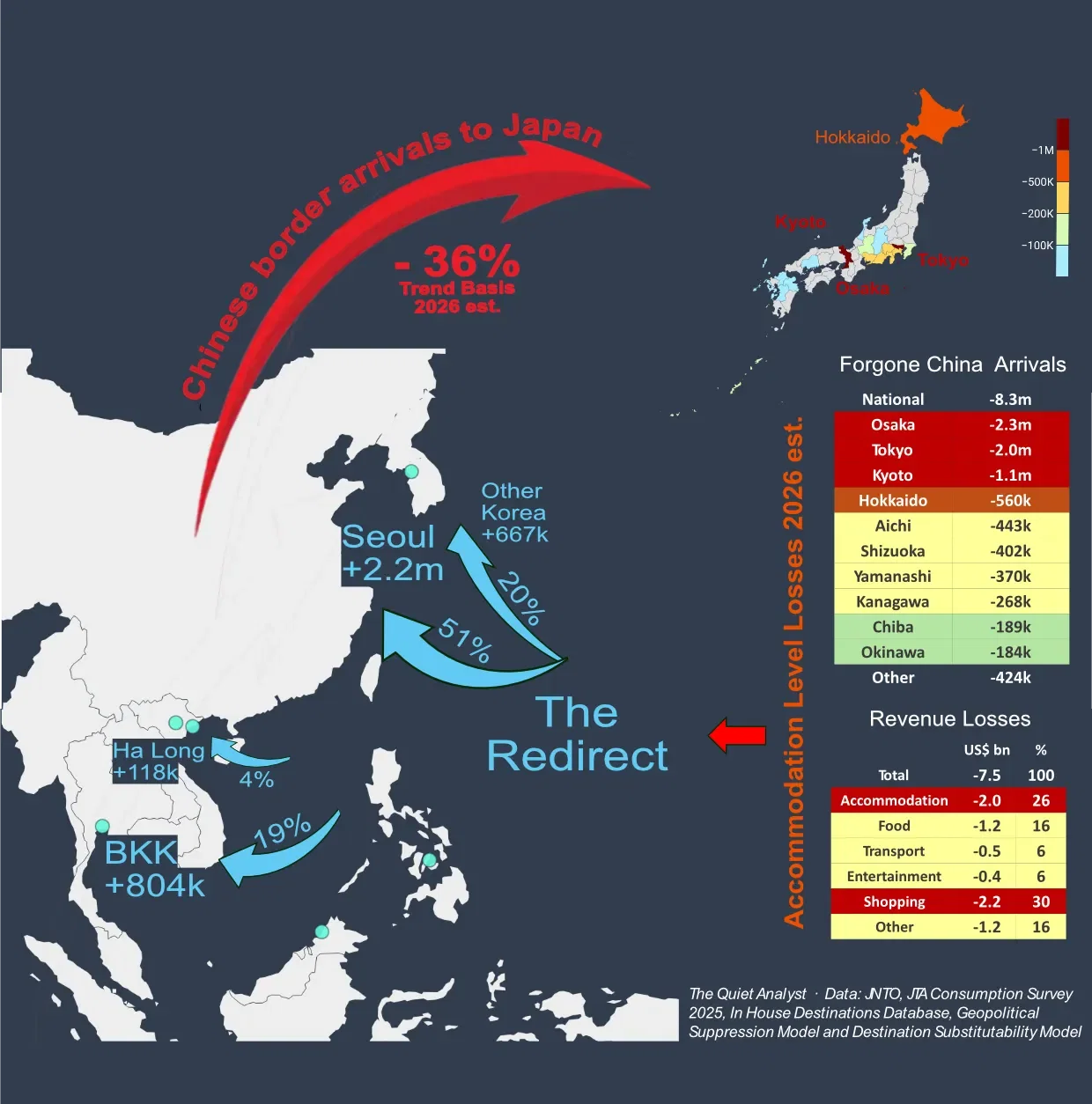
In November 2025, China issued a formal travel advisory against Japan following Prime Minister Takaichi's remarks on Taiwan's security, triggering a 45–60% collapse in Chinese arrivals that lasted through February 2026. Japan set a tourism record that same February — 3.47 million international border arrivals, up 6.4% year-on-year — as South Korean visitors surged 28% and Taiwanese visitors 37%. Transport Minister Kaneko called it a "significant achievement." The headline was accurate. It was also the wrong number to look at.
The correct baseline is not last year's arrivals — it's what China would have sent had the shock never happened. Chinese arrivals to Japan were growing at 13% annually before the advisory. On a trend basis, forgone demand over the four-month window was 1.50 million, not the 1.18 million the flat comparison implies. The non-China compensation rate falls from 141% to 111%. A comfortable surplus becomes a narrow one.
At the accommodation level it is worse. Border arrivals count bodies crossing a line; prefecture accommodation data reveals where visitors actually stayed and for how long. Chinese visitors averaged 9.1 nights and 2.8 prefecture visits per trip. Korean visitors averaged 4.0 nights and 1.6 prefectures. When Chinese visitors disappear, their multi-prefecture footprint disappears with them. Non-China arrivals replaced only 26% of China's trend loss at the accommodation level — not 111%. Tokyo, Kyoto and Osaka each compensated less than 12% of their accommodation loss. Hiroshima, with low China dependency and strong Western long-haul flows, compensated 3,400%. The gateway cities absorbed the brunt; the heritage and nature corridors were left behind.
Shopping is the only spend category in net deficit — down $310 million over four months. Chinese visitors spend $615 per trip on shopping against a non-China blended average of $359. Korean visitors average $173. The visitors who replaced Chinese tourists do not buy the same things. Mandarin-speaking staff, luxury cosmetics concessions calibrated to Chinese preferences, electronics floors optimised for Chinese purchasing patterns — none of this pivots to a Korean retail profile in a single season. The question of when shopping recovers is the question of when Chinese visitors return.
Under an 18-month recovery scenario calibrated to the 2017 China–Korea THAAD boycott, forgone Chinese accommodation arrivals in 2026 total 8.3 million nationally. Projected revenue loss reaches $7.5 billion, with shopping ($2.2 billion, 30%) and accommodation ($2.0 billion, 26%) accounting for the majority. The damage is heavily concentrated — Osaka (−2.3 million accommodation arrivals), Tokyo (−2.0 million) and Kyoto (−1.1 million) account for more than half the national loss.
When Chinese visitors skip Japan, they do not stay home. Using a substitutability-weighted gravity model scoring destinations on proximity, price, visa access and destination type similarity, Seoul captures 51% of the estimated 3.7 million redirect pool — not because it is competing for those visitors but because no other destination comes close. The Korea cluster overall accounts for 73%. Bangkok is the only meaningful secondary at 19%. But it is not a like-for-like transfer: a Chinese visitor redirected from Tokyo arrives in Seoul with a 4-night city itinerary and spends nearly $1,000 less than they would have across a 9-night Japan circuit.
Japan's 60 million arrivals and ¥15 trillion spending target for 2030 was set in March 2026 with the advisory already in effect. National resilience and local fragility are not the same thing. In the prefectures that built themselves around Chinese visitors, no national headline growth changes the local reality: the damage is real, specific, and not going away on its own.
Full analysis including prefecture-level forgone revenue tables, suppression decay scenarios and substitutability model methodology: thequietanalyst.substack.com