
Where Data Tells the Story
© Voronoi 2026. All rights reserved.

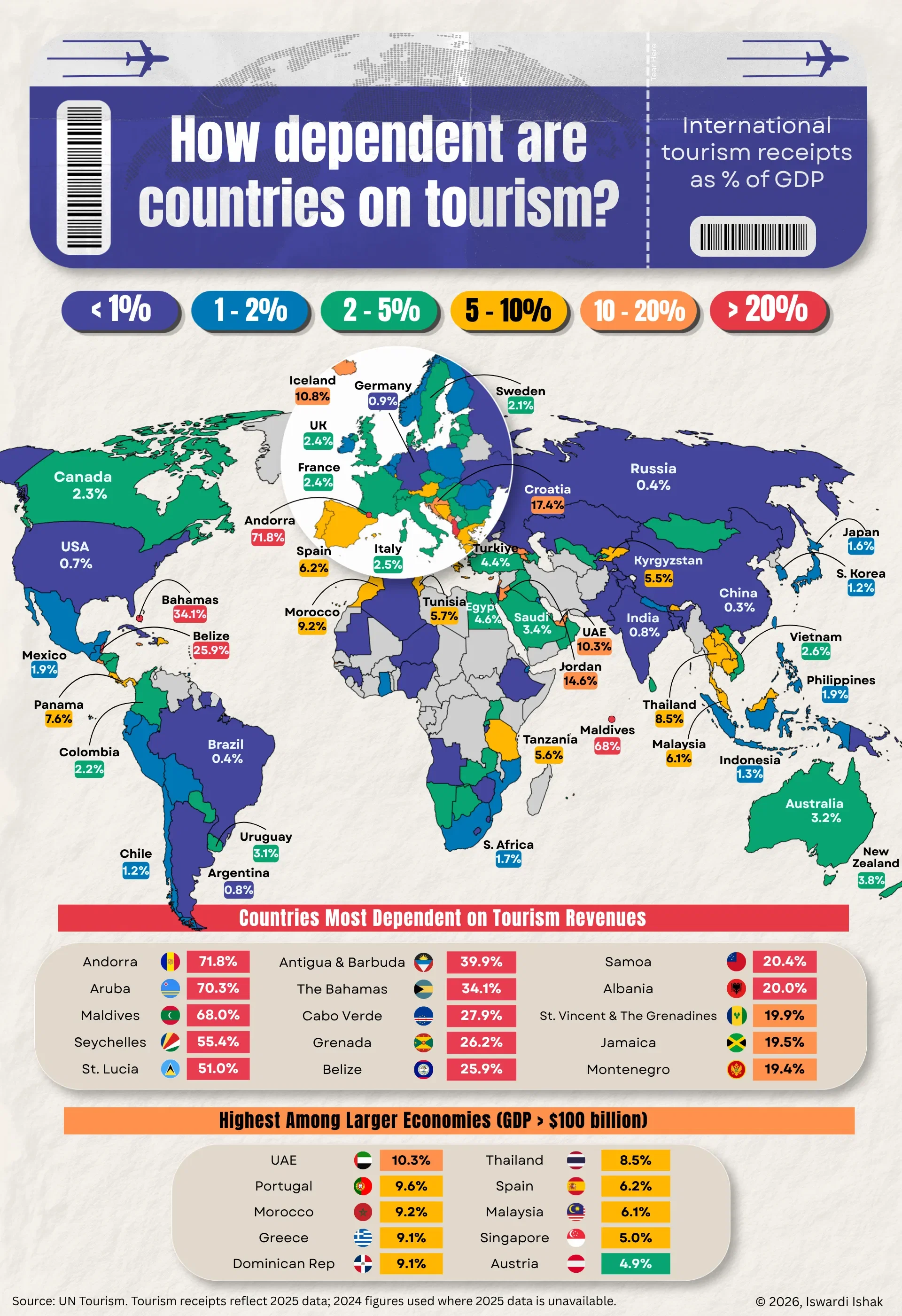
Some countries have no choice but to make you feel welcome
For most large economies, international tourism receipts are a footnote in national accounts. For a remarkable cluster of small island states, they are the headline.
Andorra derives nearly 72% of its GDP from foreign visitors. Aruba and the Maldives are not far behind, at 70% and 68% respectively. These are not merely tourism-dependent economies. They are, in any meaningful sense, tourism economies that happen to have governments attached.
The pattern is not surprising. Small island states have few alternatives. They cannot industrialise at scale, agricultural land is scarce, and domestic markets are too thin to sustain complex service sectors. Tourism offers something rare: a reason for wealthy foreigners to bring their money to you, rather than the other way around. Among larger economies, the UAE leads at 10.3%, followed by Portugal, Morocco, and Greece, all of which have leaned heavily into their geographic and cultural endowments. The United States and China register even less.
The deeper question is whether tourism dependence is a trap or simply a comparative advantage honestly accounted for. Diversification sounds prudent in a development economics seminar but is considerably harder when your only exportable asset is sunshine.