
Where Data Tells the Story
© Voronoi 2026. All rights reserved.

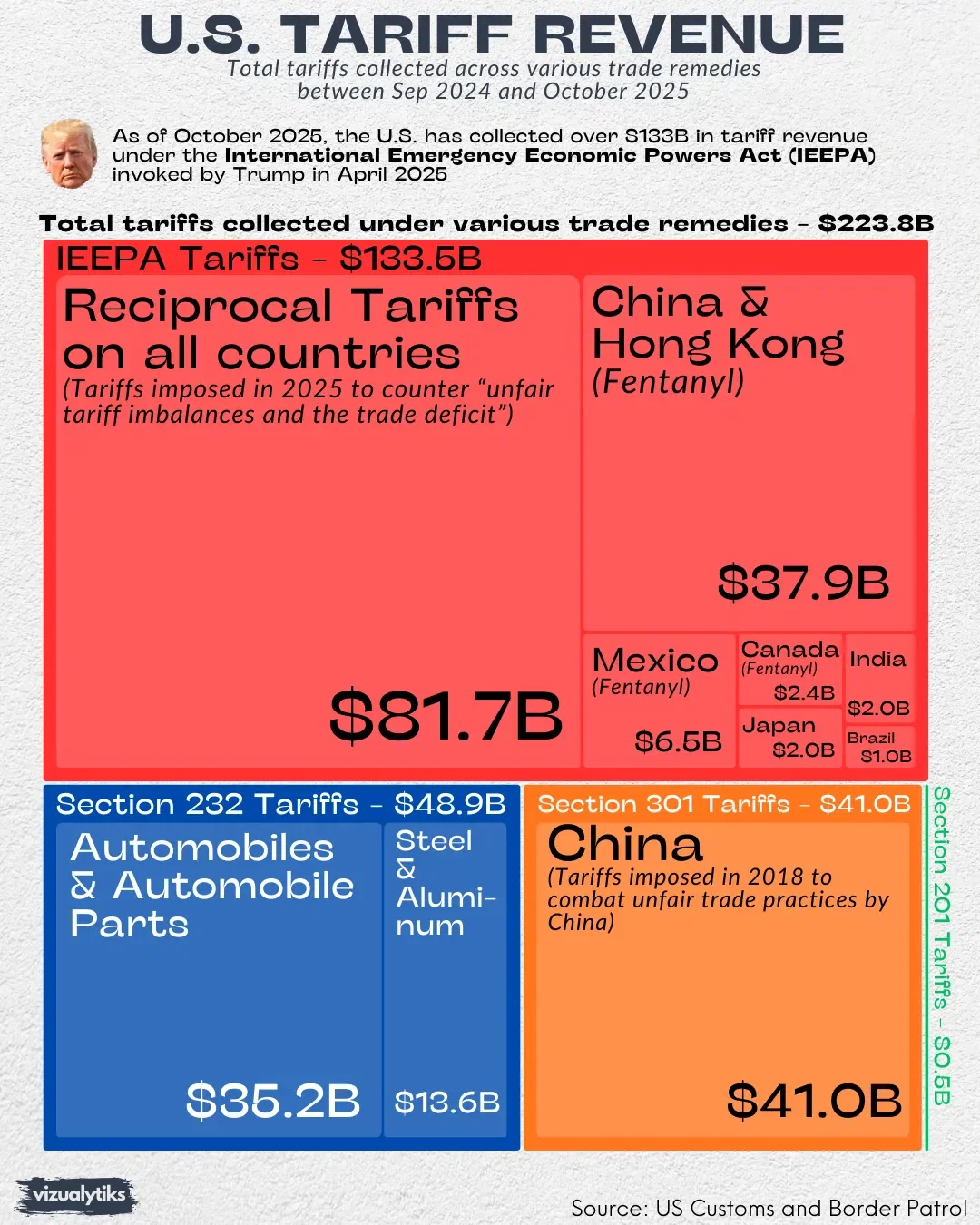
U.S. tariff collections have surged to over $223B between Sep 2024 and October 2025, underscoring how trade policy has become a major fiscal and geopolitical tool. The largest share comes from IEEPA-based tariffs ($133.5B) introduced in 2025 by President Trump, including sweeping global reciprocal tariffs ($81.7B) and fentanyl-related duties on China & Hong Kong ($37.9B), Mexico ($6.5B) and Canada ($2.4B). Earlier trade remedy measures remain significant contributors, including Section 232 tariffs ($48.9B) on autos, steel, and aluminum, and Section 301 tariffs on China ($41.0B) first imposed in 2018.
The scale of collections highlights a shift from targeted trade remedies toward broader tariff regimes aimed at supply chains, security concerns, and trade imbalances. Tariffs are no longer just protective tools, they are increasingly leveraged for geopolitical pressure, industrial policy, and border enforcement objectives.
However, today’s U.S. Supreme Court ruling invalidating the use of IEEPA to impose certain tariffs introduces fresh uncertainty. This could result in a significant portion of the revenue tied to emergency-powers tariffs being unwound, reshaping U.S. trade enforcement and forcing policymakers to rely more heavily on traditional trade statutes such as Sections 232 and 301.