
Where Data Tells the Story
© Voronoi 2026. All rights reserved.

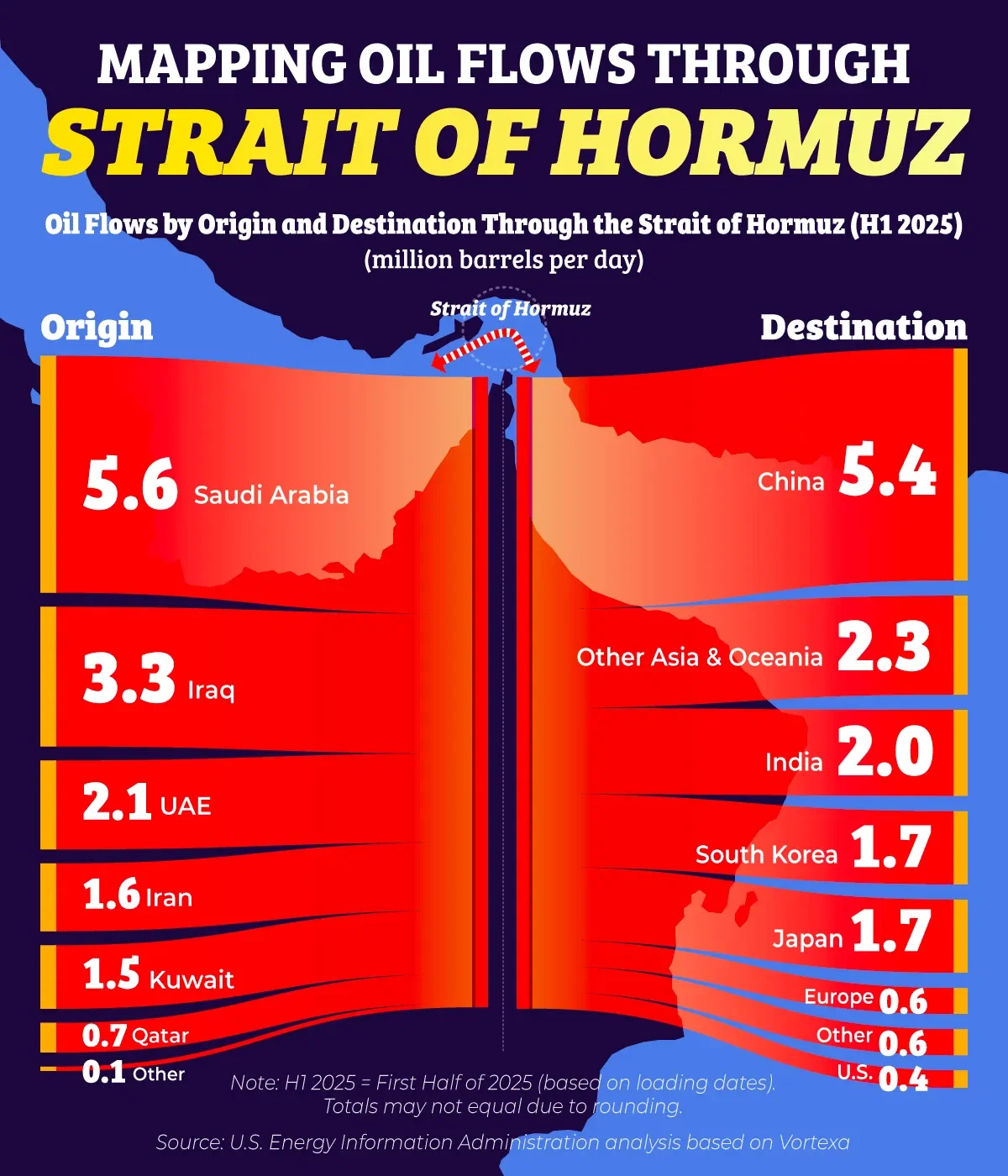
This graphic maps the flow of crude oil and condensate through the Strait of Hormuz during the first half of 2025 (H1 2025). The visualization highlights the major origin countries exporting oil through the strait and the key global destinations receiving those shipments, measured in million barrels per day. Together, these flows illustrate how a narrow waterway in the Middle East connects some of the world’s largest oil producers with major energy-consuming economies-particularly in Asia. Because such a large share of global seaborne oil passes through this chokepoint, the strait plays a critical role in global energy security, especially amid rising geopolitical tensions in the region.
• Saudi Arabia is the largest exporter through the strait. The kingdom ships about 5.6 million barrels per day, making it the biggest contributor to oil flows moving through Hormuz.
• Iraq and the United Arab Emirates follow as major suppliers. Iraq exports 3.3 mb/d, while the United Arab Emirates sends 2.1 mb/d, reinforcing the Gulf’s role as the world’s leading oil export hub.
• Asia dominates the demand side of the trade. China is the largest destination at 5.4 mb/d, followed by India, South Korea, and Japan, highlighting Asia’s heavy dependence on Middle Eastern energy supplies.
• Hormuz remains a vital global energy chokepoint. With nearly 15 million barrels of oil moving through it daily, any disruption-from conflict or naval tensions-could rapidly impact global oil markets and energy prices.