
How Global Oil Has Moved Through Key Sea Routes Since 2020
What We’re Showing
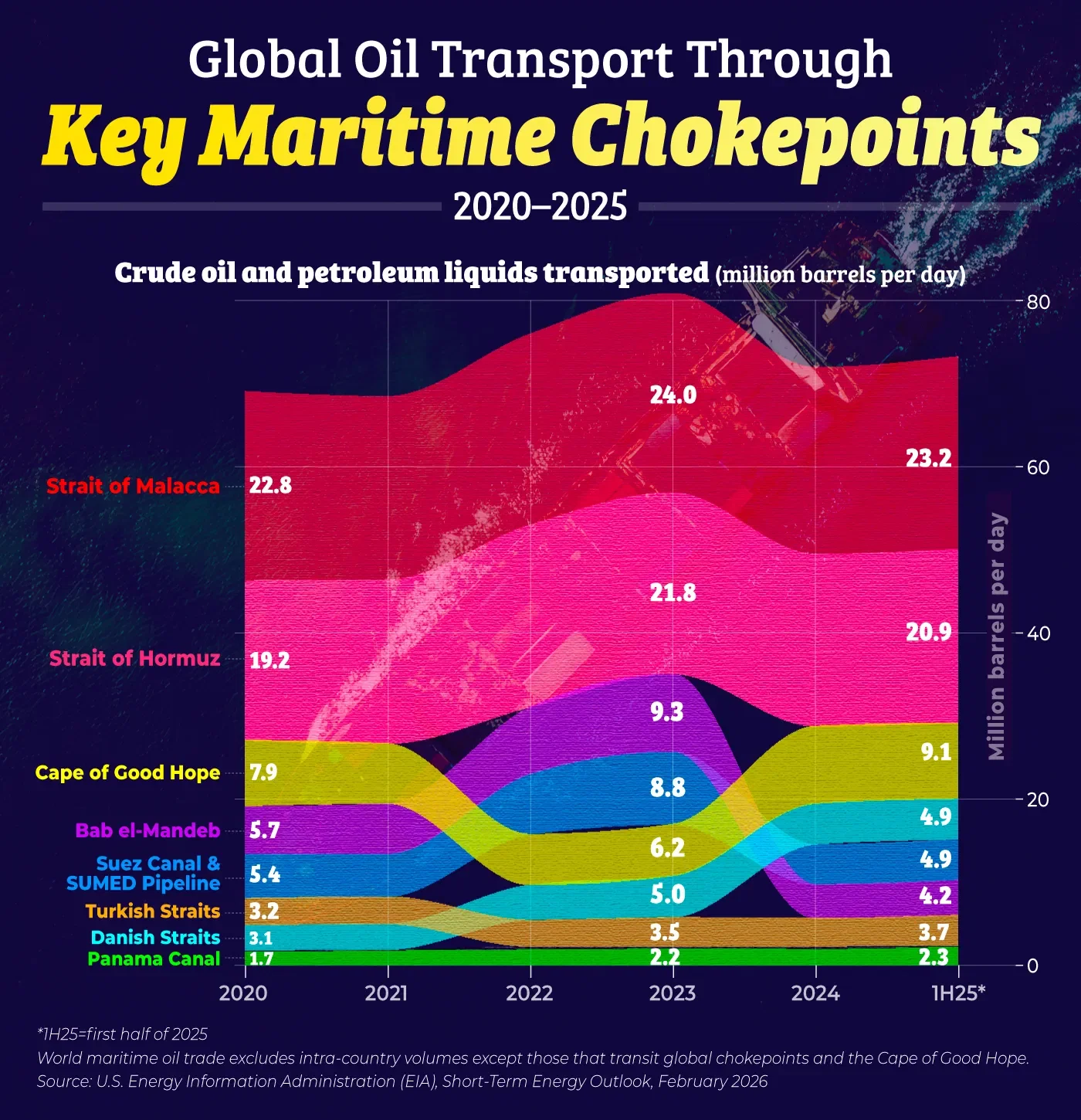
This graphic highlights the world’s most important maritime oil chokepoints, showing how crude oil and petroleum liquids move through critical sea routes between 2020 and the first half of 2025. Volumes are measured in million barrels per day (mb/d) and illustrate how a handful of narrow waterways carry a large share of global energy trade.
Together, these routes reveal the geographic concentration of global oil transport-and how geopolitical tensions, wars, and disruptions can quickly reshape shipping patterns. The data is sourced from the U.S. Energy Information Administration (EIA).
Key Takeaways
- The Strait of Malacca is the world’s busiest oil transit route, moving 22.8 mb/d in 2020 and peaking at 24.0 mb/d in 2023, before easing slightly to 23.2 mb/d in 1H 2025. It remains a vital corridor connecting Middle Eastern oil to Asian markets.
- The Strait of Hormuz remains the most geopolitically sensitive chokepoint, carrying 19.2 mb/d in 2020 and 20.9 mb/d in 2025. Rising tensions involving Iran and Gulf security keep this route at the center of global energy risk.
- The Cape of Good Hope has gained importance, with flows increasing from 7.9 mb/d in 2020 to 9.1 mb/d in 2025, as shipping routes shift to avoid disruptions in the Red Sea.
- Traffic through the Bab el-Mandeb and the Suez Canal corridor has fluctuated, reflecting security concerns and attacks on commercial vessels in the region.
Smaller chokepoints-including the Turkish Straits, Danish Straits, and Panama Canal-still play key regional roles, collectively supporting the global network of oil transport routes.