
Where Data Tells the Story
© Voronoi 2026. All rights reserved.

It’s Been 3 Years Since ChatGPT released.
On November 30, 2022, ChatGPT and reached one million users in five days. Today is December 1, 2025. That is 1,097 days later. In that short time, the global structure of AI did not evolve slowly. It snapped into place.
The new Microsoft AI Diffusion Report makes this impossible to ignore.
For comparison, the iPhone took eighteen months to reach one million users. ChatGPT reached the same milestone in five days.
Global AI adoption grew from around five percent of the working-age population to fifteen percent. One in seven adults now uses AI tools regularly.
The scale is unprecedented. The concentration is even more important.
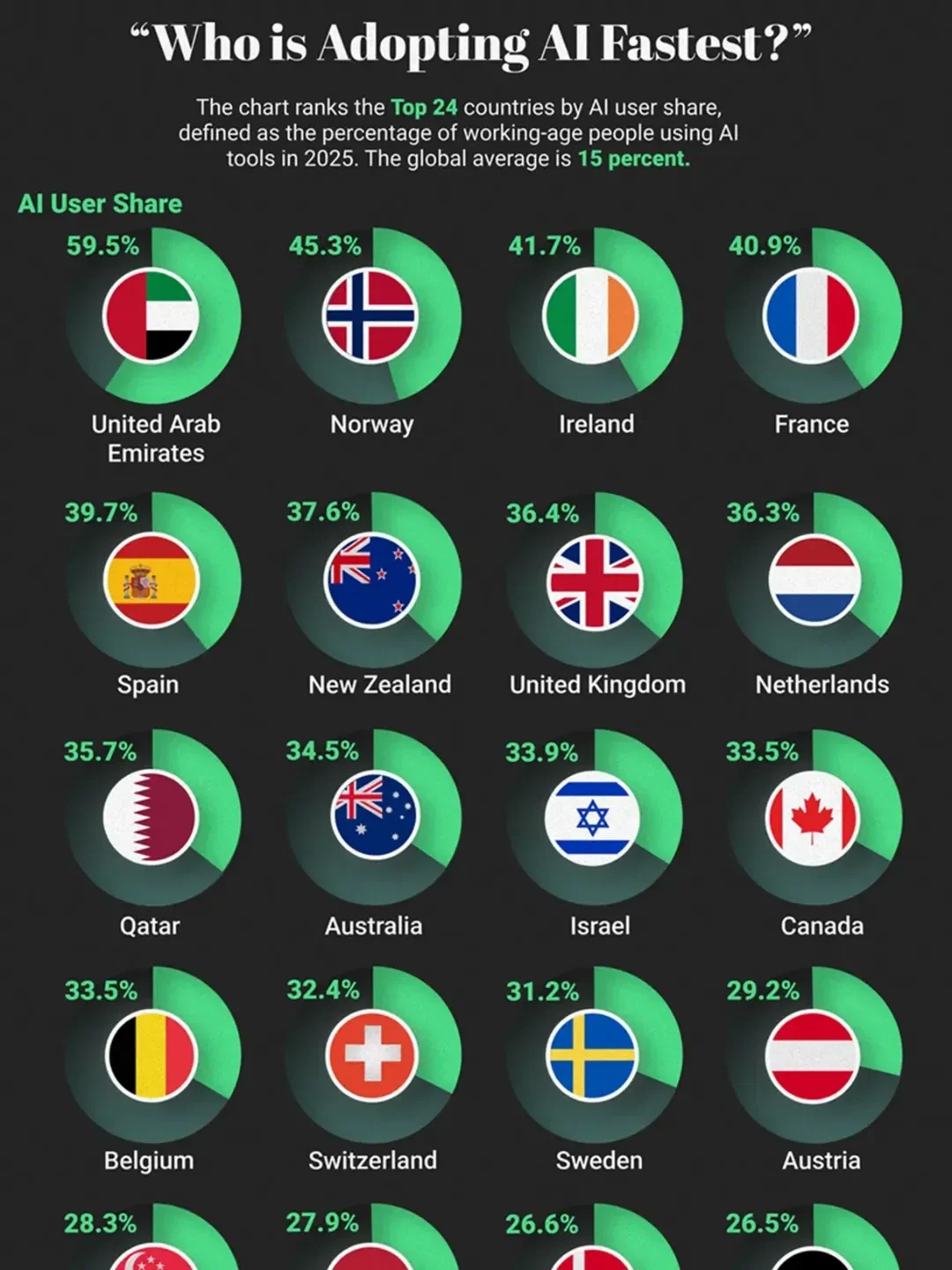
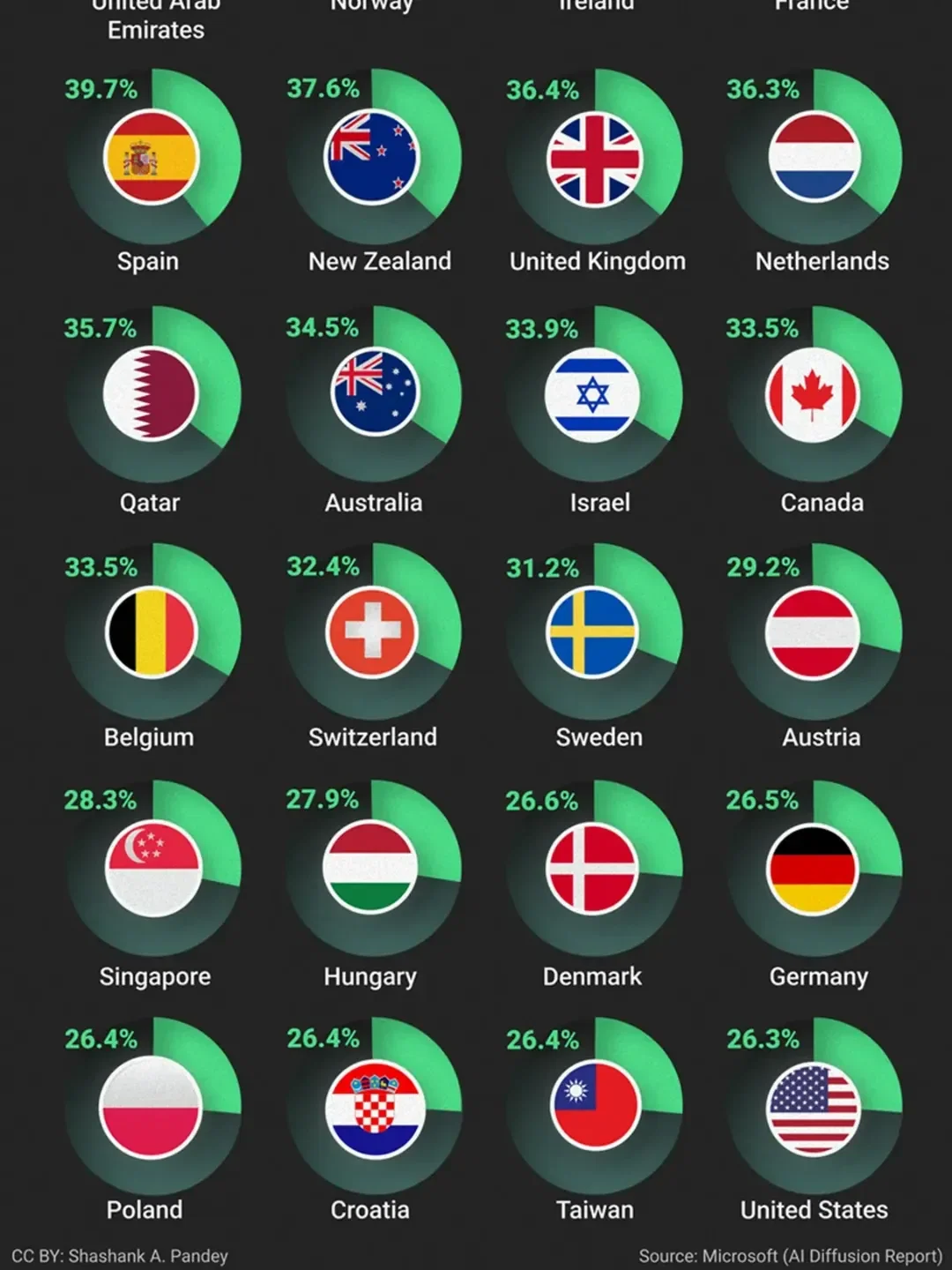
The Microsoft report ranks the top twenty-four countries by AI user share. At the top are the UAE at 59.5 percent, Norway at 45.3 percent, Ireland at 41.7 percent and France at 40.9 percent.
Yet even in the UAE, more than 40 percent of the working-age population still does not use AI regularly. In the United States, which ranks twenty-fourth, nearly 74 percent of the working-age population are non-users.
Globally, 85 percent of people live in countries where fewer than 15 percent use AI tools. The adoption curve is steep, but it is also uneven. The world is not becoming AI-native at the same pace.
How This Structure Formed So Quickly
When ChatGPT launched, capital flowed immediately. OpenAI secured rapid funding. Google accelerated investments. Anthropic raised large rounds. Venture capital firms made a clear judgment: AI would define the next decade.
The first one hundred billion dollars of investment created a gravitational pull. By 2025, most global AI deployment capital sat with a small set of funds in San Francisco, New York, London and Beijing.
In January 2025, China’s DeepSeek created a moment of disruption. For a short time, it even surpassed ChatGPT on the US App Store. But it did not change the underlying hierarchy. The companies that controlled capital, talent and infrastructure continued to dominate.
By the time Microsoft released the AI Diffusion Report, the structure was already clear. The race had consolidated.
The Three Lock-Ins of the AI Era
The first lock-in is capital. Tier-one companies now raise billions. Tier-two companies raise hundreds of millions. Tier-three companies fight for what is left. Funding patterns have hardened.
The second lock-in is talent. Eighty-two percent of the world’s top AI talent works in the top ten countries. The best researchers from India, Brazil, Europe and other regions moved to the United States or China. This accelerated the brain drain and left emerging markets without the expertise needed to close the gap.
The third lock-in is infrastructure. Compute power, data centers and foundational model capacity sit in the same places where capital and talent already exist. Companies in emerging markets now face costs that are ten to twenty times higher to deploy the same AI systems.
AI is no longer just about innovation. It is about who can deploy it at scale.