
Where Data Tells the Story
© Voronoi 2026. All rights reserved.

When a large language model needs to answer a question, it doesn't think the way Google does.
Google ranks pages by links, traffic, and domain authority, a system refined over 25 years and embedded in the $80 billion SEO industry. More backlinks meant more trust. More visitors meant more relevance. Traffic was a proxy for authority, and the proxy worked well enough that the entire commercial internet got built around it.
LLMs work differently. When ChatGPT, Claude, or Gemini generates a cited response, it draws from sources that resolve the query, regardless of how many people visit that source. Traffic and usefulness aren't the same variable.
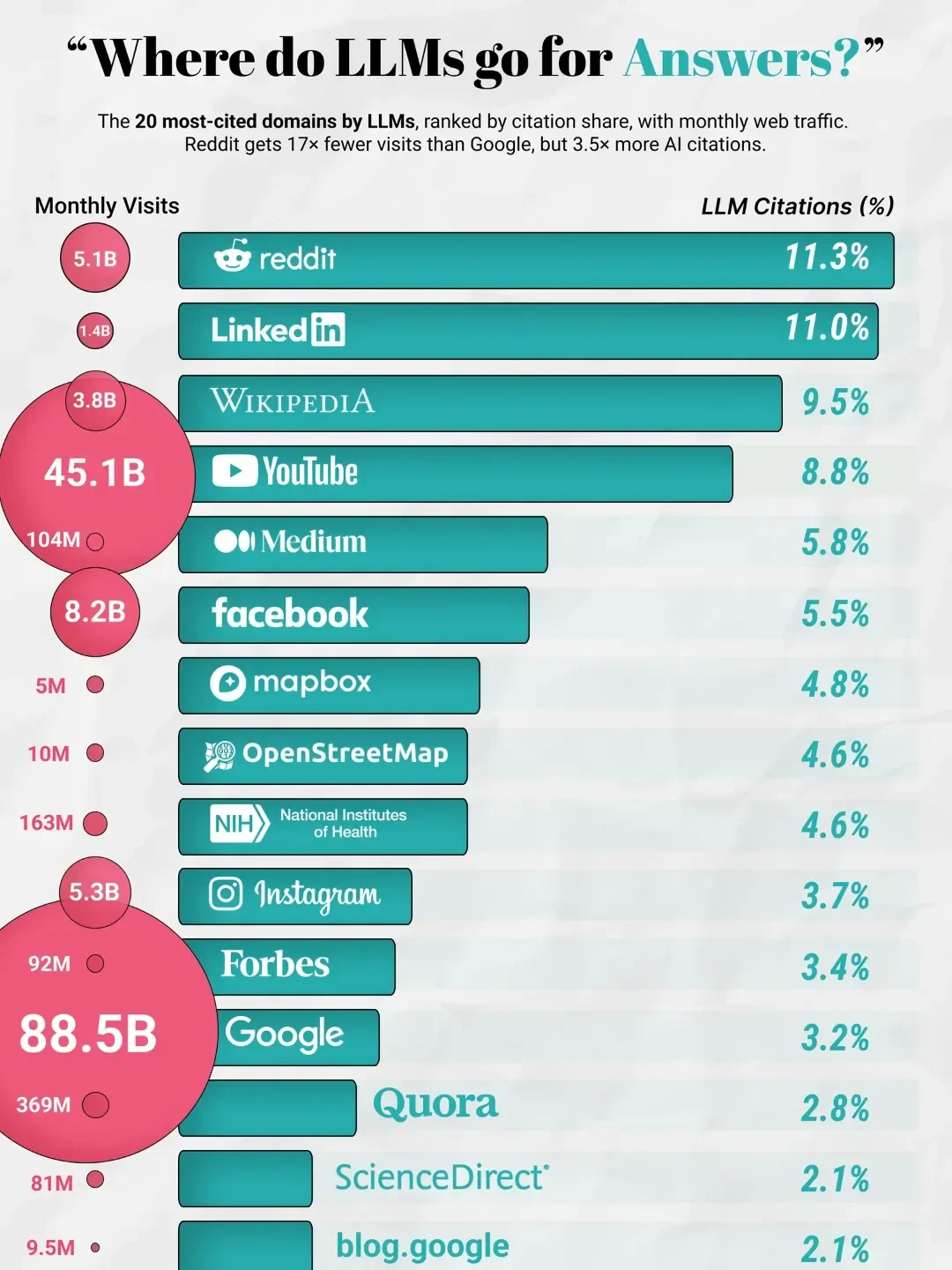
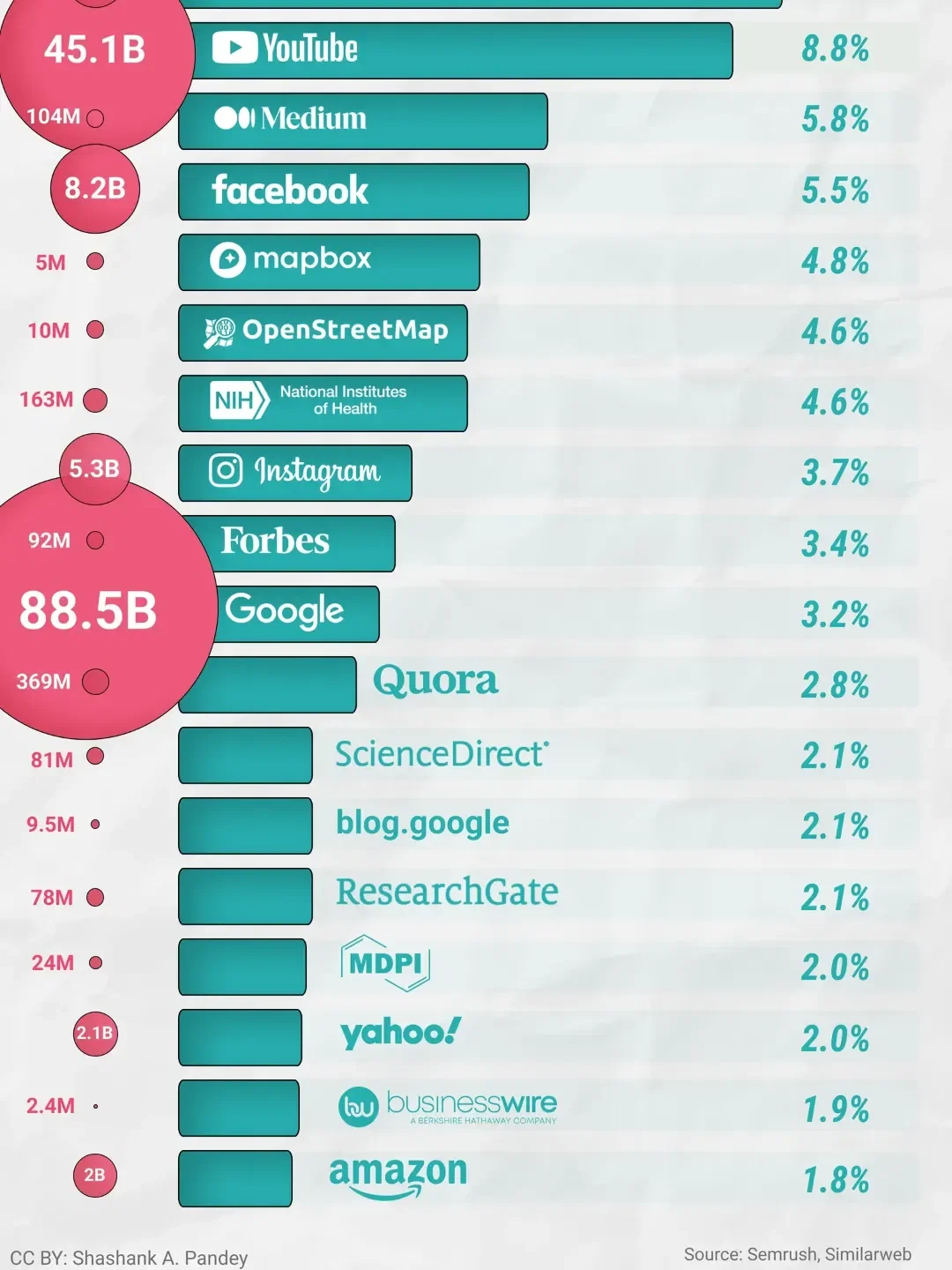
To see what this looks like concretely, we identified the 20 most-cited domains by LLMs from Semrush's citation-frequency data and cross-referenced each against monthly web traffic (January–February 2026).
Reddit leads at 11.3% of LLM citations. LinkedIn sits just behind at 11.0%. Together, they account for 22% of all LLM citation share, more than Wikipedia, YouTube, and NIH.gov combined.
Here's what makes that surprising: Google receives 88.5 billion monthly visits versus Reddit's 5.1 billion, and captures only 3.2% of LLM citations. Further down the list, Mapbox, a mapping API used primarily by developers, gets 5 million monthly visits and a higher citation share than Google (4.8% vs 3.2%). Google gets 17,700 times more traffic. Mapbox is cited, per visit, roughly 24,000 times more efficiently.
The pattern makes sense when you look at what these high-citation, low-traffic sites share: structured, specific, experience-based content that resolves questions directly. Reddit threads are first-person accounts of what actually happened over six months, not what the documentation says should happen. Medium posts walk through real debugging sessions. These formats align with what LLMs are built to extract.
Google is a portal. Its traffic reflects its role as a starting point, not a destination. Wikipedia is encyclopedic by design, neutral, broad, and resistant to the kind of opinionated specificity LLMs seem to prefer when they cite things.
Two entries in the top 10 stand out as genuinely odd: Mapbox (4.8% citation share, 5 million visits) and OpenStreetMap (4.6%, 10 million visits). Neither is a content site. Both are geospatial infrastructure platforms. Their presence probably reflects AI agents doing things that require interacting with the physical world, route planning, geocoding, and location queries. If citation patterns are a leading indicator, these infrastructure providers are already ahead of most publishers.
The scientific credibility layer is thinner than you'd expect. NIH.gov (4.6%), ScienceDirect (2.1%), ResearchGate (2.1%), and MDPI (2.0%) together hold roughly 8.9% of LLM citation authority for health, biology, and medicine claims. If any of these platforms changed access policies or degraded data quality, the downstream effect on LLM accuracy could be significant. Elsevier, which owns ScienceDirect, has leverage here that hasn't shown up in any earnings call yet.
The fair objection to all of this: about 5% of the global population uses AI tools. Google processes 8.5 billion searches per day. Traditional search isn't going anywhere.
But that 5% skews toward founders, developers, investors, researchers, and people who shape product strategy and purchasing decisions. And the organisations that understood page-one rankings in 2005, when most businesses hadn't yet heard of SEO, compounded those advantages for over a decade.
Traditional search still dominates by volume. LLM visibility is a different channel, with different rules, different content types, different structures, different signals. A page that ranks well on Google may be entirely invisible to LLMs, and vice versa.
Both games are live. One is crowded and well-mapped. The other is still early.