
Where Data Tells the Story
© Voronoi 2026. All rights reserved.

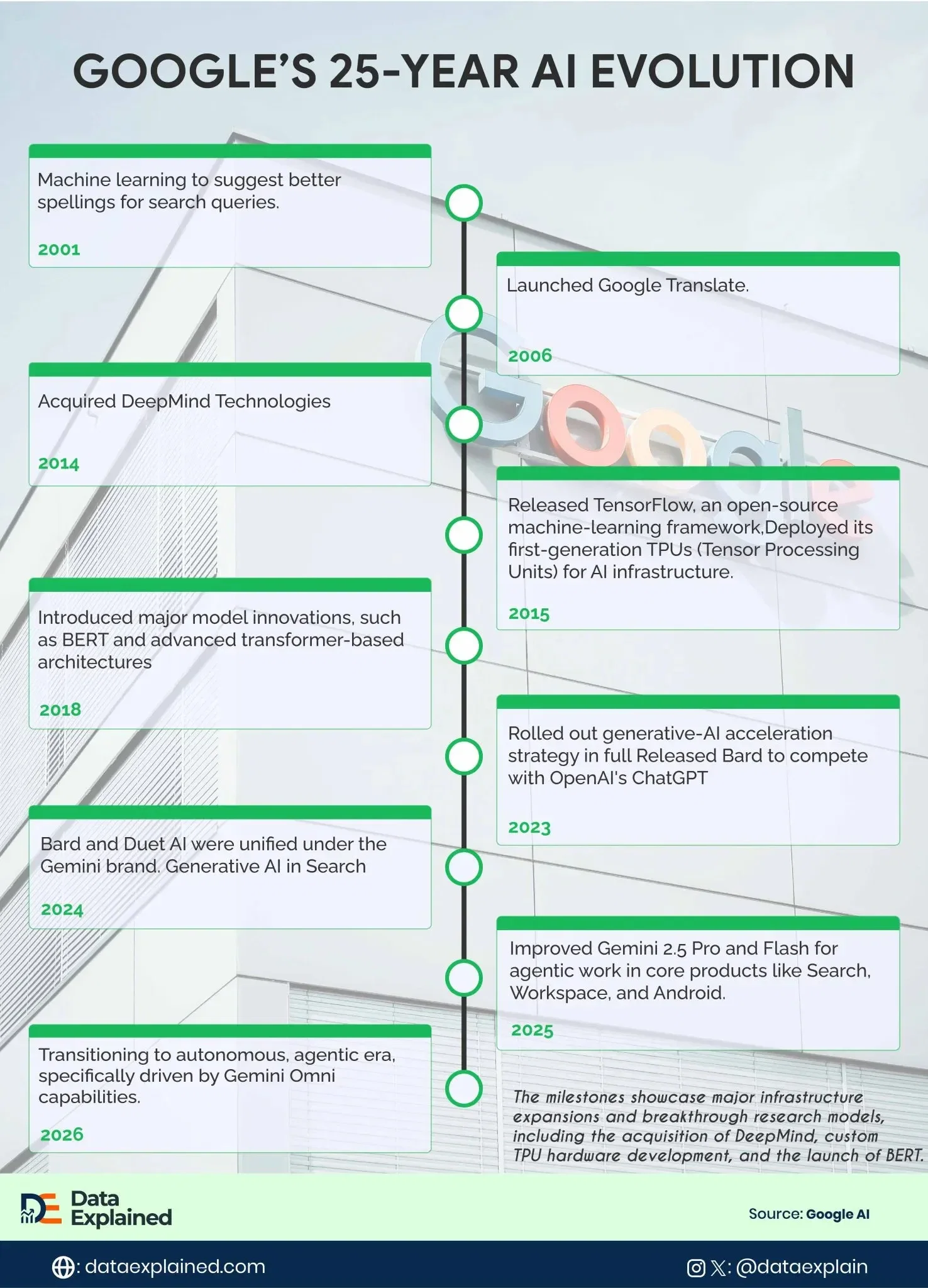
Google’s AI journey is a story of steady evolution. It began with machine learning experiments in Search and advanced to multimodal models, such as Gemini.
Here’s how the company has fared in its AI growth over the last 25 years.
Google’s journey into AI began in 2001, when it utilized machine learning to enhance spelling correction in Search.
This breakthrough enabled the system to learn from user data, rather than relying on fixed rules, thereby enhancing accuracy across billions of queries.
Though subtle, it was a turning point that paved the way for personalized recommendations, predictive text, and a culture of AI-driven experimentation at Google.
In 2006, Google launched Translate, marking its expansion of machine learning beyond Search.
Unlike rule-based translation tools, it analyzed massive bilingual text datasets and continuously improved with user input.
As Translate evolved toward neural translation, it showcased how scalable AI could power global communication and validated Google’s research-first approach to accessible intelligence.