
Where Data Tells the Story
© Voronoi 2026. All rights reserved.

Wired differently
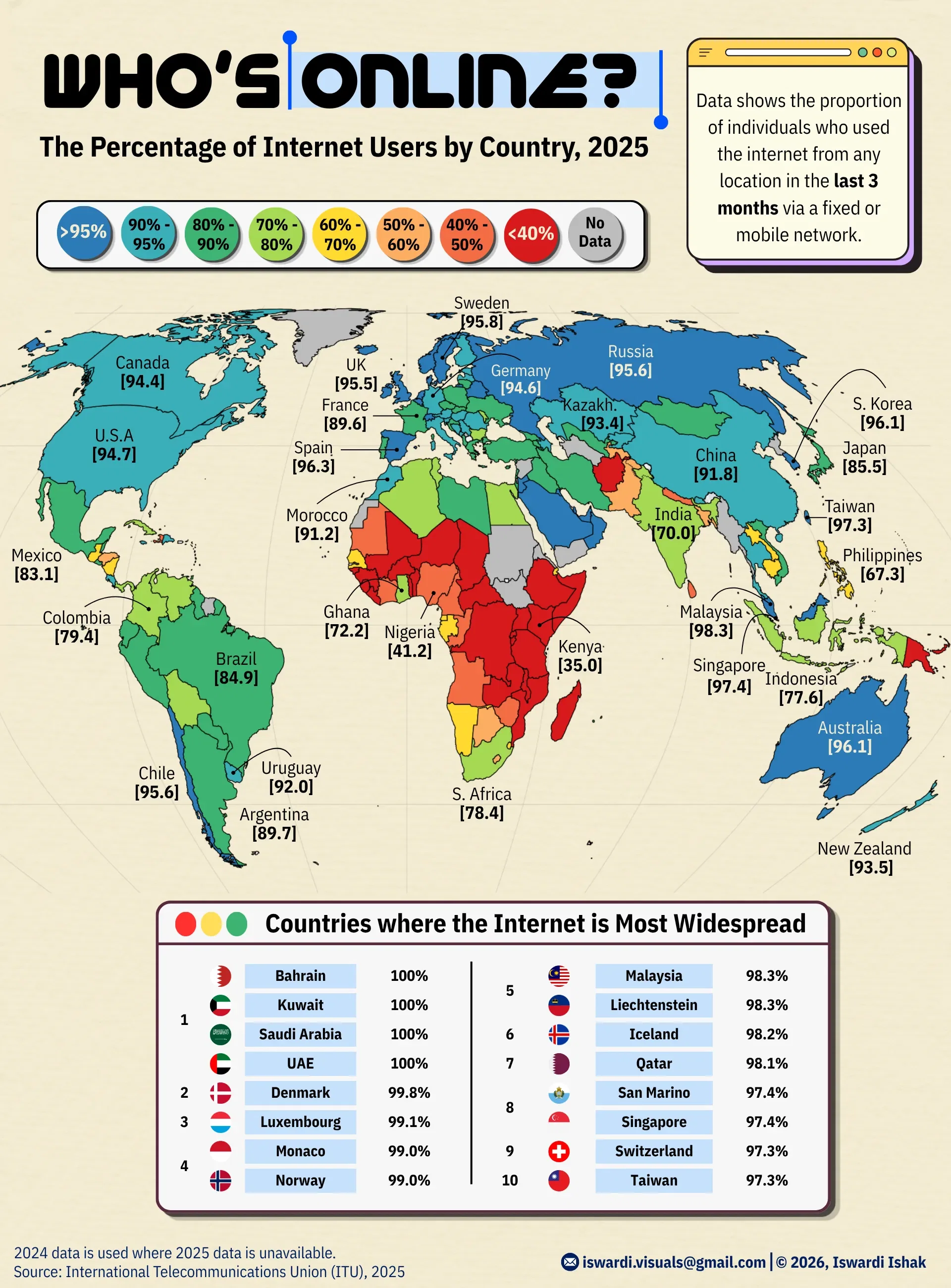
Internet use is nearly universal in the developed world but much of Africa is still waiting.
Four countries can claim that every one of their people is online: Bahrain, Kuwait, Saudi Arabia and the United Arab Emirates. Denmark, Luxembourg, Monaco and Norway are not far behind, all at or above 99%. Newly wealthy places do just as well. Malaysia, Taiwan and Singapore all sit above 97%, ahead of America (94.7%), which is itself well clear of China (91.8%).
Money is not the whole story, though. Japan, one of the richest countries on the list, manages only 85.5%, behind Chile, Uruguay and Morocco. Its population is old, and older people are the least likely to log on.
The Digital Divide matters because the internet is among the great levellers. A farmer with a phone can check prices without a middleman, a small firm can sell to customers far beyond its town, and a student can learn from the same lectures as one at a top university. Whole industries have grown from the connection: e-commerce, fintech, e-hailing and even esports, which turns teenagers with fast broadband into paid professionals. Places that are online get to build such things. Places that are not are left out.
The numbers measure anyone who has used the internet in the past three months, on any device. That is a generous test, and many of those counted are online only occasionally. The countries at the bottom of the table have a long way to go, and the true distance is probably greater than the figures suggest.