
Where Data Tells the Story
© Voronoi 2026. All rights reserved.

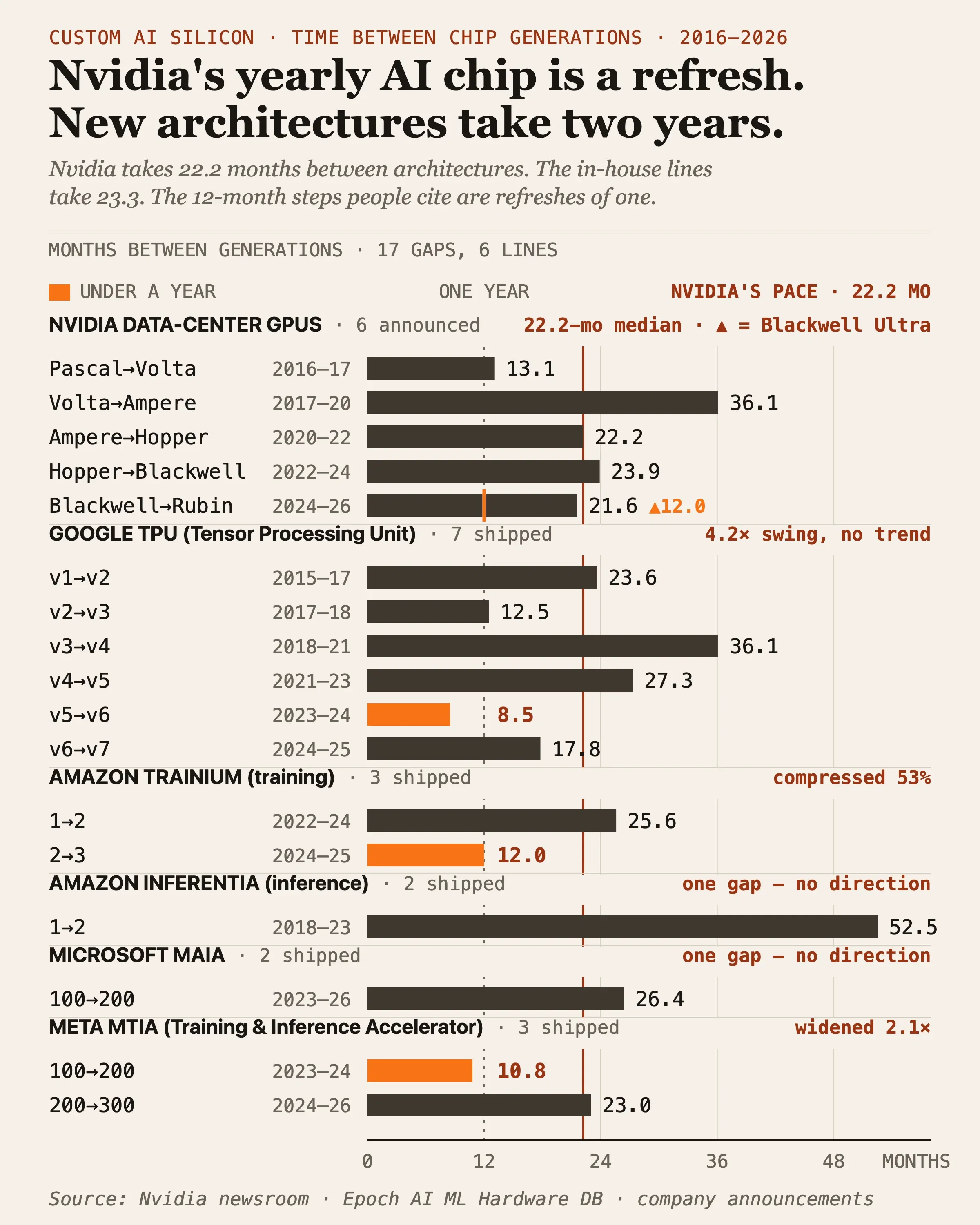
Nvidia is said to have moved to a one-year cadence for AI chips, and the in-house accelerators built by Google, Amazon, Microsoft and Meta are usually described as the slower alternative. Measured the same way, against each chip's earliest documented public disclosure, that difference does not exist. Nvidia's median gap between architectures is 22.2 months. The five in-house chip lines run 23.3. The two medians are 1.1 months apart.
What produces the annual impression is a mid-generation refresh. Nvidia's five architecture steps since 2016 — Pascal to Volta to Ampere to Hopper to Blackwell to Rubin — measure 13.1, 36.1, 22.2, 23.9 and 21.6 months. Not one is under a year. The 12-month steps people cite are Blackwell to Blackwell Ultra and Blackwell Ultra to Rubin, which upgrade an existing architecture rather than replace it. On this graphic the Blackwell Ultra refresh is drawn as a mark inside the Blackwell-to-Rubin bar, because that is what it is: a subdivision of a two-year step, not a step of its own.
The same rule is applied to everyone. Google's TPU v5p is a variant of v5e and is counted once, which is exactly how Blackwell Ultra is counted against Blackwell. Under that rule the in-house lines vary widely — Amazon compressed its Trainium gap from 25.6 months to 12.0, Meta's most recent MTIA (Meta Training and Inference Accelerator) took 23.0 months after a 10.8-month predecessor, and Google's seven TPU (Tensor Processing Unit) generations swing from 8.5 to 36.1 months — but they vary around the same two-year centre Nvidia sits on.
The practical read: if you are planning capacity, budgets, or a migration on the assumption that AI silicon now turns over annually, you are planning around refreshes. The step that changes what your software has to target arrives about every two years, and it does so whoever makes the chip.
Data: Nvidia dates from Nvidia's own newsroom announcements; in-house chip dates from the Epoch AI Machine Learning Hardware database (CC-BY) plus company announcements from Google, AWS, Microsoft and Meta. Gaps are measured to each chip's earliest documented public-disclosure date.