
Where Data Tells the Story
© Voronoi 2026. All rights reserved.

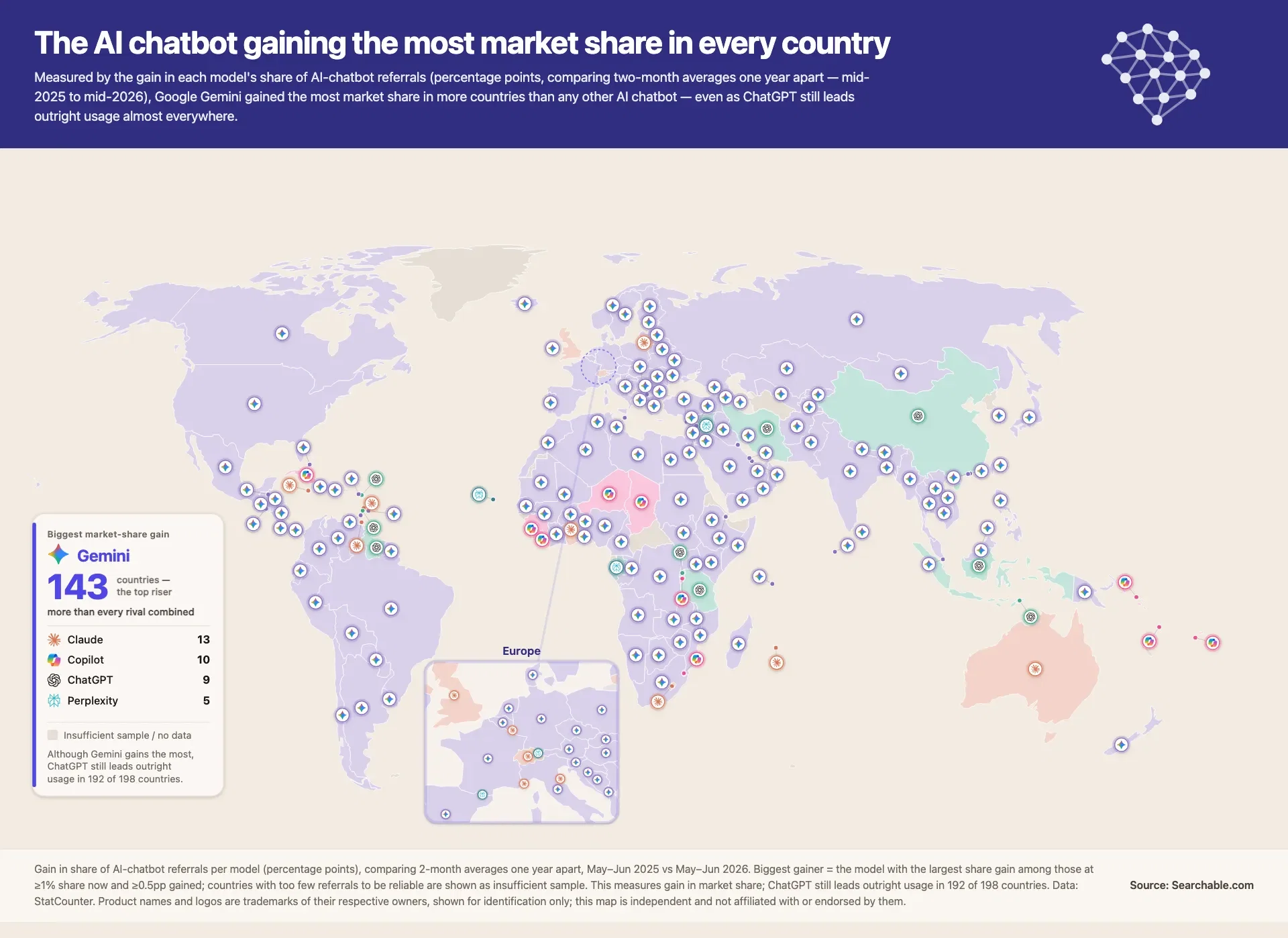
Although ChatGPT remains the most popular chatbot almost everywhere in the world, as the leader in 192 countries, its popularity appears to be slipping. This new analysis by Searchable, the AI-visibility platform, found that ChatGPT's share of traffic that AI tools send to the open web fell in 172 of 198 countries over the past year, from roughly 78 percent to 71 percent.
Elsewhere, Anthropic's Claude has attracted plenty of news headlines in the past year, but it is Google's Gemini that has gained the most global ground in that time, rising the most in 143 countries. That's more than every rival combined.
For both everyday and emerging users of AI chatbots, this data illustrates that people are beginning to embrace the wider choice of large language models (LLMs) on offer. Earlier this year, Microsoft estimated that 24.7 percent of the working-age population in the Global North and 14.1 percent in the Global South were using AI tools such as ChatGPT. As adoption continues to expand, the competition among LLMs looks set to accelerate with it.
For businesses, the implications of adopting a wider range of LLMs mean they will have to be more closely aware of how their brand and reputation are being represented. According to 6sense's survey of 4,000 B2B buyers, 94 percent of them use an LLM as part of their purchase journey. But each LLM prioritises its sources of information differently, and the way in which a company surfaces within them will vary in prominence and frequency.
Searchable calculated the percentage-point change in AI chatbot market share per country (May–Jun 2025 vs May–Jun 2026). Data on raw market share was sourced from StatCounter’s tracking network for AI chatbot market share, and represents which assistant sent each visitor to the sites it monitors. 18 low-sample micro-states are greyed out in the map and not credited with a winner. Results for markets with substantial VPN usage, including Iran, China and Russia, may be less representative of domestic behaviour, since traffic routed through foreign servers can distort the recorded national share.