
Where Data Tells the Story
© Voronoi 2026. All rights reserved.

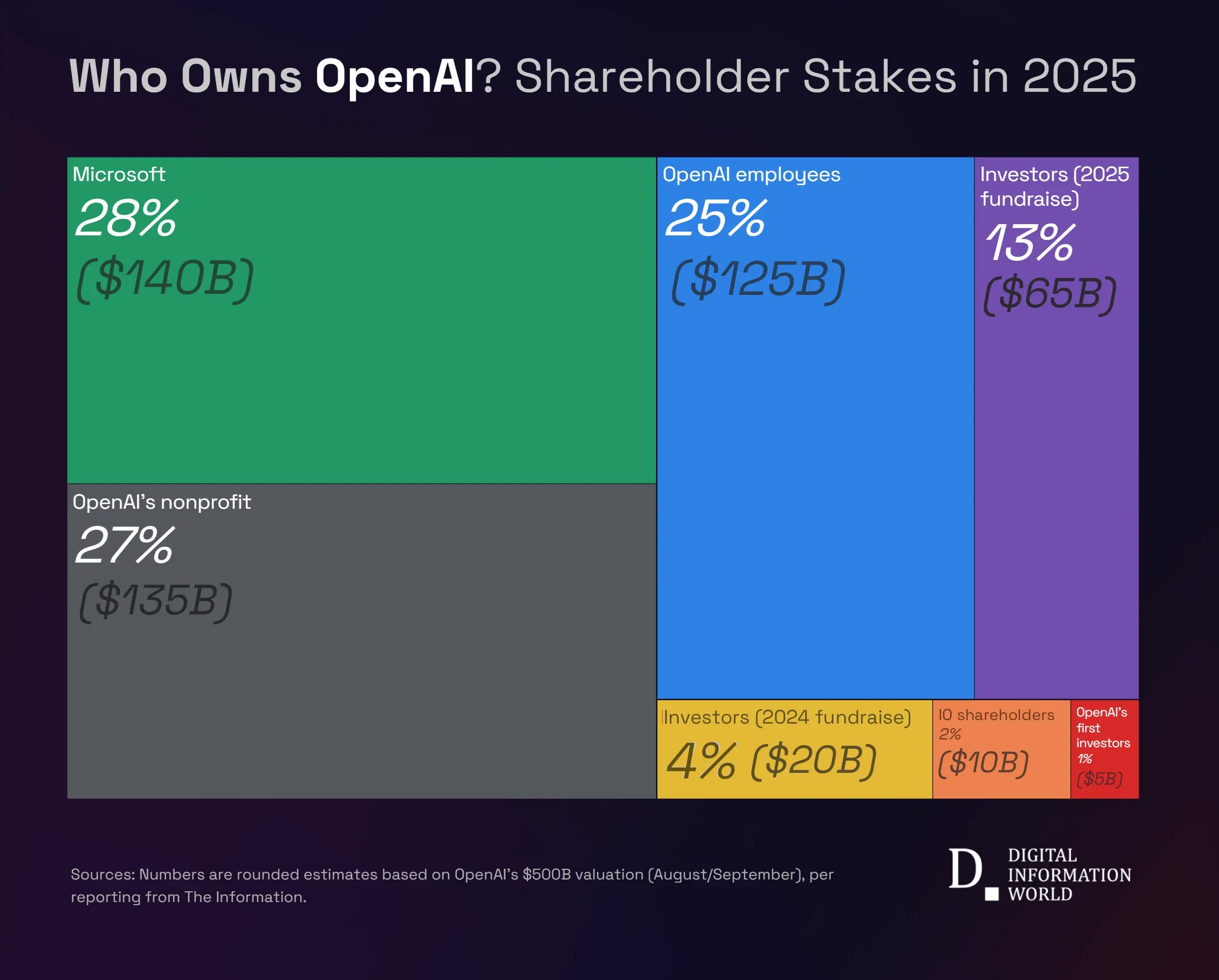
OpenAI’s valuation has climbed to half a trillion dollars, placing the company among the most influential names in global technology. With that scale comes growing interest in who actually controls the firm and how those interests may guide its next chapter.
The largest slice of ownership belongs to Microsoft, whose stake sits at just over a quarter of the company. Worth about $140 billion, that position reflects years of financial support and integration of OpenAI tools into Microsoft’s own platforms.
Close to Microsoft’s share is the nonprofit parent organization that still anchors OpenAI’s governance. Holding around $135 billion in equity, the nonprofit continues to safeguard the original mission that emphasizes public benefit and responsible development of artificial intelligence.
Employees are another central force. Collectively, their quarter share of ownership is valued at roughly $125 billion. The approach shows how OpenAI has tied its growth to the people building its systems, rewarding staff with equity in return for their expertise and commitment.
The remainder is divided among investors who joined during the 2025 and 2024 funding rounds, alongside smaller groups that include IO shareholders and the earliest backers. Together, those layers account for about one fifth of the company, with stakes ranging from $65 billion down to $5 billion.
This mix reflects more than just financial weight. It shows how corporate influence, nonprofit oversight, employee involvement, and venture capital combine to shape one of the most closely watched companies in the world. The balance of these groups will likely determine how OpenAI grows and how its technology is steered at a time when artificial intelligence is becoming central to the global economy.