
Where Data Tells the Story
© Voronoi 2026. All rights reserved.

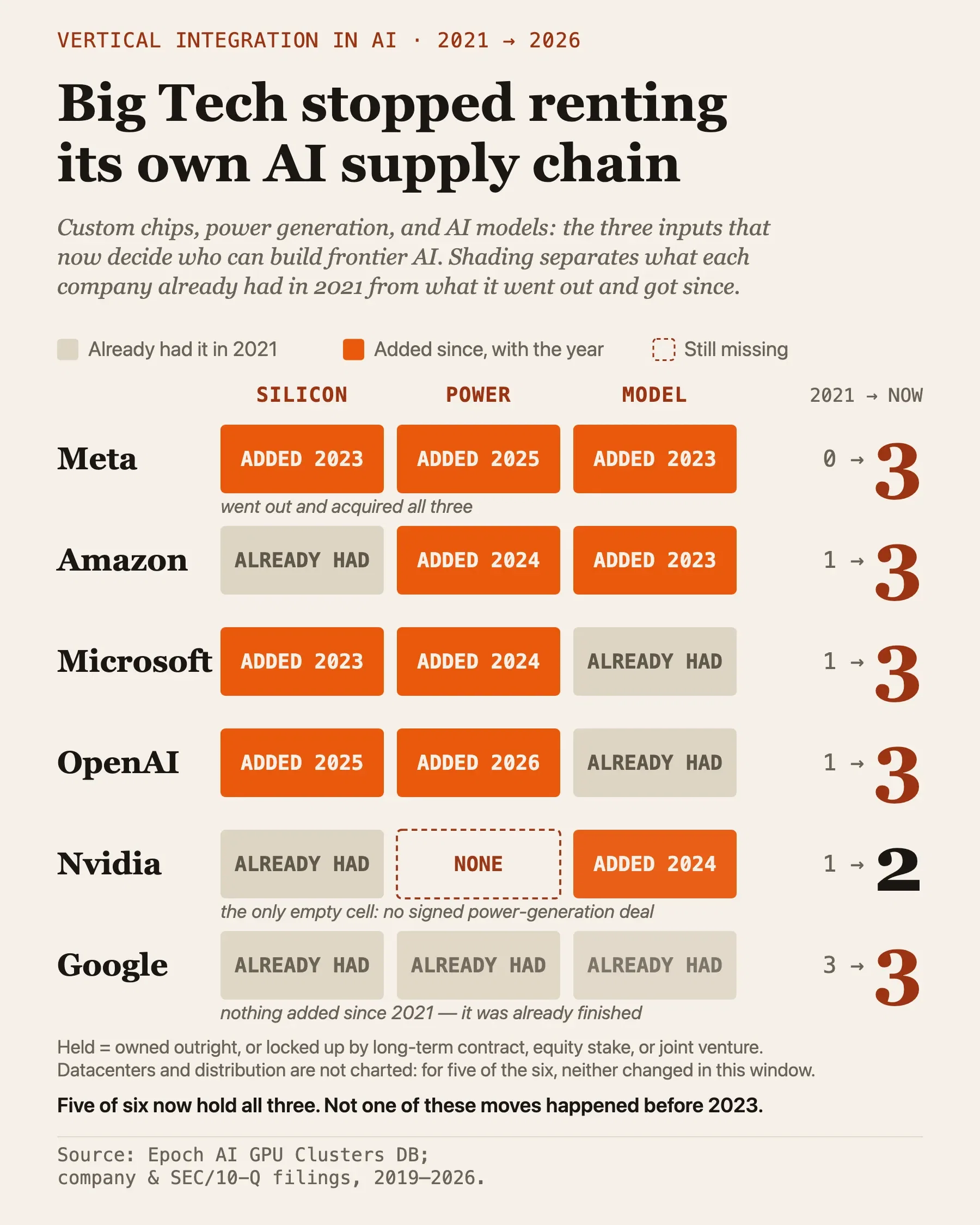
Building and running frontier AI takes three inputs that a company can either buy on the open market or bring in-house: custom AI accelerator chips, dedicated electricity generation, and the foundation models themselves. This chart counts an input as held when a company either owns it outright or has locked it up under a long-term contract, equity stake, or joint venture. Buying chips from a vendor at market prices does not count; designing your own, or signing a 20-year deal for a specific power plant's output, does.
In 2021, Meta held none of the three. Amazon, Microsoft, OpenAI, and Nvidia each held exactly one. Google held all three. By mid-2026, Meta, Amazon, Microsoft, and OpenAI have each closed the gap, and every one of those moves was announced in 2023 or later — Meta's MTIA chip and Llama models, Amazon's Anthropic stake and its Talen Energy nuclear campus, Microsoft's Maia chip and the Three Mile Island restart, OpenAI's Broadcom chip collaboration and its SB Energy investment. In all four cases the power agreement was the last of the three to close, and the power column is the only one on the chart with nothing dated 2023.
Two companies sit outside the pattern, in opposite directions. Nvidia, whose chips the others are building alternatives to, is the only one with an empty cell: its two 2026 nuclear announcements are reported as exploratory research partnerships, not signed supply agreements. Google is the opposite case — its chip program dates to 2015 and its first next-generation geothermal power agreement was signed in 2021, so it added nothing in this window because it had nothing left to add. OpenAI reached all three fastest, but it is also the only one of the six that does not own the datacenters it runs in.
By 2026, the list of companies that still have to go to the open market for chips, power, or models is down to one name — and it is the company selling everyone else their chips.