
Where Data Tells the Story
© Voronoi 2026. All rights reserved.

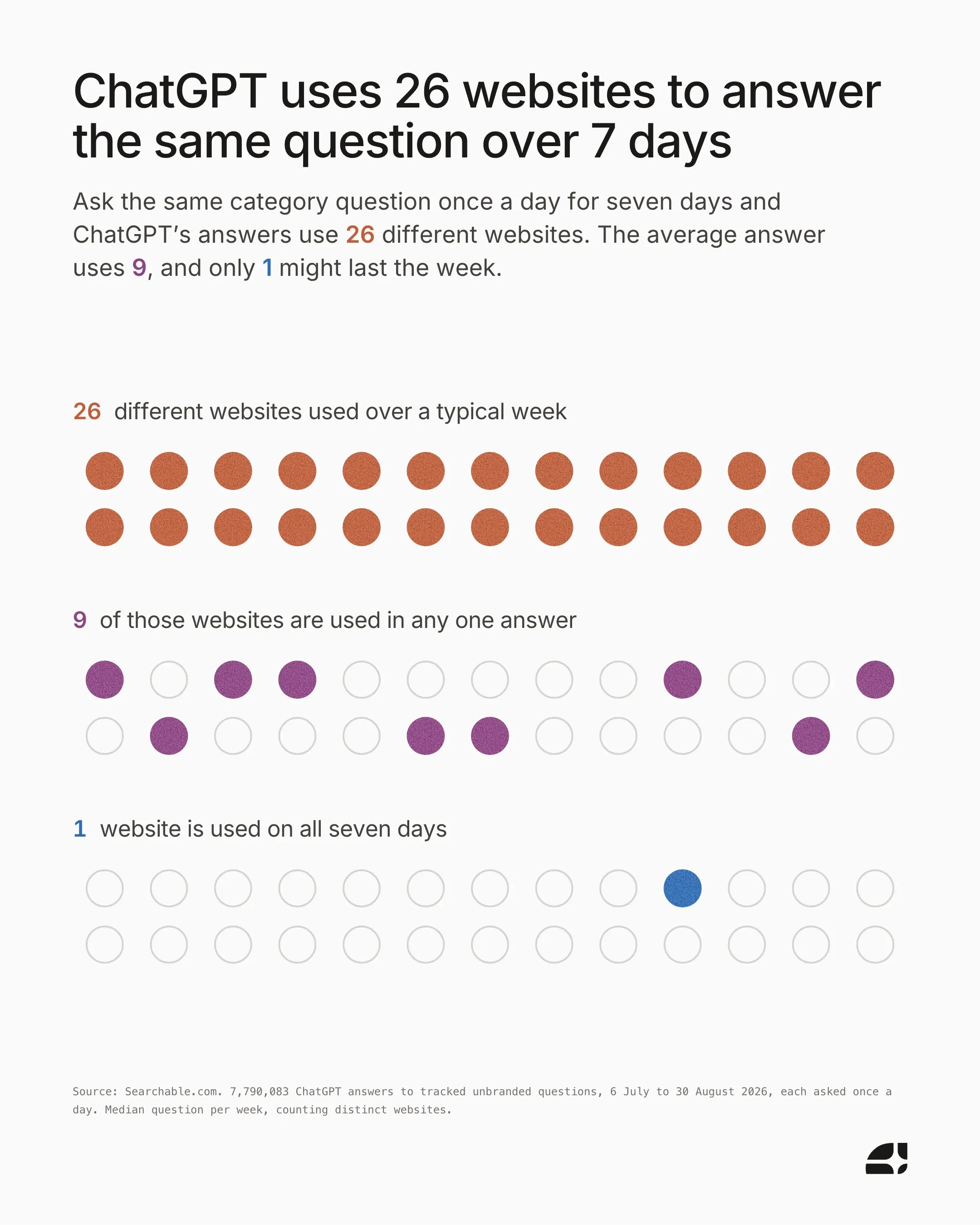
AI chatbot sources are volatile. Searchable's analysis of 7.7 million ChatGPT citations over 55 days shows that when you ask ChatGPT a question, it uses an average of nine websites to respond, but most of those sources can change if you ask the same question the following day.
If you ask the same question every day for a week, ChatGPT can use anywhere between 21 and 32 websites to answer it during that time period. Just like the sources that feed an AI chatbot's answer, the companies that they recommend also often change positions in terms of how highly they are recommended. One day they could be the top-rated, while another day they could be missing entirely. According to SparkToro, there is less than a 1 in 100 chance that ChatGPT will produce the same list of brand recommendations if asked the same query 100 times.
This can be partly explained by the type of content AI favours when considering which brands to recommend. Most of ChatGPT's web search for sources focusses on third-party content, such as news, product reviews, rankings and directories. Muck Rack's Generative Pulse survey shows that large language models (LLMs) heavily favour recent earned media, with the highest citation rate for content referenced by them occurring within the first seven days of publication
Brands can begin auditing their AI visibility in 30 minutes, by seeing how they appear in response to relevant, unbranded customer prompts and examining which sources are cited in response to those prompts on ChatGPT. If they monitor this regularly, they will start to understand how consistently they appear on a search platform that doesn't produce fixed commercial rankings that are as stable as a search engine like Google's.
Searchable analysed the web domains used as sources by ChatGPT to answer the same unbranded questions over seven consecutive days. This is based on logged in accounts rather than API access, to reflect more accurately what a user sees without any prior search history on the app. They repeated this experiment for seven weeks. The final analysis considers 7.79 million answers in response to more than 300,000 unique questions.