
Where Data Tells the Story
© Voronoi 2026. All rights reserved.

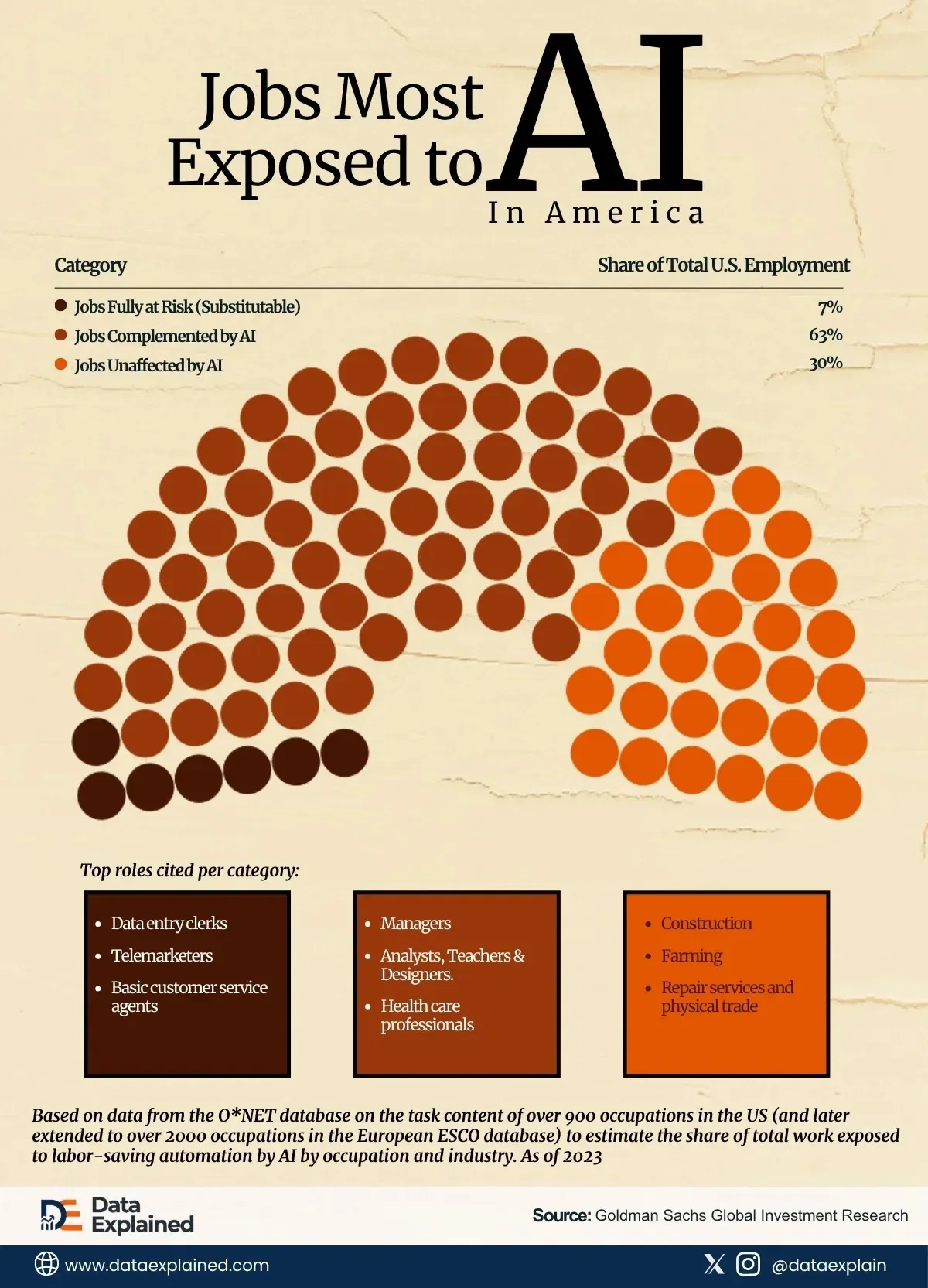
Out of all the tasks Americans perform in paid work, one-quarter could feasibly be done by AI tools without human input.
But because most jobs blend automatable and non-automatable tasks, only about 7% of actual jobs would be fully replaced.
Data gathered from Goldman Sachs Global Investment Research revealed that AI is likely to change how most people work, rather than immediately throwing most people out of work.
Scaling the U.S. analysis worldwide, Goldman estimates 18% of work globally could be automated.
There’s a larger effect in developed markets, where office-based and knowledge work are a larger share of employment.
There’s a smaller near-term effect in many emerging economies with larger agricultural and manual workforces.
That means the macro gains (the productivity payoffs) are concentrated where tasks align with what AI can do.
Recent data from a YouGov survey shows that more than one in five (22%) people think that AI could perform some of their tasks.
According to the OECD paper “Who Will Be the Workers Most Affected by AI?”, some of the most AI-exposed jobs are held by science & engineering professionals, chief executives, managers, business professionals, and IT professionals.
PwC’s 2024 Global AI Jobs Barometer shows that sectors least exposed to AI tasks have experienced lower productivity growth than AI-exposed sectors.