
Where Data Tells the Story
© Voronoi 2026. All rights reserved.

China’s decision to block a $2 billion acquisition by Meta Platforms in April has drawn attention not just for its timing but for what it means for global technology power.
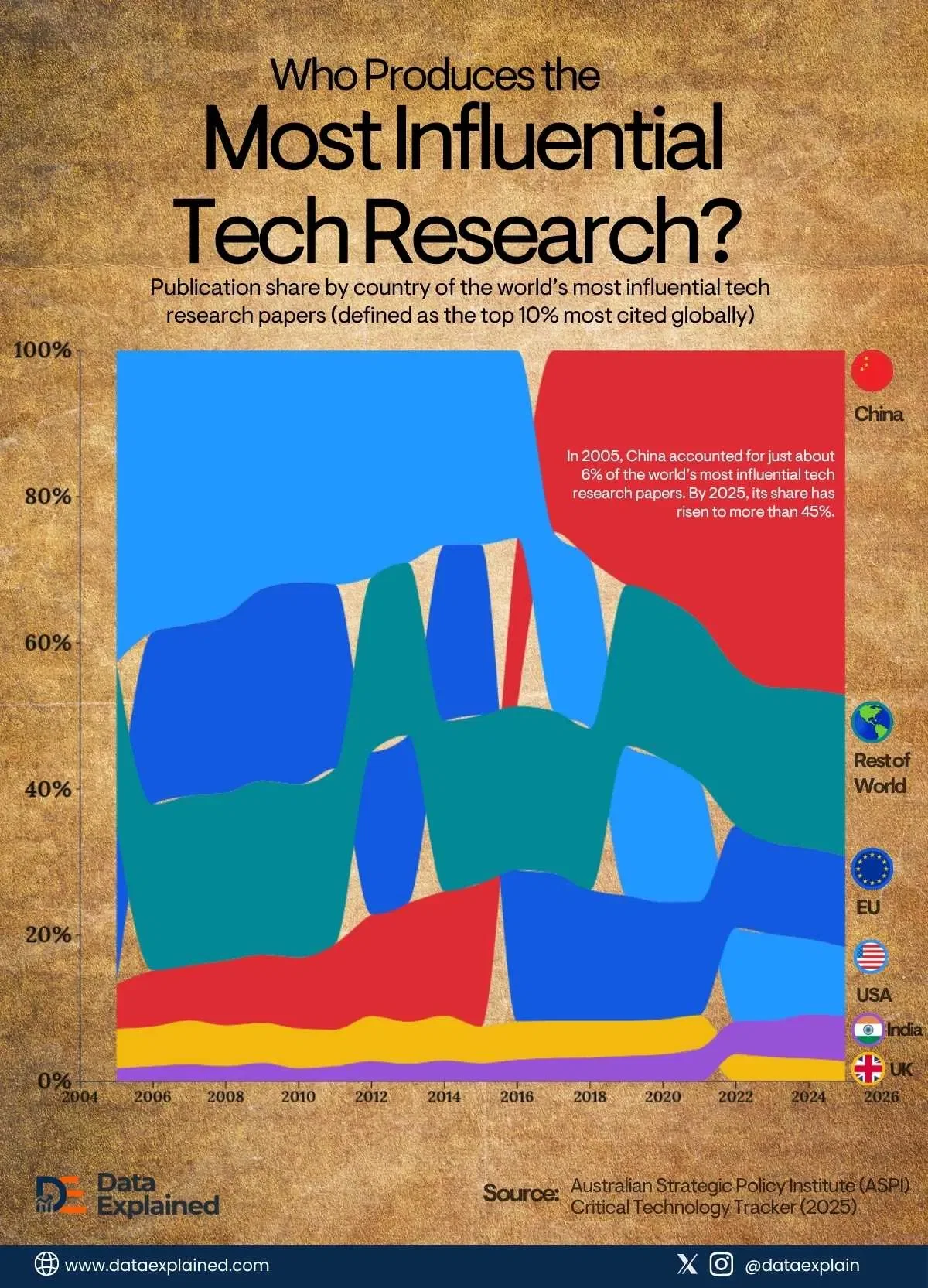
The visualization above is based on data from the Australian Strategic Policy Institute (ASPI).
It shows that China now produces nearly half of the world’s most influential tech research papers (defined as the top 10% most cited globally).
In 2005, China accounted for just about 6% of those publications. By 2025, its share has risen to more than 45%.
Over the same period, the United States has moved in the opposite direction.
Its share of top-tier research has fallen from around 40% in 2005 to roughly 10% in 2025, according to the ASPI data.
Why Does this Matter?
Unlike broader publication counts, the ASPI dataset focuses on the most-cited research.
That means work that tends to shape future innovation in areas such as:
That makes the findings less about academic volume and more about influence.
Still, the Data Doesn’t Tell the Full Story
While China leads in publication share, the United States continues to play a central role in commercializing new technologies, particularly through its deep venture capital ecosystem and global technology firms.
Many leading AI models, software platforms, and semiconductor innovations are still developed or scaled by U.S.-based companies.
In addition, research quality is difficult to measure solely through citation counts.
Some experts argue that breakthrough innovation (especially in emerging fields) may not always be captured by publication metrics alone.