
Where Data Tells the Story
© Voronoi 2026. All rights reserved.

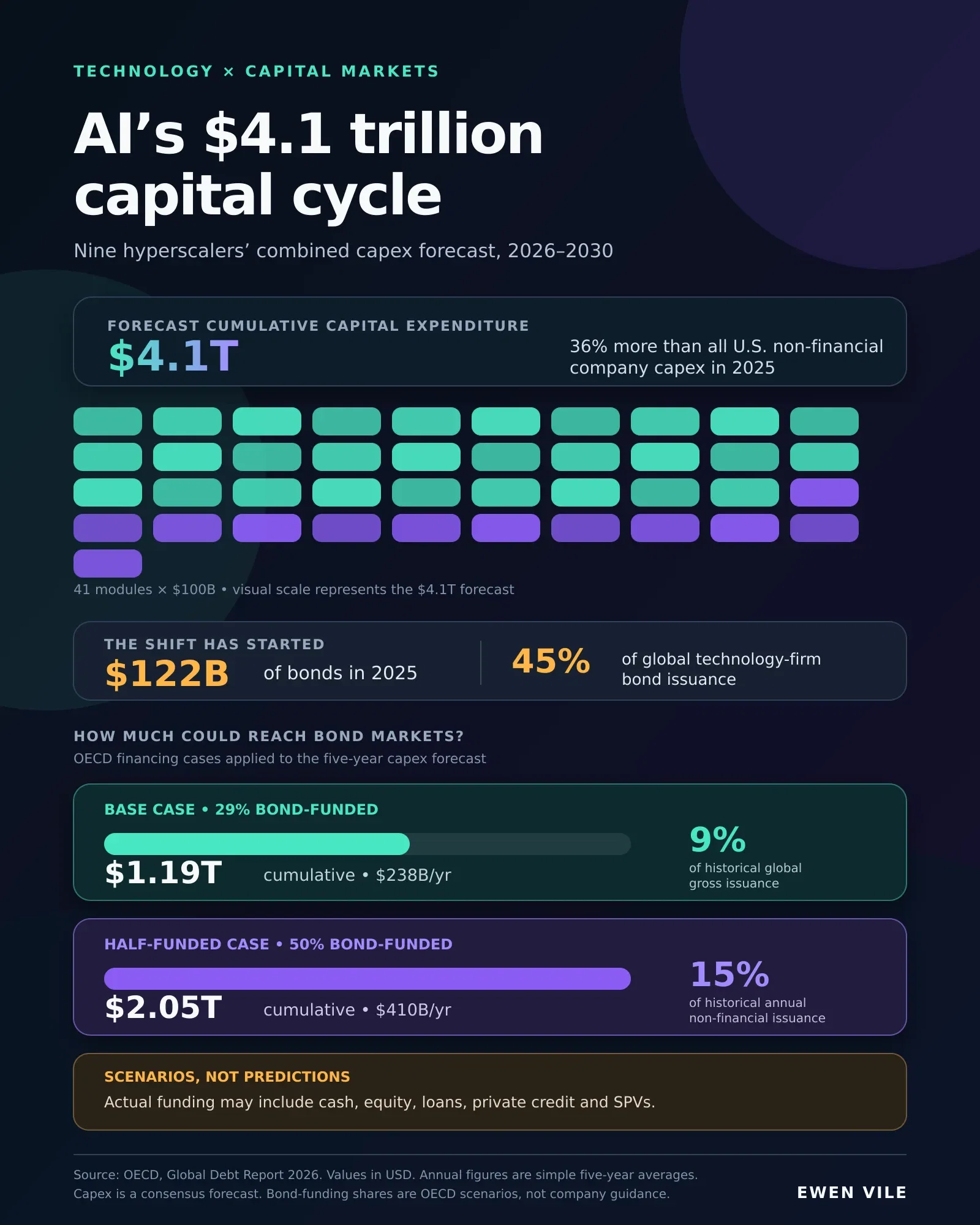
Nine major technology companies described by the OECD as hyperscalers have forecast a combined $4.1 trillion of capital expenditure between 2026 and 2030. That is 36% more than the capital spending of every U.S. non-financial company combined in 2025.

The bigger capital-markets question is how much of that buildout could be financed with bonds. OECD's conservative base case assumes 29% of capex is bond-funded, matching the hyperscalers' average bond-issuance-to-capex ratio from 2020 to 2025. Applied to the $4.1 trillion forecast, that equals roughly $1.19 trillion over five years, or $238 billion per year on a simple annual-average basis.

If half of the capex were bond-financed, cumulative issuance would reach $2.05 trillion—an average of $410 billion per year. OECD estimates that the base case would equal about 9% of historical global gross issuance by non-financial companies, while the half-funded scenario would account for 15%.

The shift is already visible. In 2025, the nine hyperscalers issued $122 billion of bonds, equal to 45% of all technology-firm issuance globally.

These financing cases are scenarios, not predictions. Actual funding could include internal cash, equity, loans, private credit and special-purpose vehicles. The $4.1 trillion capex total is itself a consensus forecast; for Alibaba, Apple and Tencent, OECD carries 2029 estimates into 2030 because 2030 estimates were unavailable.