
Where Data Tells the Story
© Voronoi 2026. All rights reserved.

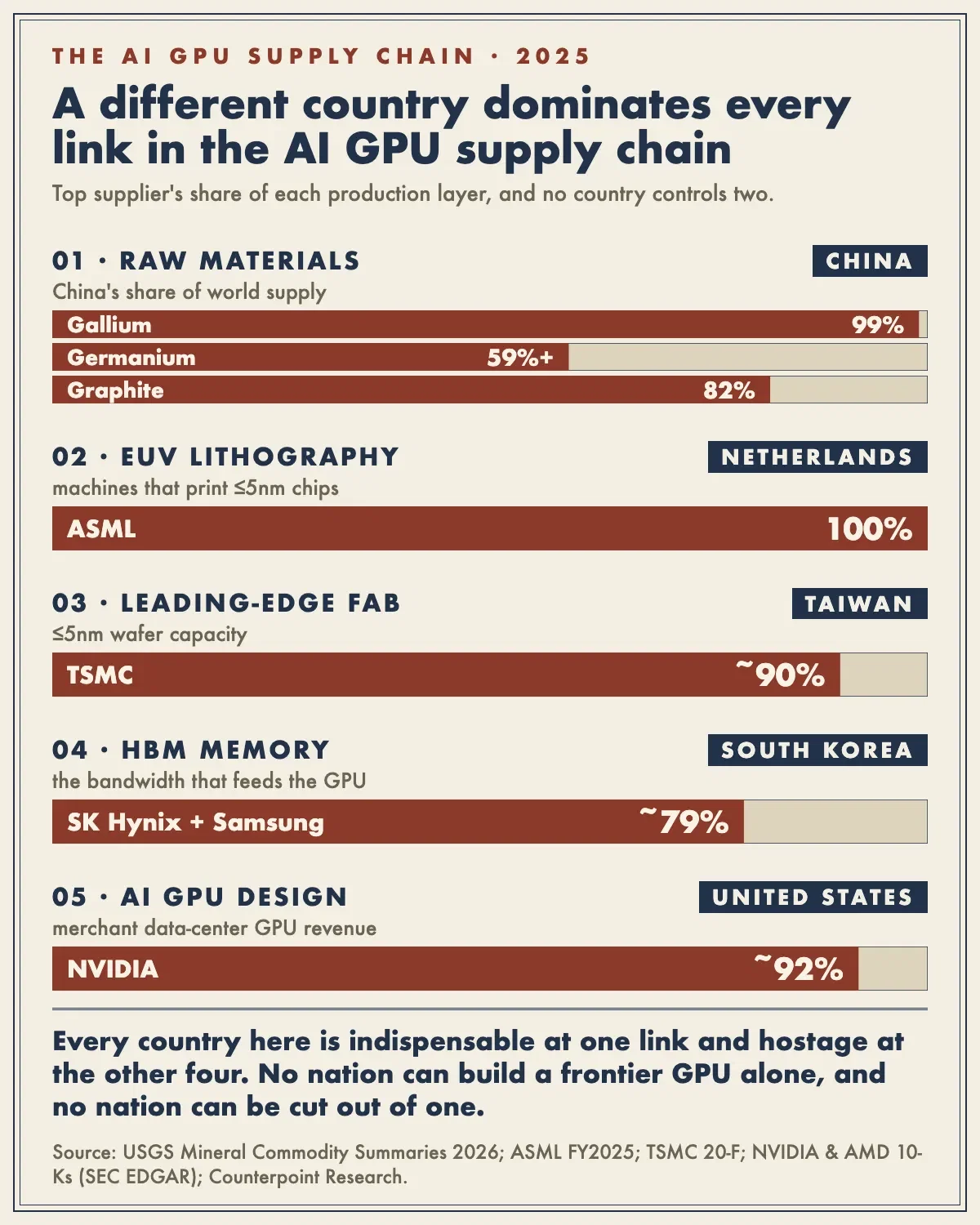
From raw gallium to the finished accelerator, an AI GPU crosses five production layers, and at every one the top supplier controls between 79% and 100% of the market. China produces 99% of the world's low-purity gallium, ASML in the Netherlands builds 100% of EUV lithography machines, TSMC in Taiwan runs roughly 90% of leading-edge (≤5nm) wafer capacity, SK Hynix and Samsung in South Korea hold a combined 79% of HBM revenue, and NVIDIA in the United States books roughly 92% of merchant data-center GPU revenue between itself and AMD.
The striking part is not that each link is concentrated. It is that no country holds two of them. Every nation on this chain is simultaneously indispensable at one layer and hostage at the other four: China can choke the gallium but cannot print a wafer; the US designs 92% of the accelerators but makes neither the memory nor the machines that etch them. That symmetry, not the concentration itself, is what holds the chain together, and it is why a restriction at any single layer lands on everyone downstream, including the country imposing it.
HBM is the one link where the roster moved in 2025, easing from a roughly 85% Korean duopoly in 2024 to 79% as Micron took about a fifth of the market. But the layer did not open up. Second place changed hands twice inside two quarters while the combined Korean share sat at 79% at both ends of the churn. Concentration is sticky even when the names underneath it are not.
Data: USGS Mineral Commodity Summaries 2026; ASML FY2025 results; TSMC 20-F FY2025 and NVIDIA / AMD 10-K filings via SEC EDGAR; Counterpoint Research Q3 2025 HBM revenue shares.