
Where Data Tells the Story
© Voronoi 2026. All rights reserved.

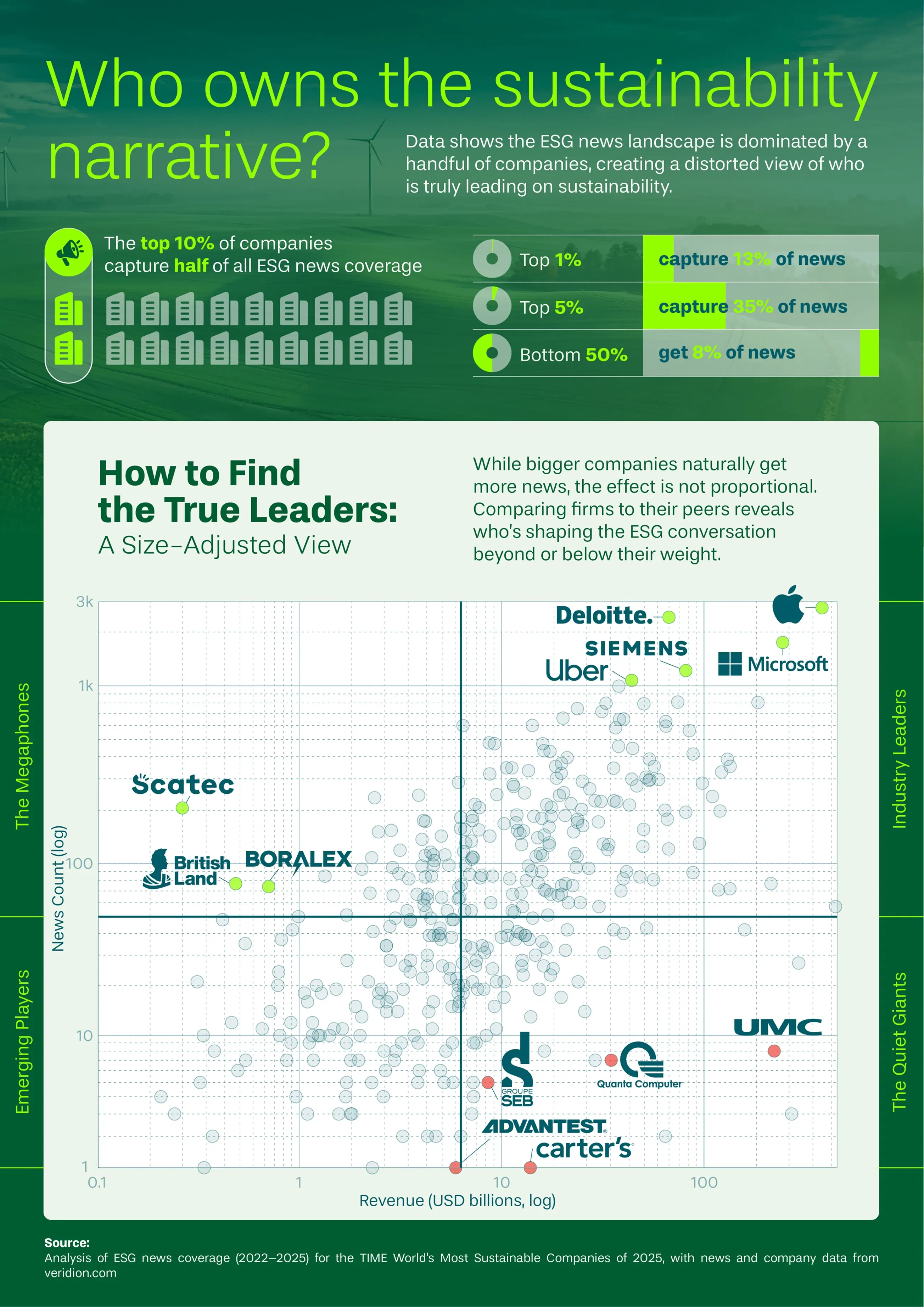
Is the company with the most sustainability headlines truly the leader? We conducted an in-depth analysis to find out, and the results challenge some common perceptions.
Our analysis examined three years of ESG news coverage (2022-2025) for the 500 companies listed in the TIME World's Most Sustainable Companies of 2025. We compared each firm's ESG media footprint to its annual revenue to see who is truly shaping the conversation beyond their size.
⬘ Extreme News Concentration
The sustainability narrative is heavily concentrated. The top 10% of companies capture a staggering 50% of all ESG news, while the bottom 50% of firms share just 8% of the coverage.
⬗ Bigger Isn't Proportionally Louder
While larger companies get more news, the effect is not proportional. Our analysis shows that doubling a company's revenue brings much less than double the media coverage. This means the firms dominating the conversation are doing so through more than just their size.
⬙ Identifying "Megaphones" and "Quiet Giants"
The most crucial insight comes from identifying the outliers. Our 2x2 analysis pinpoints "The Megaphones” (i.e. companies with an outsized media presence for their revenue) and "The Quiet Giants," (i.e. massive corporations whose sustainability stories are going largely untold).
Investors, policymakers, and consumers who equate media volume with leadership may be systematically overlooking quiet innovators while overvaluing firms that are simply better at public relations.
While assessing a company's ESG performance is a complex task, size-adjusted models and systematic comparisons are one way to achieve a more nuanced, evidence-based, and accurate evaluation of true sustainability leadership.