
Where Data Tells the Story
© Voronoi 2026. All rights reserved.

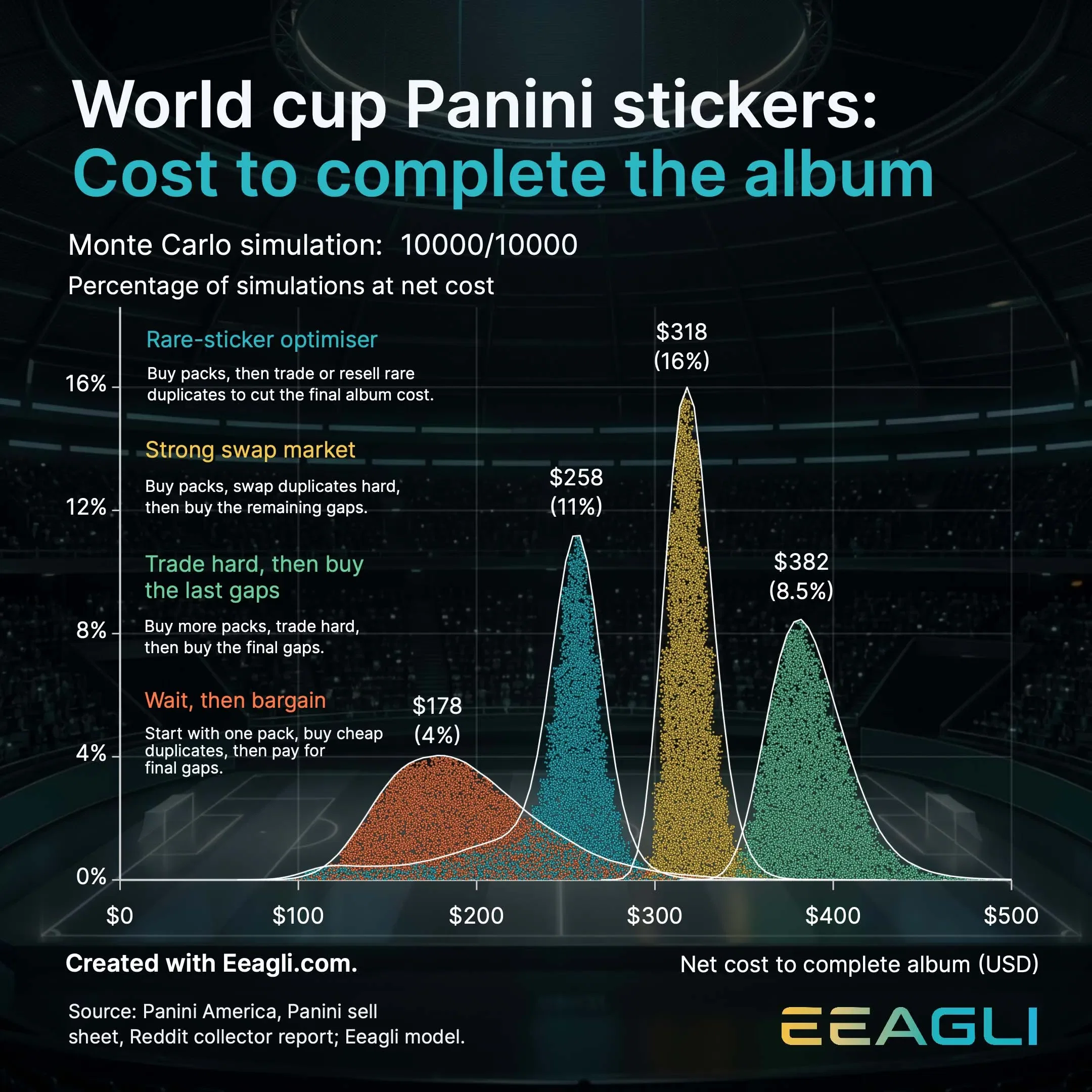
This is for my 10-year old son. We looked for the cheapest way to complete a World Cup Panini sticker album.
Over dinner, we started debating the best way to complete the album without spending a ridiculous amount of money. So naturally, we turned it into a data experiment.
We tested four strategies:
1. Buy packs until the album is complete.
2. Buy packs, then fill the gaps.
3. Buy packs and use rare duplicates to trade or sell.
4. Wait, start small and trade hard.
The fourth strategy won.
I modelled the Panini sticker album as a Monte Carlo simulation: a brute-force probability model that repeatedly simulates thousands of possible collecting journeys under different strategies. The assumptions included the number of stickers in the album, stickers per pack, pack prices, duplicate rates, trading behaviour, and the cost of filling final gaps. Each strategy was run many times to estimate the likely total cost of completing the album, rather than relying on a single outcome. The visualisation was built in Eeagli, using its data visualisation and animation tools to show how the simulated outcomes build up over time, with the final distributions revealing which strategy was cheapest, riskiest, and most efficient.
The reason is simple. When the album first comes out, lots of kids rush to buy huge boxes of stickers. They fill the easy gaps quickly, but soon end up buried in duplicates.
That is where the patient collector has an advantage. If you start later with fewer stickers, almost every swap is useful. You have more empty spaces, more possible trades and less wasted money.
In other words, patience beats panic buying.
To test it, I ran a Monte Carlo simulation. That sounds fancy, but it is really just a brute-force way of understanding probability. You simulate the same situation thousands of times and see what usually happens.
And what usually happened was clear: the patient trader saved a lot of money.
The best part is that this strategy was not just cheaper. It was also more fun. More swapping, more negotiating, more playground economics. He comes back home with at least 100 stickers a day.
It's all about taking advantage of irrational exuberance.
What do you think?