
Where Data Tells the Story
© Voronoi 2026. All rights reserved.

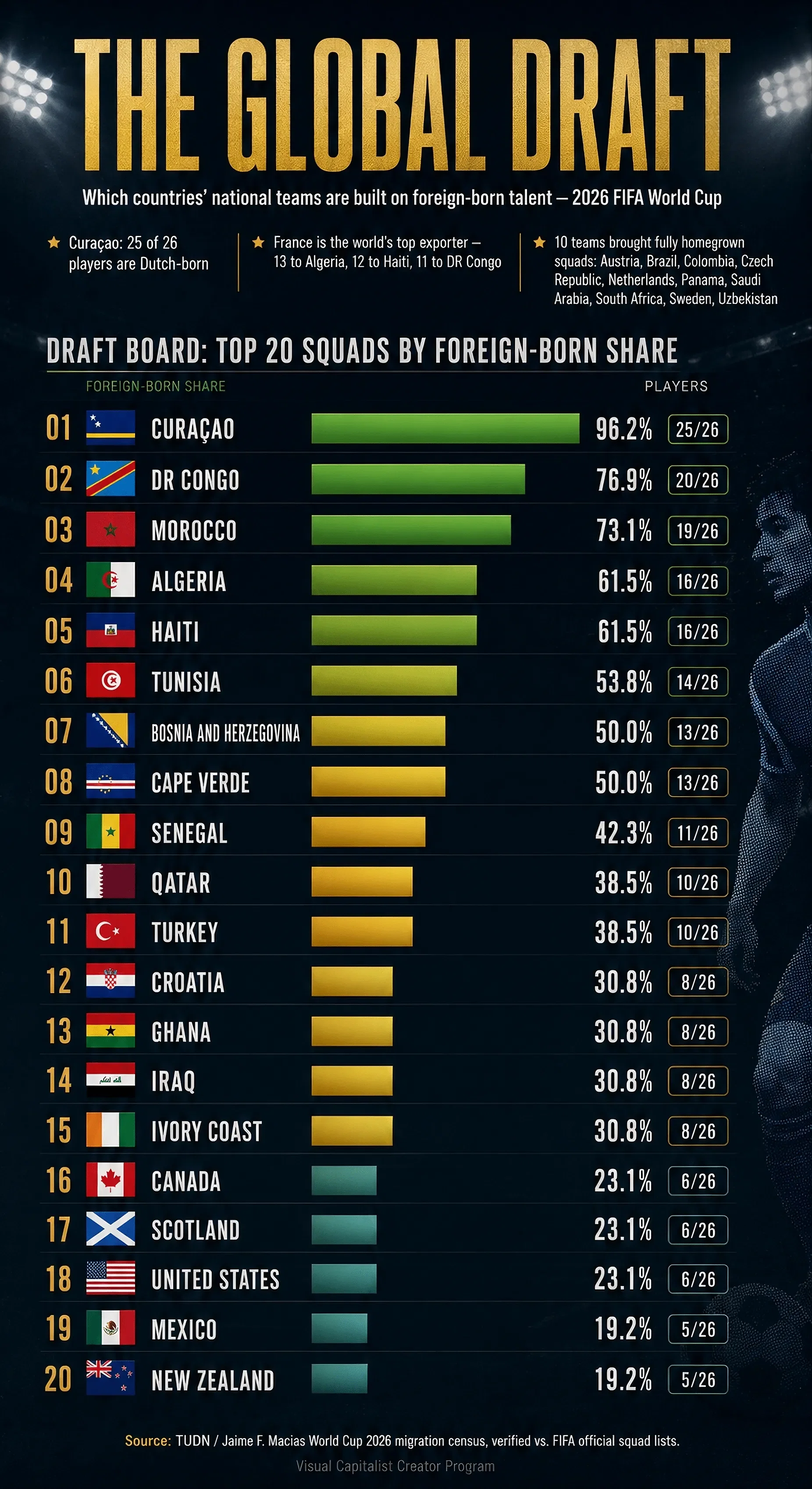
The 2026 FIFA World Cup is the first 48-team edition, and its rosters tell a migration story as much as a football one. About a quarter of the tournament’s 1,248 players were born outside the country they represent, the highest share in World Cup history.
Using player-level birth-country data cross-checked against FIFA’s official June 2026 squad lists, we calculated the foreign-born share of every 26-player roster across all 48 qualified teams.
The ranking runs from one almost entirely diaspora-built squad to ten fully homegrown teams, with a clear regional pattern in between.
Curaçao leads by a wide margin: 25 of 26 players were born in the Netherlands, giving it a 96.2% foreign-born share. It is also only the second nation with fewer than 200,000 people to qualify for a World Cup.
African teams dominate the top of the ranking. DR Congo, Morocco, Algeria, Tunisia, Cape Verde, Senegal, Ghana, and Ivory Coast all field a majority or near-majority of foreign-born players, mostly drawn from European diaspora communities.
France is the world’s biggest talent exporter. France-born players represent Algeria (13), Haiti (12), DR Congo (11), Senegal (10), Ivory Coast (8), Tunisia (7), Morocco (6), Cape Verde (3), and Ghana (3), reflecting both France’s migration history and its elite academy system.
At the other end, ten teams brought fully homegrown squads: Austria, Brazil, Colombia, Czech Republic, Netherlands, Panama, Saudi Arabia, South Africa, Sweden, and Uzbekistan.
The clearest pattern is regional. Countries with large, established European diaspora communities—often former colonies or states shaped by major 20th-century emigration—field the most foreign-born squads.
Top six
Curaçao is the extreme case. With a population under 200,000, its federation recruited Dutch-born players of Curaçaoan descent to build a competitive squad. Only Tahith Chong was born on the island.
No country supplies more foreign-born World Cup talent than France. Its large North and West African diaspora, combined with one of football’s strongest development systems, provides core players for several national teams.
Some were overlooked by France’s senior team and later chose a parent’s or grandparent’s country. This route has become more common as FIFA eligibility rules have become more flexible.
The ten fully homegrown teams fall into three broad groups.
Large domestic talent pools: Brazil, Netherlands, and Sweden can rely heavily on players born at home.
Lower diaspora recruitment: Austria, Czech Republic, Panama, Saudi Arabia, South Africa, and Uzbekistan draw less from foreign-born eligible players.
Colombia is the exception: despite a large diaspora, its federation has continued to prioritize domestic development over recruiting dual-eligible players born abroad.
Foreign-born share is not only a demographic outcome. It reflects active federation recruitment under FIFA eligibility rules based on birthplace, parentage, or grandparentage.
Bosnia and Herzegovina’s 50% foreign-born squad reflects the legacy of the 1990s Yugoslav Wars. Many players were born in Germany, Austria, and Sweden, major destinations for Bosnian refugees. Its playoff win over Italy—featuring Argentina-born Mateo Retegui—was itself a diaspora-versus-homegrown storyline.
Qatar is different. Its foreign-born players come from a broad set of countries—Egypt, Algeria, Belgium, Brazil, France, Ghana, Portugal, and Senegal—reflecting naturalization policy more than historical emigration.
This analysis covers all 48 teams at the 2026 FIFA World Cup. Foreign-born share equals the number of players in each 26-player squad born outside the country they represent, divided by 26.
The TUDN / Jaime F. Macías World Cup 2026 migration census identifies 287 of the tournament’s 1,248 players. Of these, 260 belong to qualified teams; 27 were born in non-qualified countries and are excluded from team totals.
The data was cross-checked against Flashscore, Front Office Sports, The Conversation, GiveMeSport, beIN Sports, Bolavip, US Soccer, and FIFA’s confirmed June 2026 squad lists.
Where multiple countries supplied the same number of foreign-born players to a squad, all are listed as tied primary sources.