
Where Data Tells the Story
© Voronoi 2026. All rights reserved.

Reid Wiseman, Victor Glover, Christina Koch, and Jeremy Hansen are currently in lunar orbit; the first humans to travel that far from Earth since December 1972.
NASA’s Artemis II mission launched on April 1, 2026, and the crew is now conducting a close flyby of the Moon, passing within 4,067 miles of the surface, losing radio contact as they transit the lunar far side, and viewing parts of it no human eye has seen directly before.
The mission is historic.
However, the financial architecture behind it is documented in a single row of data:
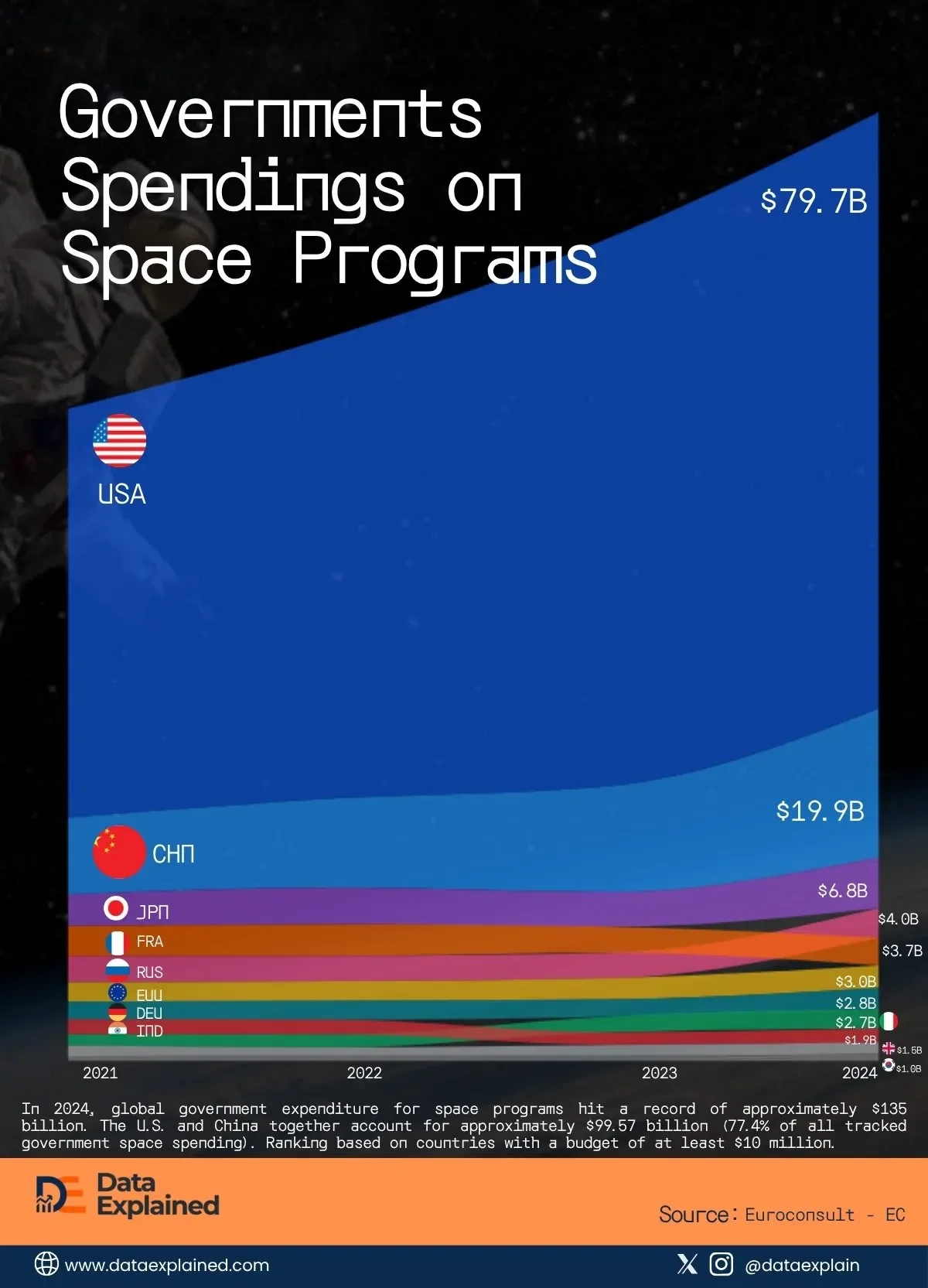
The United States spent $79.68 billion on government space programs in 2024.
Today’s visualization shows government expenditure on space programs. It comes from the Euroconsult-EC (now Novaspace).
The dataset tracks expenditure in billion USD across 11 countries from 2021 through 2024. It covers only countries with a budget of at least $10 million.
Russia spent $3.96 billion on space projects in 2024.
Its budget has been essentially flat since 2021, edging between $3.41 billion and $3.96 billion over four years, while every other major program has grown.
Russia launched Sputnik. It sent the first human into space. For decades, it operated the most capable space program on Earth.
It now spends less than Japan and less than France, and its annual space budget has been compressed by war expenditure, economic sanctions, and fiscal contraction to a figure that Italy (at $2.65 billion) is approaching from below.
Context matters here:
Today, there are six government space agencies with full launch and extraterrestrial landing capabilities:
NASA is the most renowned of them all. The requested FY 2024 budget for all sectors is $27.2 billion.