
Where Data Tells the Story
© Voronoi 2026. All rights reserved.

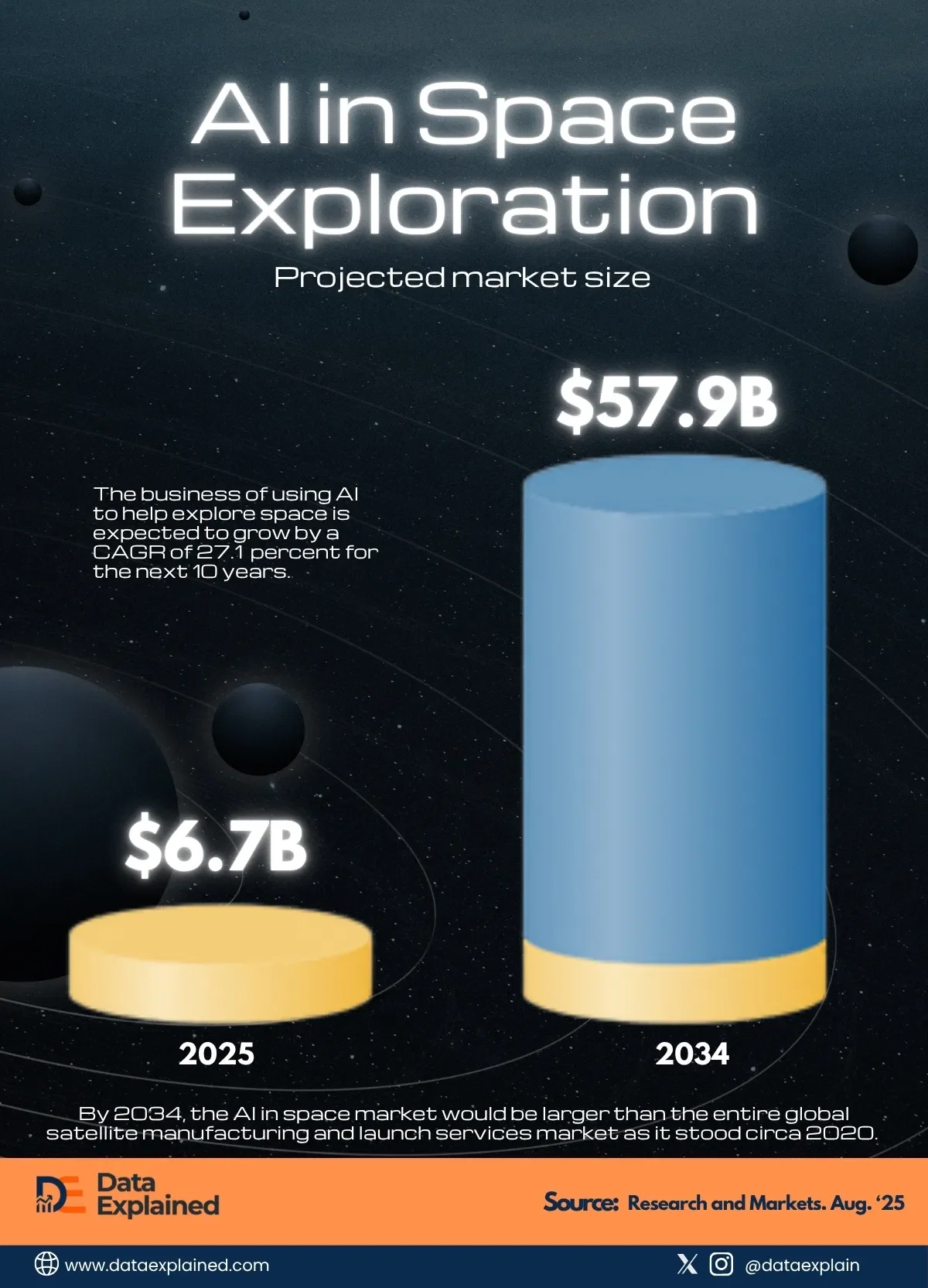
The market for artificial intelligence in space exploration is projected to grow from $6.7 billion in 2025 to $57.9 billion in 2034, an 8.6-fold increase over nine years at a compound annual growth rate of 27.1%.
The data comes from Research and Markets.
That growth rate means the market roughly doubles every 2.9 years.
Last week, SpaceX moved to position itself at the center of that curve.
Elon Musk’s rocket company secured an option to acquire Cursor, an AI coding startup, for $600 million, or enter a deep strategic partnership for $100 million if it decides against full acquisition.
The agreement gives SpaceX a direct foothold in AI coding infrastructure, a segment where the company has lagged behind competitors such as GitHub Copilot.
It’s backed by Microsoft and OpenAI’s Codex.
The six times price spread between the partnership and acquisition options is structurally unusual.
It reflects genuine strategic uncertainty on SpaceX’s part.
The company has secured the right to decide without yet committing to a direction.
The announcement itself, regardless of which option SpaceX ultimately exercises, signals to the market that AI coding capability has become a strategic asset in the space sector rather than a productivity tool.
Cursor is an AI-assisted code editor.
SpaceX’s interest in it is less about space exploration AI directly and more about engineering speed.
That is, writing, testing, and deploying the software that runs rockets, satellites, and spacecraft faster than human engineers working without AI assistance can manage.