
Where Data Tells the Story
© Voronoi 2026. All rights reserved.

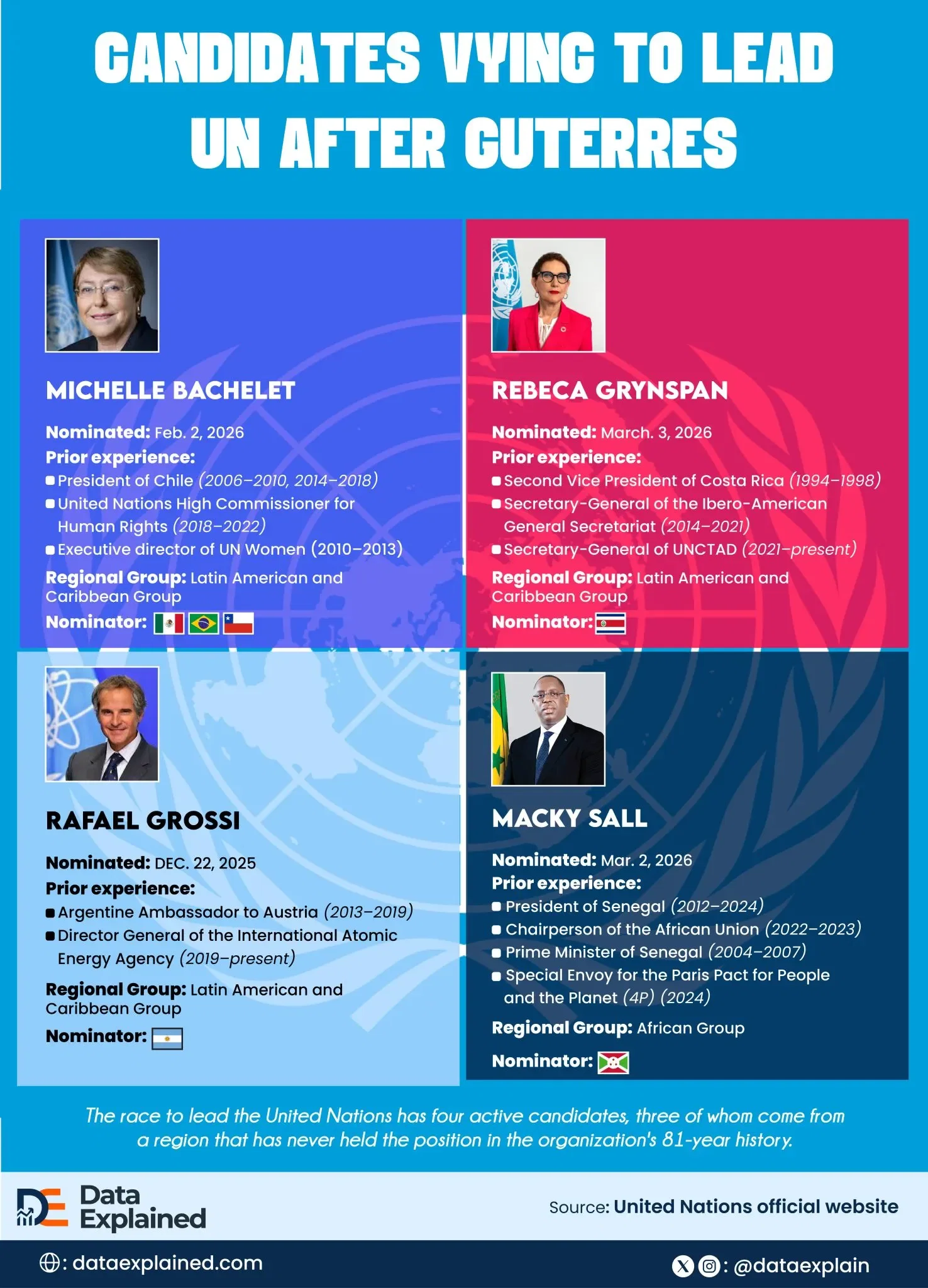
The race to lead the United Nations has four active candidates, three of whom come from a region that has never held the position in the organization’s 81-year history.
The selection process to find a successor to António Guterres, whose term ends on December 31, 2026.
Five candidates were nominated. One subsequently withdrew. Four remain, and the field they represent tells a specific story about regional ambition.
The Historic Gender Moment
The United Nations has never had a female Secretary-General.
In 81 years and across nine consecutive appointments, every person to hold the role has been a man.
Bachelet and Grynspan are both women (and both are from the LACG).
If either is selected, it would be simultaneously the first female Secretary-General and the first from Latin America.
The Veto Calculation
The Security Council’s permanent members each hold the power to block any candidate they find unacceptable.
China’s position is the most analytically significant in the current field.
Bachelet’s tenure as UN High Commissioner for Human Rights produced a report on human rights conditions in Xinjiang that drew sharp official condemnation from Beijing.
China has never publicly confirmed whether it would use its veto against Bachelet, but the report’s existence is an acknowledged complication in her path to the Security Council’s recommendation.
Grossi’s Iran-related work at the IAEA intersects with the P5 members’ interests in various ways.
Russia and China have both used the Security Council to resist Western-backed resolutions on Iran’s nuclear program.
Grossi’s agency is the neutral monitor in that dispute.
Whether that neutrality is seen as a qualification or a liability depends on which P5 member is doing the assessing.