
Where Data Tells the Story
© Voronoi 2026. All rights reserved.

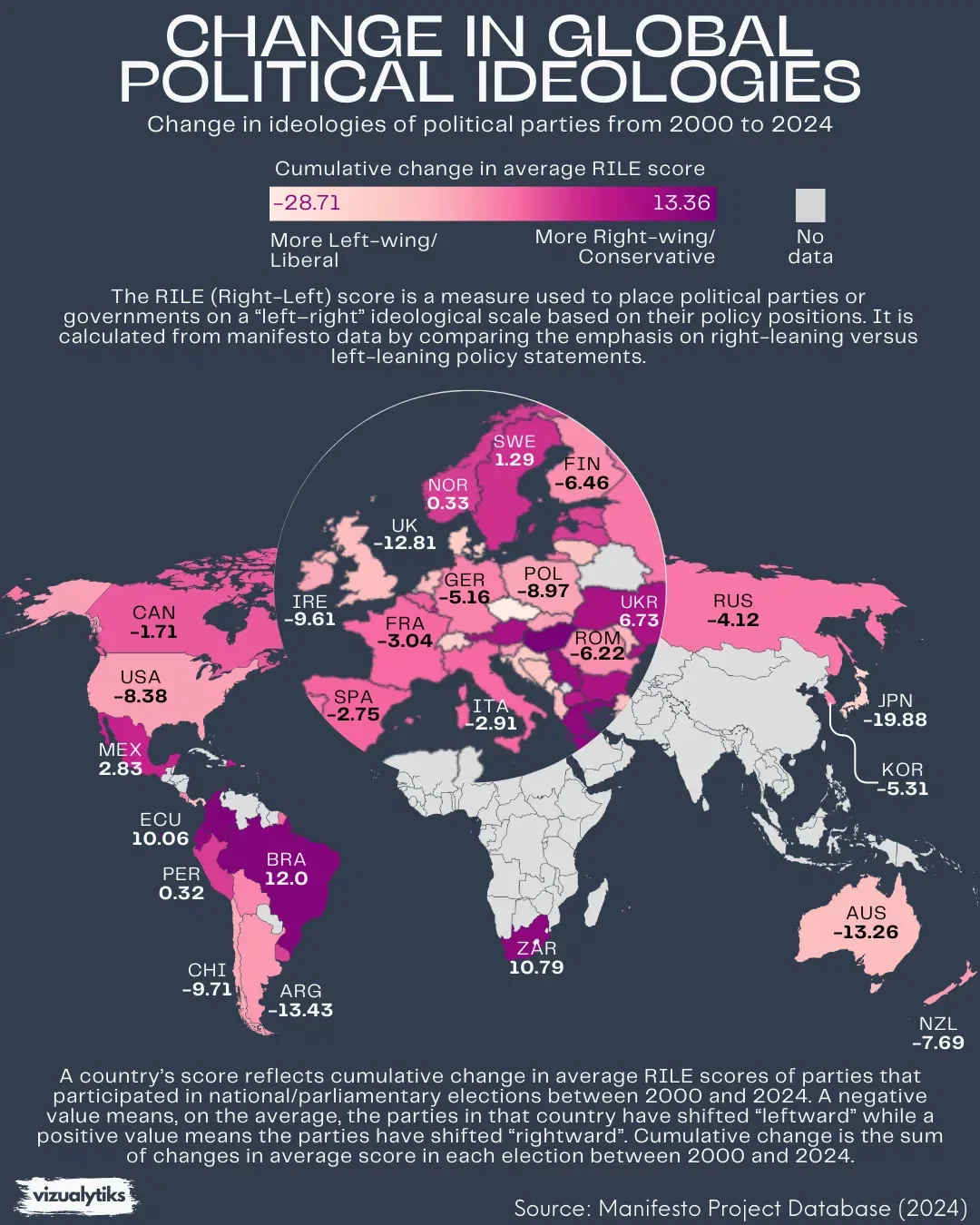
Over the past two decades, political parties around the world have gradually shifted their positions, and those changes add up. Looking across elections since 2000, the data shows that many countries have seen a steady move in the average ideology of their major parties, rather than abrupt swings driven by a single vote or government.
Much of Western Europe, along with Canada, the United States, Japan, and Australia, has moved modestly leftward on average, reflecting a greater emphasis on liberal or progressive policy positions over time. By contrast, parts of Latin America and Eastern Europe have shifted more clearly to the right, with countries such as Brazil, South Africa, Ukraine, and Romania showing some of the strongest conservative movements across repeated elections.
The key takeaway is that political ideology is not static. Party platforms evolve as societies change, and the cumulative effect of those adjustments can reshape a country’s political center over time. This longer-term view helps explain why today’s political landscape looks the way it does and why it continues to change.