
Where Data Tells the Story
© Voronoi 2026. All rights reserved.

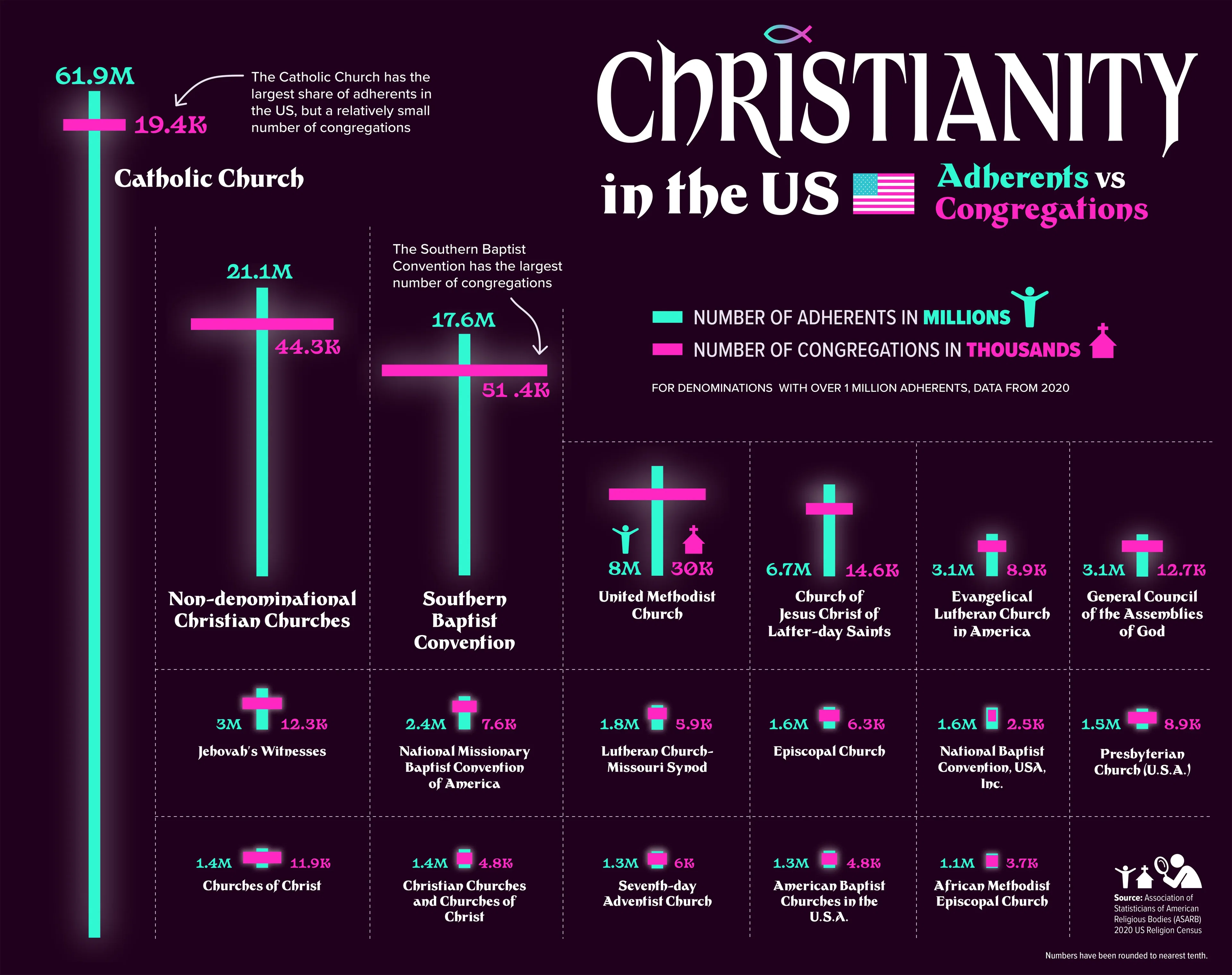
Which Christian bodies have the strongest presence in the United States?
Drawing from the 2020 US Religion Census, this infographic charts the top Christian denominations (those with over 1 million adherents) by both metrics, revealing contrasts in scale and reach.
The US Religion Census (USRC) defines a congregation as "a group of individuals who meet regularly at a pre-announced time and location," encompassing parishes, churches, and other gathering places. Adherents represent "the most complete count of individuals affiliated with a congregation," including members, their children, and other attendees who are not members but are considered participants in the congregation.
Compiled by the Association of Statisticians of American Religious Bodies, the USRC examined 372 religious bodies to create this comprehensive snapshot. Some bodies such as “Churches of Christ” and “Christian Churches and Churches of Christ” have redundant sounding names. Though their names appear almost the same, these denominations operate as two distinct fellowships with different reporting methods.
Note on Non-denominational Churches: The USRC aggregates these into a single category due to their increasing growth, significant share of the religious landscape (making them the second-largest group by adherents after Catholics), and research showing most are theologically and functionally akin to Protestant evangelical churches. In the USRC's words: "When attempting to count these non-denominational and independent churches, a necessary first, and rather difficult, step is to determine what is a "non-denominational church." Much confusion surrounds this label because it often is defined by what it is not. The approach used by the USRC is to identify non-denominational churches by allowing congregations to self-identify their denominational affiliation or lack thereof. Following this self-identification as non-denominational, considerable effort was made by a team of researchers to probe for any ties to quasi-denominational entities."
Sources: US Religion Census 2020; Association of Statisticians of American Religious Bodies. Data reflects 2020 estimates and may vary slightly by methodology.