
Where Data Tells the Story
© Voronoi 2026. All rights reserved.

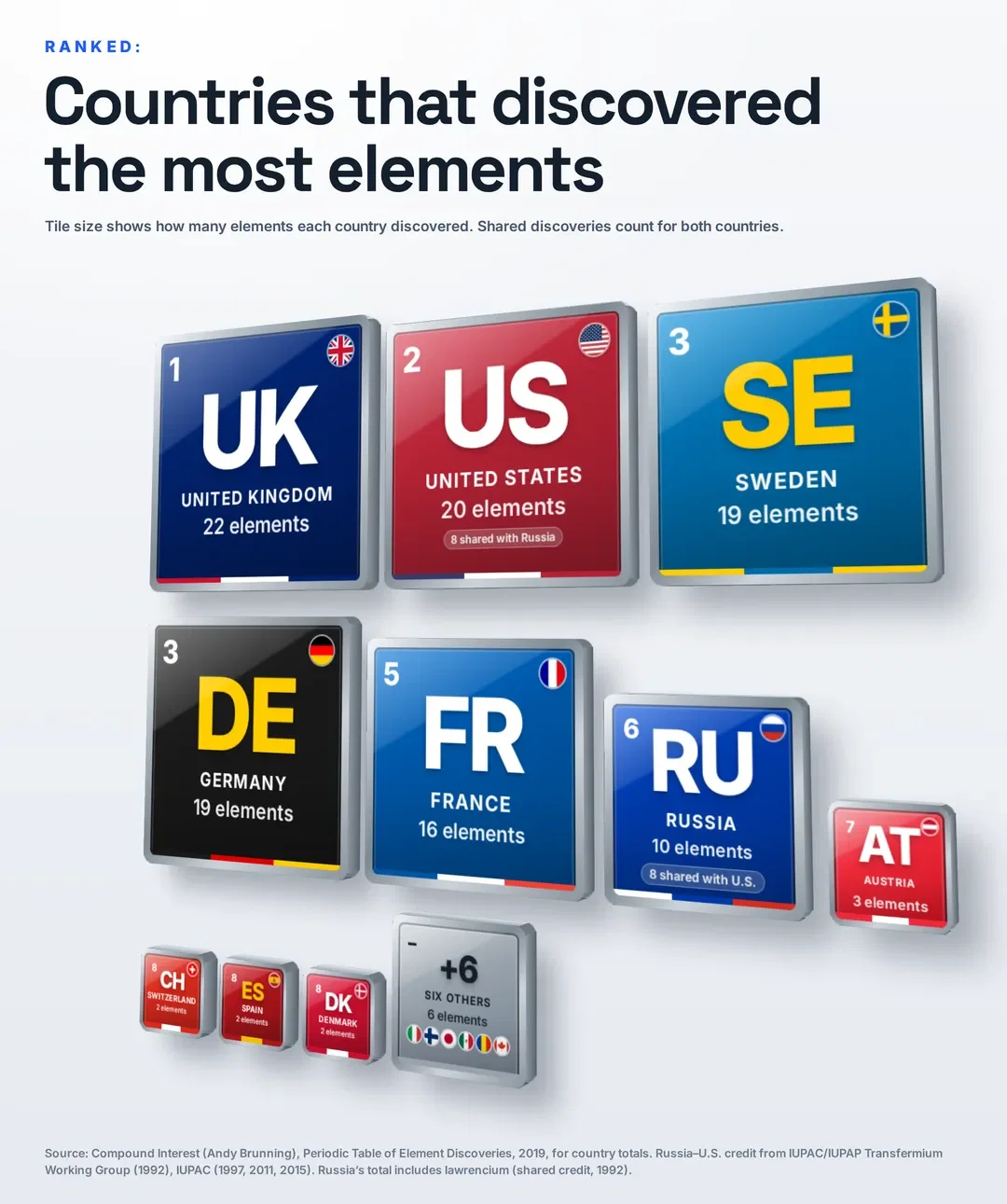
Britain has found more elements than any other country. Twenty-two of the periodic table’s elements were first identified there, including sodium, potassium and the noble gas argon. Chemists Humphry Davy and William Ramsay took part in half of those discoveries.
The United States is next with 20, and every one of them is a synthetic element made in a lab. Sweden and Germany tie for third at 19 each, ahead of France at 16 and Russia at 10. Beyond that the list drops off fast: Austria has 3, Switzerland, Spain and Denmark have 2 apiece, and six other countries (Italy, Finland, Japan, Mexico, Romania and Canada) found one each.
When two countries share credit for an element, it counts for both. That matters most for Russia and the U.S., who share eight elements. Five came from joint projects between the Dubna lab and Livermore, and three (lawrencium, rutherfordium and dubnium) were split between Dubna and Berkeley after decades of dispute.
Each tile is sized by the number of elements a country discovered and colored from its flag. Ten elements, including gold, iron and carbon, were known since antiquity, so no country gets credit for them.