
Where Data Tells the Story
© Voronoi 2026. All rights reserved.

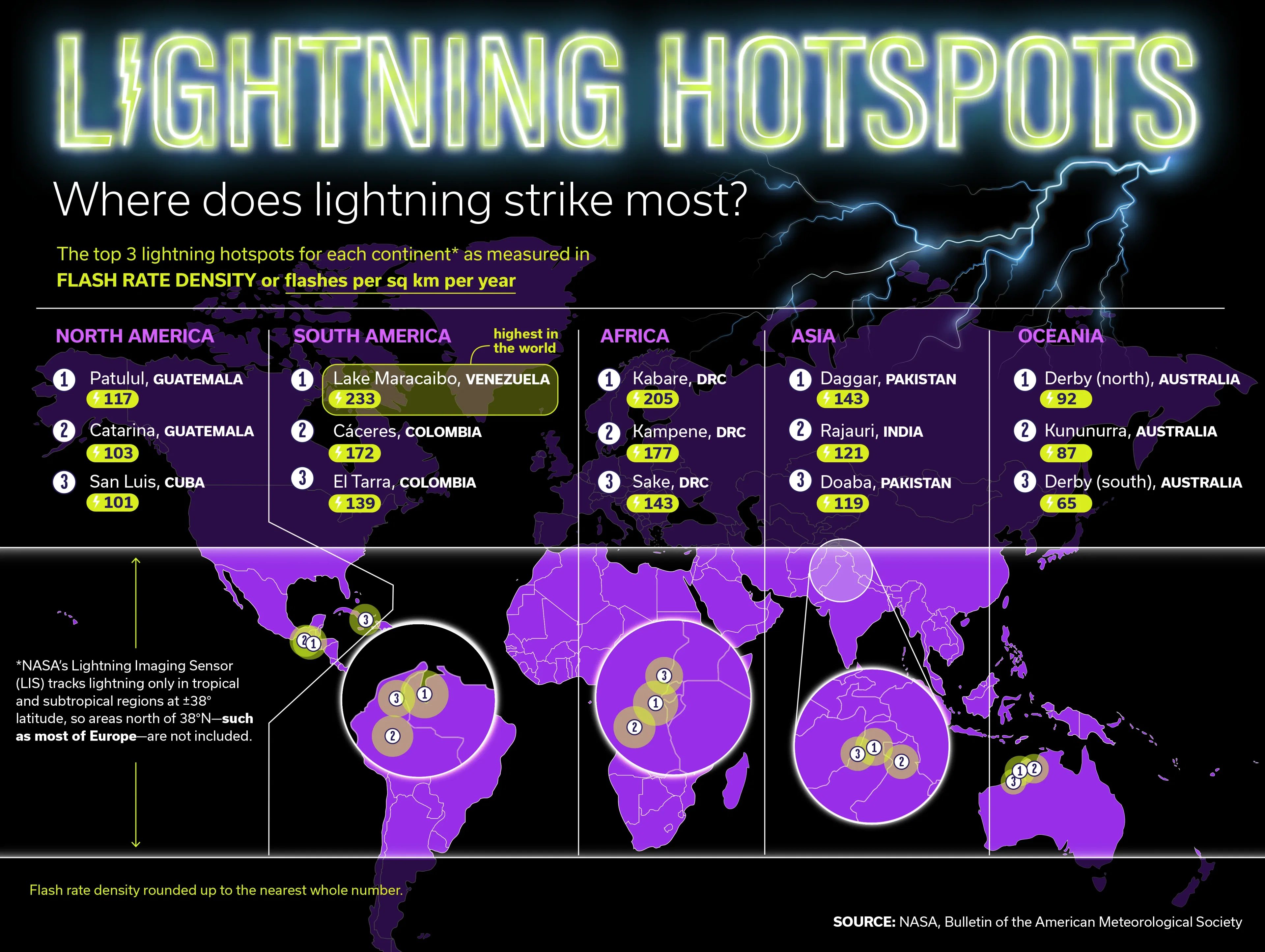
Where in the world does lightning strike most frequently?
Using data from NASA’s Lightning Imaging Sensor (LIS) collected between 1998 and 2013, this map highlights the top three lightning hotspots for each continent. Lightning frequency is measured in flashes per square kilometer per year. To identify hotspots, researchers used high-resolution climatology, dividing the globe into 0.1° grid cells. The cities listed represent the nearest populated locations.
Because LIS focused on tropical and subtropical regions—where lightning activity is most intense—areas north of 38° latitude, including most of Europe, were not included in the study. Many of the world’s lightning hotspots cluster near lakes, coastlines, or mountainous terrain, where warm, moist air and the natural topography promotes strong convection.
The most active lightning hotspot on Earth is over Lake Maracaibo, Venezuela. Nocturnal thunderstorms occur so frequently here that the lightning once served as a beacon for Caribbean sailors in colonial times, known as the Lighthouse of Catatumbo. The lake’s warm waters, combined with surrounding mountains and its connection to the Gulf of Venezuela, create ideal conditions for persistent storm development. The storms are so frequent that they have become a tourist attraction, with evening boat tours showcasing the nightly lightning displays.
Africa’s strongest hotspots lie near Kahuzi-Biéga National Park in the Democratic Republic of the Congo, on the western slopes of the Mitumba Mountains near the Rwanda border.
Asia’s top hotspot is found along the northwestern foothills of the Himalayas near Daggar, Pakistan.
In North America, the first and second hotspots are Patalul and Catarina, Guatemala, which are located in a narrow lowland corridor between the Pacific Ocean and the Sierra Madre mountains.
Oceania’s most intense lightning activity occurs along the northwest coast of Australia near Derby, where tropical weather patterns drive frequent thunderstorms.
Note: While Florida experiences the most lightning in the United States, its flash rates are significantly lower than those in Central America and the Caribbean. The highest U.S. density—near Orangetree in the Everglades—ranks 14th for North America and so did not make into the top three.