
Where Data Tells the Story
© Voronoi 2026. All rights reserved.

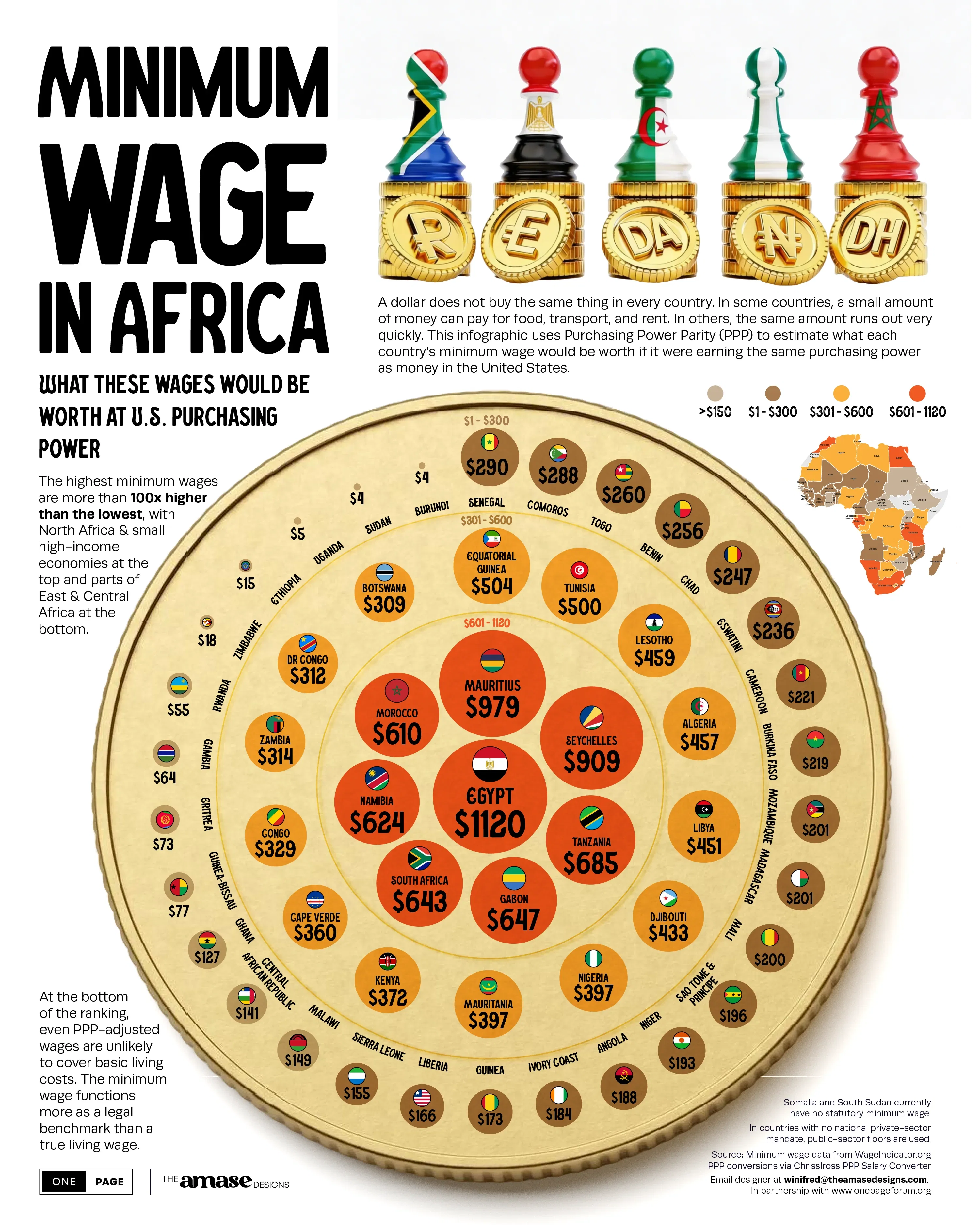
A dollar does not buy the same thing everywhere.
So instead of comparing minimum wages across Africa using exchange rates, this visualization adjusts them using Purchasing Power Parity (PPP), estimating what each country’s minimum wage would be worth if it had the same purchasing power as money in the United States.
The picture that emerges is quite revealing. Even after adjusting for cost of living, the gap remains enormous, from about $4 in Sudan and Burundi to over $1,100 in Egypt.
Countries like Mauritius ($979), Seychelles ($909), and South Africa ($643) sit near the top of the distribution, while several economies in East and Central Africa remain at the very bottom.
In several countries, particularly those at the lower end of the scale, such as Sudan, Burundi, and Uganda, the statutory minimum wage appears to function more as a legal benchmark than a true living wage when adjusted for purchasing power.
When you look at wages through the lens of purchasing power, the conversation shifts from how much people earn to what those earnings can actually sustain.