
Ranked: Central Bank Assets Relative to GDP
The post 2008 financial crisis era has seen central banks expand their balance sheets dramatically, as monetary authorities responded to successive financial, economic and market shocks.
While balance sheets have begun to normalise in some economies following the tightening cycle, their size relative to the underlying economy varies significantly across countries.
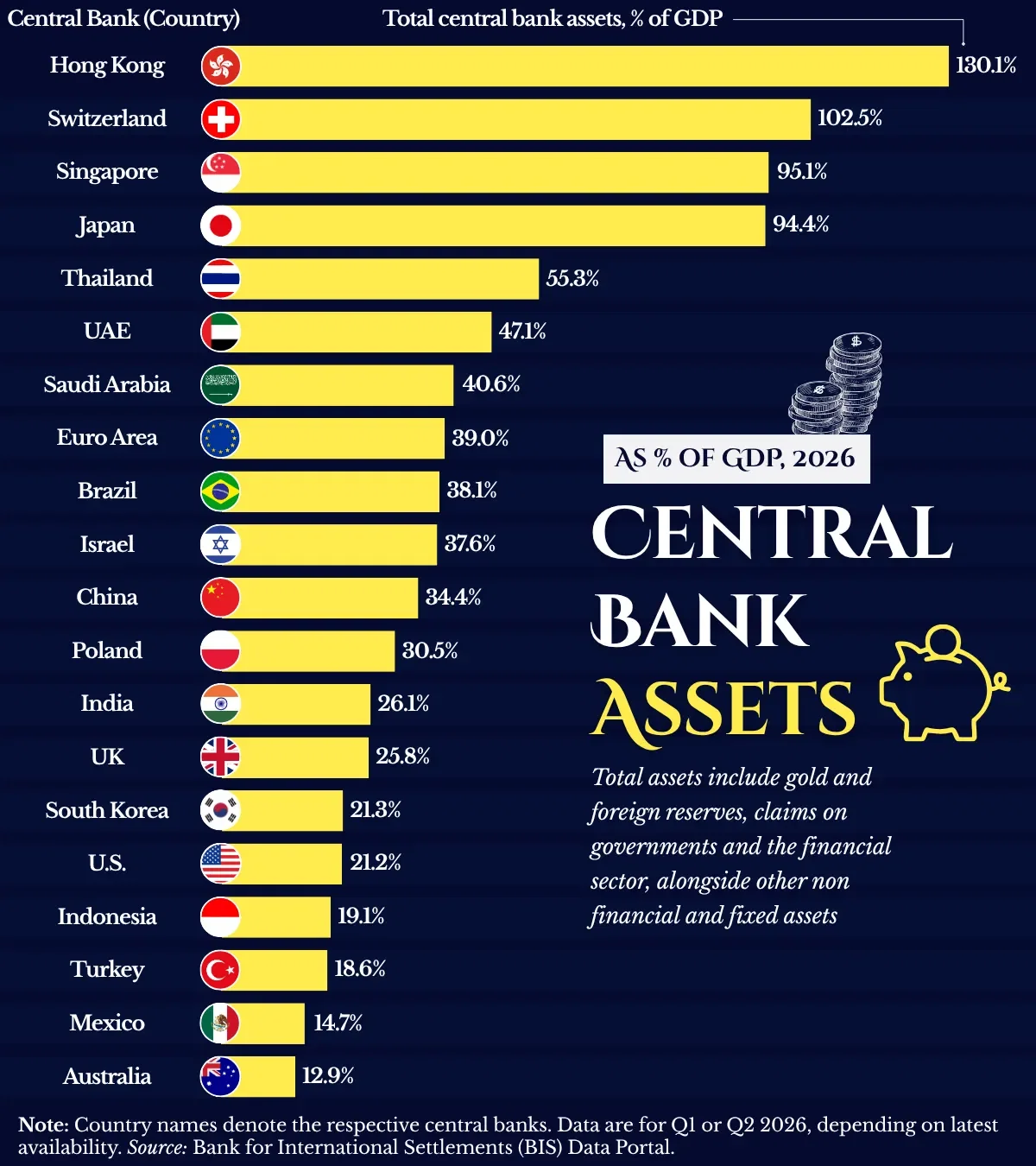
This chart ranks 20 major economies and financial centres by total central bank assets as a share of GDP, highlighting where central bank balance sheets are largest relative to the size of the economy. The data are based on the latest available observations reported to the Bank for International Settlements (BIS) for Q1 or Q2 2026.
Key takeaways from the data are:
- Hong Kong tops the ranking, with central bank assets equivalent to 130.1% of GDP — the only economy where the ratio exceeds the size of its annual economic output.
- Switzerland, Singapore and Japan follow closely, with central bank assets exceeding 90% of GDP in each case, underscoring the exceptionally large balance sheets maintained by several major financial centres and advanced economies.
- Thailand is a notable step down, at 55.3% of GDP, while the UAE and Saudi Arabia also record relatively high ratios of 47.1% and 40.6%, respectively.
- China and the Euro Area stand at 34.4% and 39.0%, while the U.S. is at just 21.2%. India, at 26.1%, sits modestly above the U.S. but below China and the Euro Area.
- At the bottom of the ranking, Australia, Mexico and Turkey have central bank assets equivalent to less than 20% of GDP, highlighting the wide variation in balance-sheet size across economies.
Central bank assets include gold and foreign reserves, claims on governments and the financial sector, alongside other non-financial and fixed assets.
Note: Country names denote the respective central banks. Data are for Q1 or Q2 2026, depending on latest availability. Euro Area represents the consolidated balance sheet of the Euro-system.
Source: Bank for International Settlements (BIS) Data Portal.
Access: https://data.bis.org/topics/CBTA/tables-and-dashboards