
Where Data Tells the Story
© Voronoi 2026. All rights reserved.

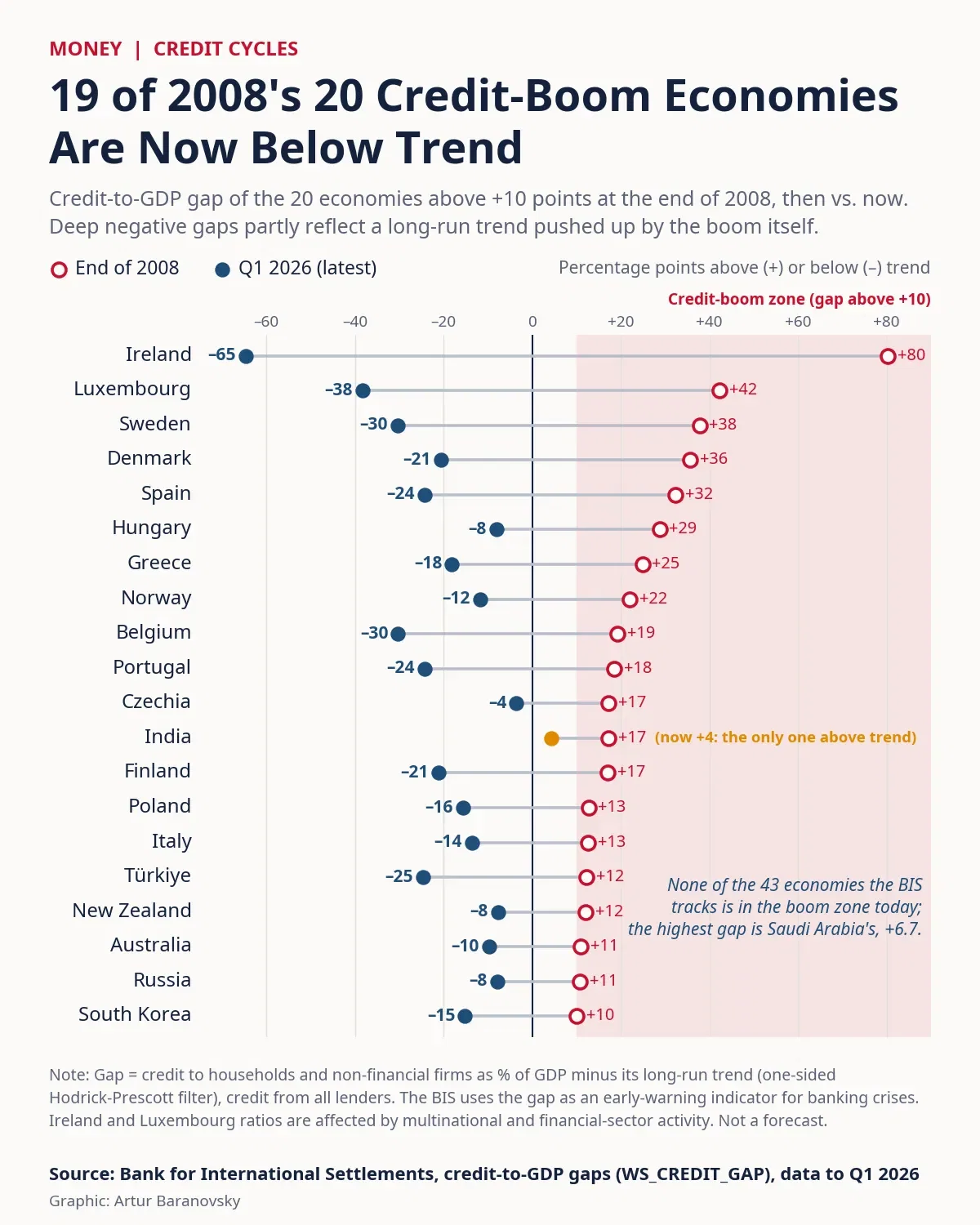
At the end of 2008, 20 of the 43 economies tracked by the Bank for International Settlements (BIS) had credit running more than 10 percentage points of GDP above its long-run trend, the level at which Basel III guidance calls for the maximum countercyclical capital buffer. In the latest BIS data, for Q1 2026, none does.
This graphic, created by Artur Baranovsky, shows where those 20 economies stood then and where they stand now.
Key Takeaways
The gap compares credit to households and non-financial firms, as a share of GDP, with that ratio's long-run trend. The BIS uses it as an early-warning indicator for banking crises.
No. Sweden's credit equals 236% of GDP, yet its gap is −30 points. The trend is estimated from past data, so years of fast borrowing pull it up, and deep negative gaps after a boom partly reflect that.
The IMF's October 2026 Global Financial Stability Report says "the global banking system remains broadly resilient," while flagging rising leverage in private credit, a segment this aggregate measure does not isolate. Supervisors also rely less on the gap alone: according to the Basel Committee, "an increasing number of jurisdictions have voluntarily chosen to introduce a positive neutral CCyB," a buffer kept above zero even when risks are not elevated.