
Where Data Tells the Story
© Voronoi 2026. All rights reserved.

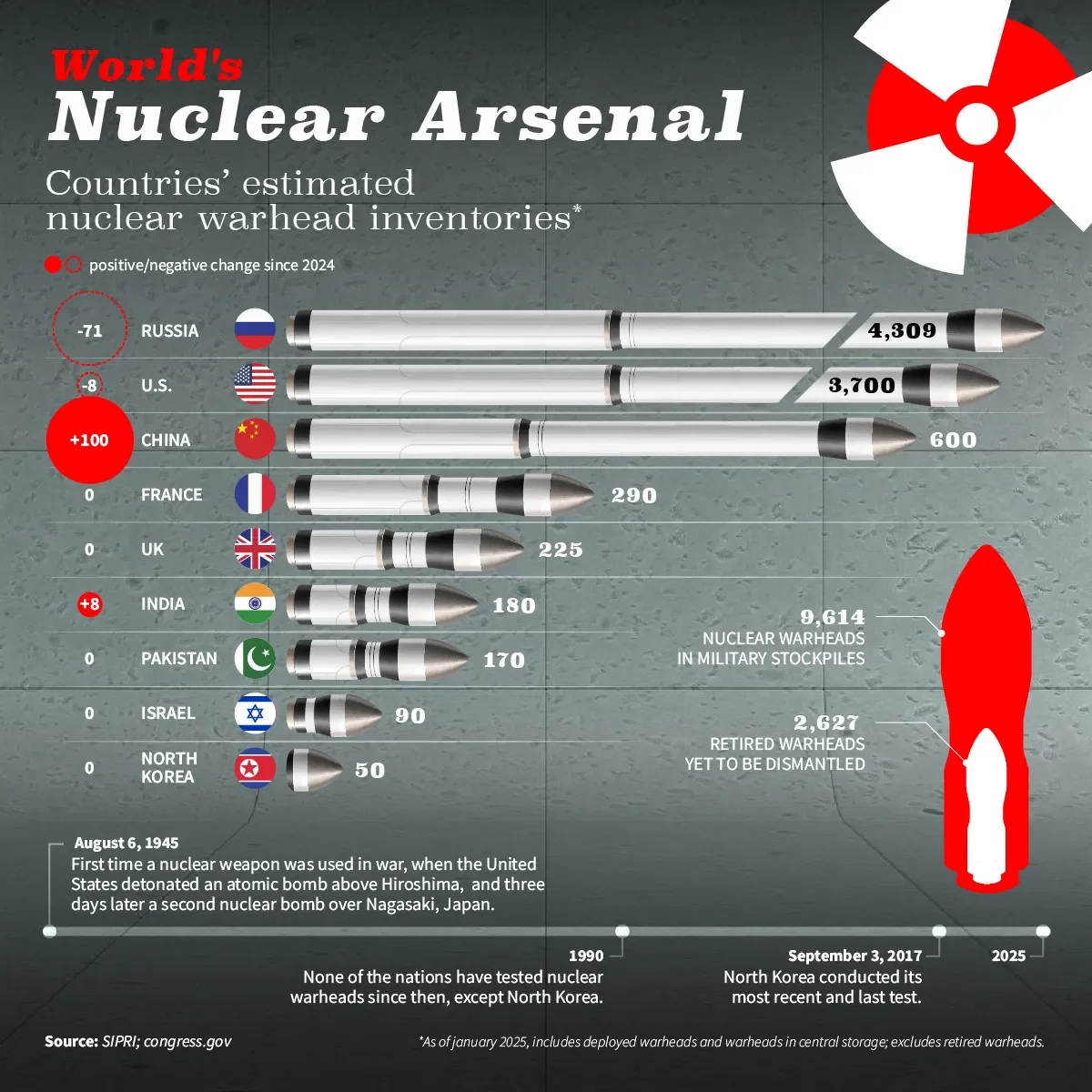
The first use of a nuclear weapon in war occurred on August 6, 1945, when the United States dropped an atomic bomb on Hiroshima, Japan. Three days later, a second nuclear bomb was dropped by U.S. on Nagasaki. These bombings marked the only time nuclear weapons have been used in active combat, though the global production, deployment, and stockpiling of nuclear arms have continued since then.
Approximately 9,614 nuclear warheads are estimated to be in military stockpiles, available for potential use by nine countries. The U.S. and Russia together hold 8,009 of these, accounting for the overwhelming majority of global stockpiles. In addition to active warheads, there are an estimated 2,627 retired warheads awaiting dismantling.
Recent data from the Stockholm International Peace Research Institute (SIPRI) reveals concerning trends in the nuclear arsenals of some countries. For instance, China has increased its stockpile by 100 nuclear warheads since January 2024, bringing its total to 600. India has also expanded its nuclear capability, adding eight warheads to reach an estimated total of 180. The two nuclear powers in Europe, France and the United Kingdom, maintain a combined total of 515 operational warheads.
None of these nations have conducted nuclear tests since the 1990s, with the exception of North Korea.
North Korea has carried out six explosive tests since 2006. The most recent nuclear test took place on September 3, 2017, followed by an announcement that the country would cease nuclear testing and the destruction of the entrances to two test tunnels in May 2018. However, reports from the International Atomic Energy Agency (IAEA) say that North Korea began restoring its test tunnels in March 2022.