
Where Data Tells the Story
© Voronoi 2026. All rights reserved.

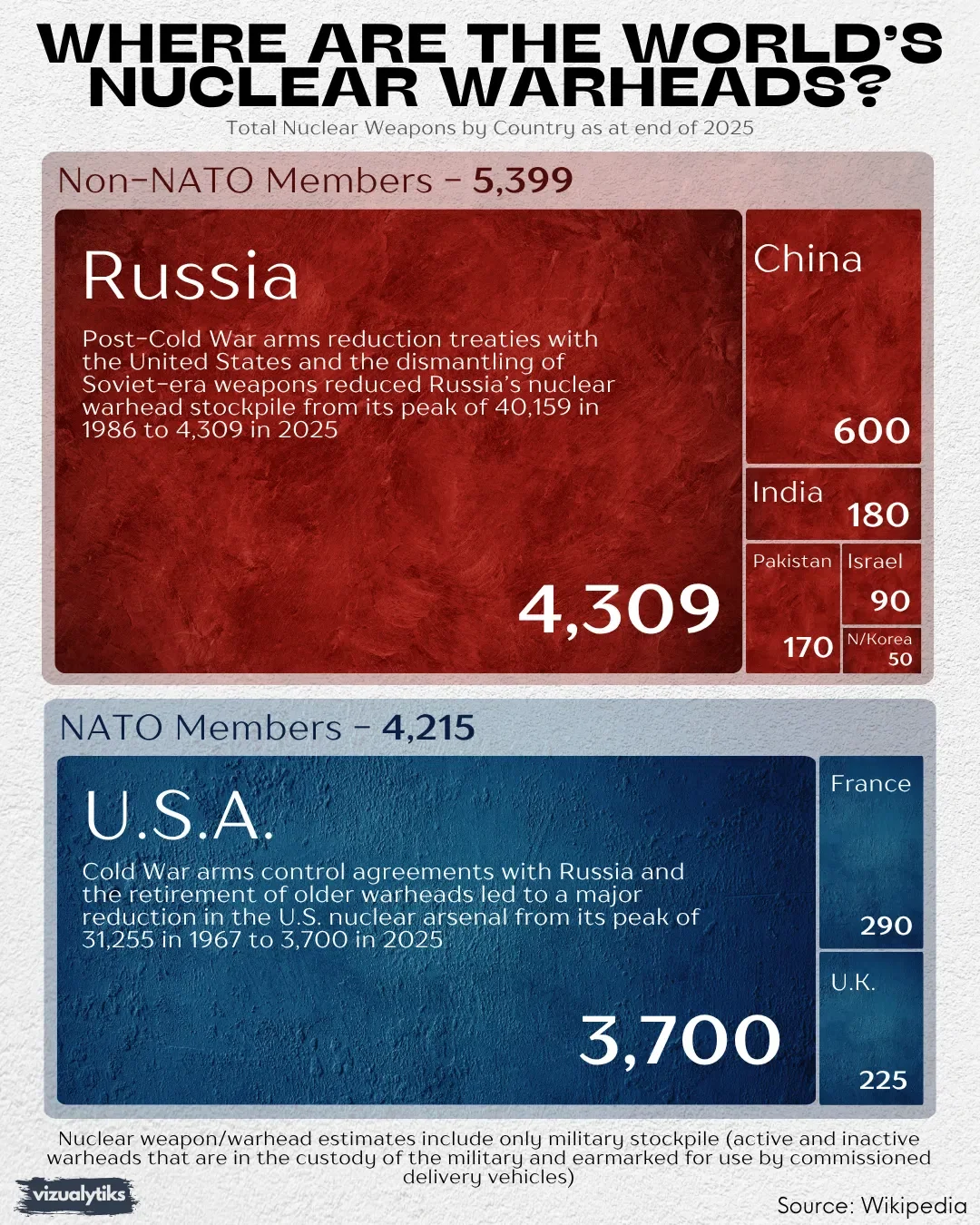
The world’s nuclear weapons remain concentrated in the hands of a few countries. As of the end of 2025, Russia and the United States still dominate the global stockpile, accounting for the vast majority of the roughly 9,600 nuclear warheads held by nuclear-armed states. Both countries once possessed far larger arsenals during the Cold War, but decades of arms control agreements and the retirement of older warheads have reduced those totals significantly.
Russia’s arsenal has fallen sharply from its Soviet-era peak of over 40,000 warheads in the mid-1980s to about 4,309 today, while the U.S. stockpile has declined from more than 31,000 in the late 1960s to roughly 3,700. Together, NATO nuclear powers (the United States, France, and the United Kingdom) hold over 4,200 warheads, compared with 4,409 held by Russia alone and 5,400 among non-NATO nuclear states (led by Russia and China).
Yet the current geopolitical climate is raising new concerns about the direction of nuclear arsenals. Tensions between major powers, wars in Europe and the Middle East, and growing rivalries in Asia are prompting several countries to modernize or expand their nuclear capabilities. While total stockpiles remain far below Cold War levels, the strategic importance of these weapons and the risks tied to them are once again moving back to the center of global security discussions.