
Where Data Tells the Story
© Voronoi 2026. All rights reserved.

Global conflicts have seen an uptick in recent years with the intensification of geopolitical tensions and shifting security priorities. The Russia-Ukraine war is in its fourth year and the Middle-East region continues to be mired by conflicts - especially the power struggle between Israel and Iran.
Global defence spending has also surged - keeping with the trend as countries scamper to keep up with the security challenges of the day.
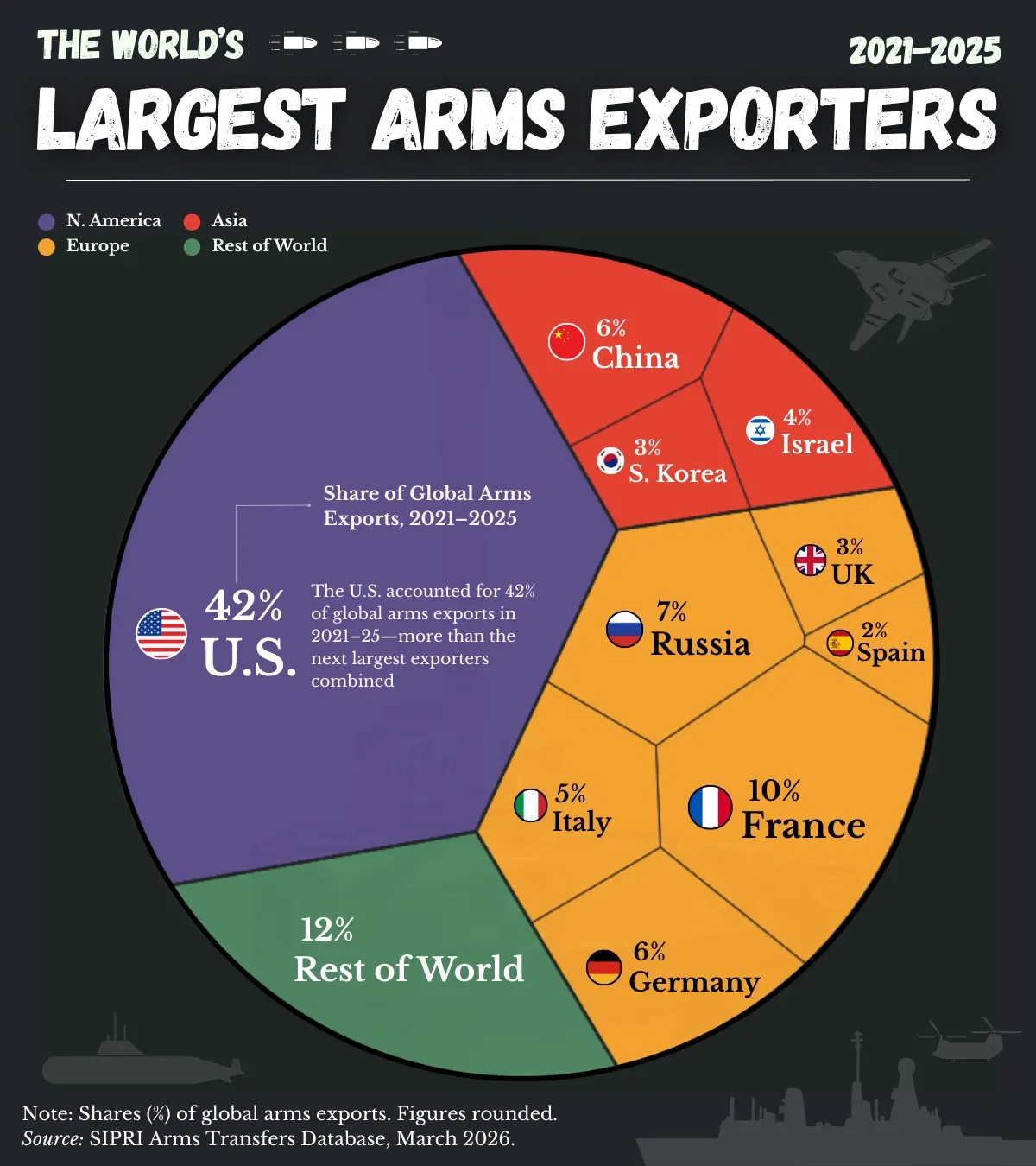
This surge has cemented the dominance of a few arms exporters - especially in Europe and the U.S. According to the latest data from the Stockholm International Peace Research Institute (SIPRI), the United States accounted for 42% of global arms exports between 2021 and 2025—more than the next several exporters combined.
The global arms trade remains highly concentrated, with a small group of suppliers accounting for the majority of transfers. Long-standing defence industries, technological advantages, and deep military alliances continue to shape export patterns and influence where weapons systems are supplied.
Based on data from SIPRI’s Arms Transfers Database, this chart ranks the world’s largest arms exporters by their share of global exports between 2021 and 2025.
Key takeaways:
More broadly, the data highlight how the global arms trade is shaped by strategic alliances, defence industrial capacity, and shifting geopolitical dynamics.
Note: Shares represent each country’s proportion of global arms exports for the period 2021–2025. Figures rounded and in %.
Source: SIPRI Arms Transfers Database, March 2026.
Access: https://www.sipri.org/databases/armstransfers