
Where Data Tells the Story
© Voronoi 2026. All rights reserved.

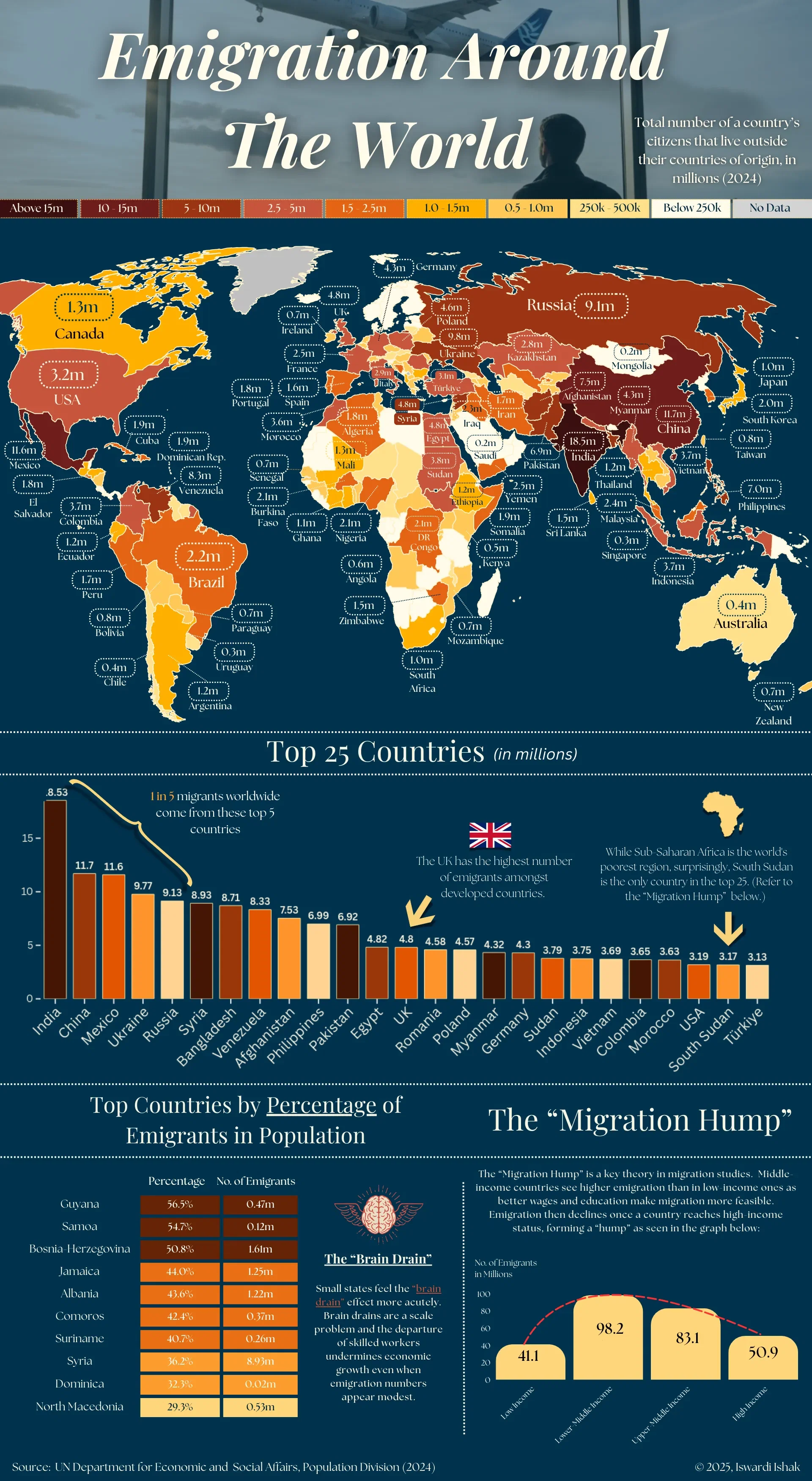
Around 280 million people now live outside the country of their birth, and their origins reveal as much about global inequality as about aspiration. India sits at the top of the emigration table in absolute terms, followed by China and Mexico. Together, a small group of populous countries accounts for a striking share of the world’s migrants. This is less a story of mass exodus than of scale: large countries produce large diasporas even when only a small fraction of citizens leave.
A different picture emerges when emigration is measured as a share of population. Small and fragile states dominate this ranking. In places such as Guyana, Samoa and Bosnia-Herzegovina, more than half of all citizens live abroad. For these countries, migration is not a marginal choice but a structural feature of national life, shaping labour markets, family structures and politics.
Income plays a subtle role. The poorest countries often lack the means to migrate in large numbers. Middle-income countries, by contrast, send the most people abroad. As incomes rise, education improves and connections deepen, migration becomes easier until prosperity at home reduces the incentive to leave. Economists call this pattern the “migration hump”.
The consequences are mixed. Remittances prop up household incomes and foreign exchange reserves. Yet sustained emigration can drain countries of skilled workers, a problem felt most keenly in small states. For richer destinations, migrants help offset ageing populations and labour shortages, even as politics grows more fractious.
Migration, then, is neither crisis nor cure. It is a predictable response to uneven development and a reminder that people move not just away from poverty, but towards possibility.