
Where Data Tells the Story
© Voronoi 2026. All rights reserved.

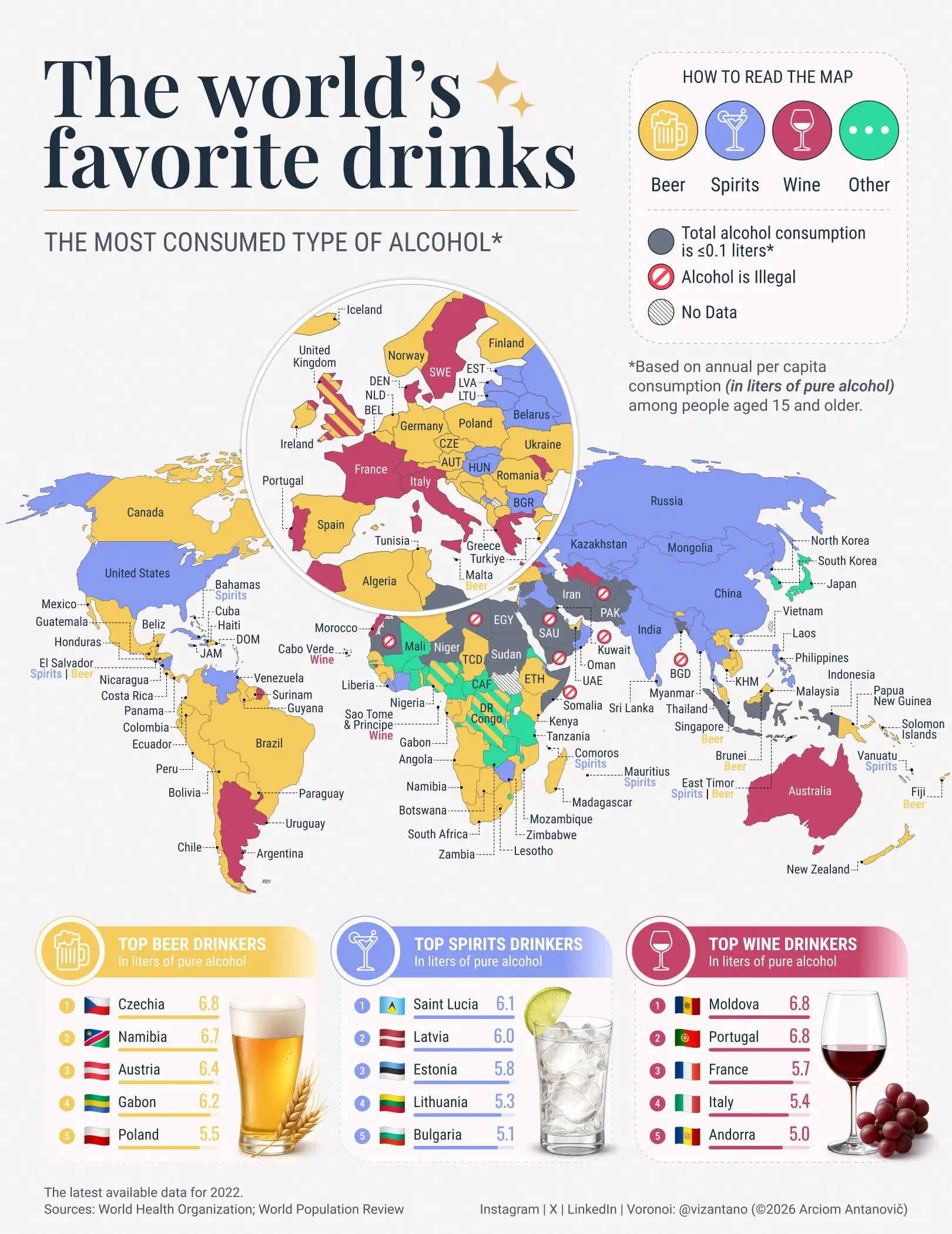
Using data from the World Health Organization, this map breaks down alcohol consumption into four key categories, measured in liters of pure alcohol per capita (age 15+). This approach allows for a like-for-like comparison across beverages with very different strengths.
🍺 Beer
Beer dominates in many parts of the world, particularly in Europe, the Americas, and parts of Africa.
This category includes:
Despite its relatively low alcohol content, beer often leads due to high volume consumption.
🥃 Spirits
Spirits represent distilled alcohol, typically with a much higher alcohol content.
This category includes:
In Eastern Europe and parts of Asia, spirits dominate due to cultural preferences and historical production patterns.
🍷 Wine
Wine consumption is concentrated in regions with strong winemaking traditions.
This category includes:
Southern and Western Europe, along with parts of South America, stand out as global wine strongholds.
🍶 Other Alcoholic Beverages
This is the most diverse and often misunderstood category.
It includes:
In many countries, a high “Other” share signals the importance of local traditions or unrecorded consumption that falls outside standardized categories.