
Where Data Tells the Story
© Voronoi 2026. All rights reserved.

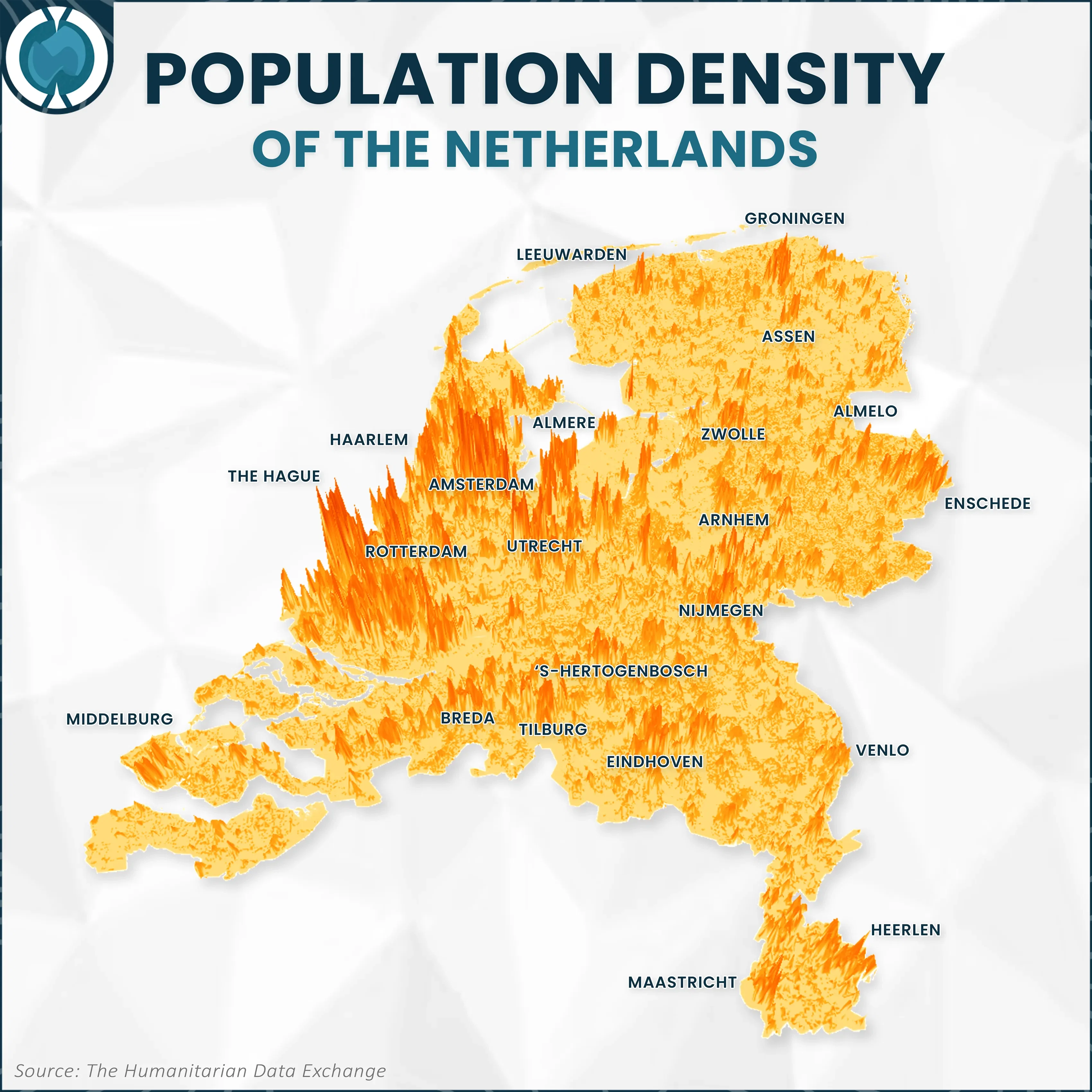
Europe's most fascinating example of polycentric urbanism is clearly visible in this relief map of the Netherlands. Rather than a single monocentric capital dominating the landscape (like London or Paris), the Dutch population structure forms a distinct 'horseshoe' known as the Randstad. This conurbation connects the economic spikes of Amsterdam, the logistical hub of Rotterdam, the diplomatic center of The Hague, and the academic node of Utrecht. Together, these four cities and their satellites account for nearly 50% of the country's GDP despite occupying a fraction of the land area.
Crucially, the visualization highlights the intentional void within this urban ring: the 'Green Heart' (Groene Hart). This low-density zone between Amsterdam and Utrecht demonstrates the effectiveness of strict Dutch spatial planning and zoning laws designed to prevent urban sprawl from merging these distinct metro areas into a single concrete block. In contrast, the northern provinces (Friesland, Groningen) and the Zeeland delta in the southwest show significantly dispersed settlement patterns, emphasizing the massive population pressure placed on the low-lying, flood-prone western provinces.