
Mapped: South Africa’s Xenophobic Violence, by Province
Several countries, including Ghana, Malawi, and Mozambique, have recently repatriated their nationals due to safety concerns.
Manipulated videos, fabricated crime reports, and misleading social media content have circulated widely in South Africa’s 2026 xenophobic violence wave, portraying migrants as responsible for criminal activity or economic decline.
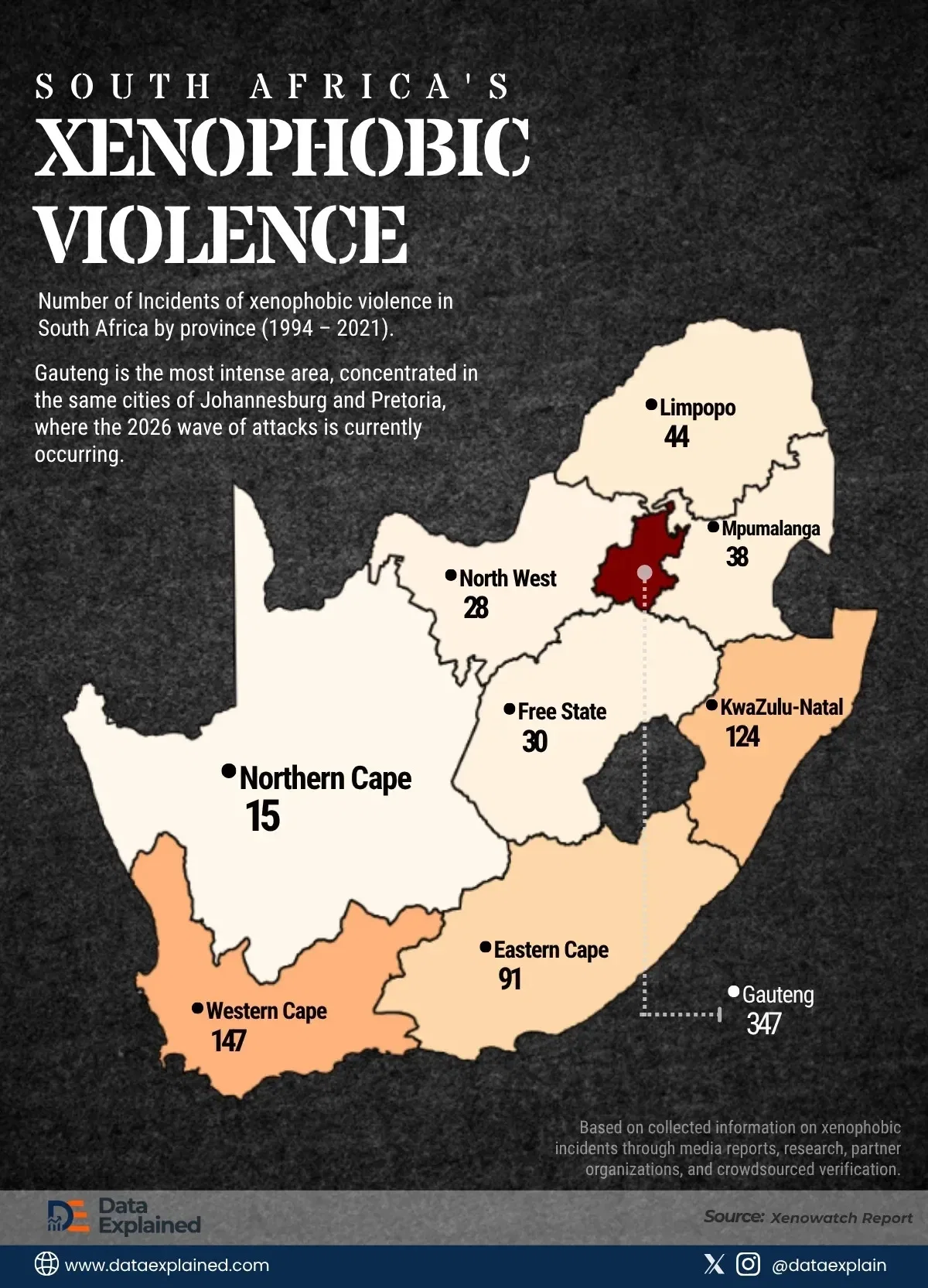
The graphic above shows the number of reported incidents of xenophobic violence in South Africa by province from 1994 to 2021.
This data comes from The Xenowatch Report.
It is based on collected information on xenophobic incidents through media reports, research, partner organizations, and crowdsourced verification
The cities currently generating the most alarming reports are the same ones that have dominated three decades of historical data.
- Gauteng alone accounts for 347 of xenophobic incidents (39.7%), concentrated in the same Johannesburg and Pretoria cities where the 2026 wave of attacks is currently occurring.
- The current 2026 wave, driven by anti-immigrant groups including the March and March movement and Operation Dudula, is occurring at South Africa’s worst recorded unemployment level of over 43%
ALSO READ: Mapped: Majority of Humans Live With Restricted Freedom of Expression
South Africa’s unemployment rate exceeds 43%.
The Xenowatch data covers a 27-year period during which unemployment moved from approximately 20% in the late 1990s to its current historic high.
The 2026 wave is occurring at the highest sustained unemployment level in the dataset’s entire corresponding period.
Vigilante groups feed off the country’s frustrations and socioeconomic rights regression, unemployment, and lack of efforts to address the equity gaps that we have as a country, according to activists at the Kopanang Africa Against Xenophobia coalition.
A 2018 Pew Research poll found that 62% of South Africans expressed negative sentiment toward foreign nationals.
It revealed that they believed immigrants are a burden on society by taking jobs and social benefits.
In that same poll, 61% thought immigrants were more responsible for crime than other groups.
Migration researchers and economists consistently dispute those claims, noting that migrants account for a small percentage of South Africa’s population and contribute significantly through entrepreneurship and trade.
ALSO READ: Africa’s Population On Track to Hit 2.5 billion By 2050