
Where Data Tells the Story
© Voronoi 2026. All rights reserved.

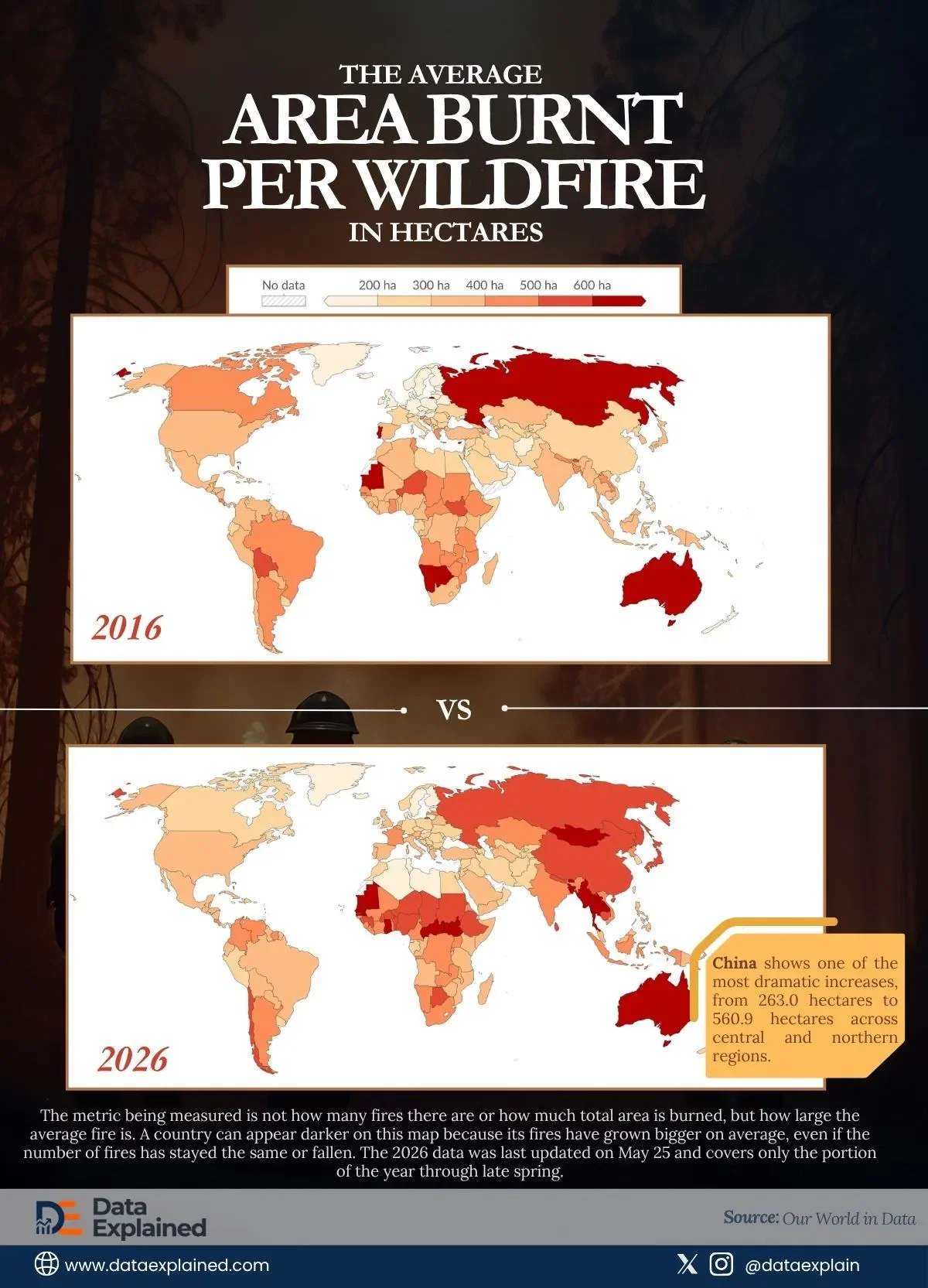
Today’s visualization shows the average area burnt per wildfire in hectares by country. It compares 2016 and 2026, averaging around 200-600 hectares and above.
The data comes from The Global Wildfire Information System, accessed via Our World in Data.
The metric being measured is not how many fires there are or how much total area is burned, but how large the average fire is.
A country can appear darker on this map because its fires have grown bigger on average, even if the number of fires has stayed the same or fallen.
Bigger fires are harder to suppress, burn longer, require more resources to contain, and cause more sustained damage to infrastructure.
Average fire size is a measure of both fire intensity and fire management difficulty.
The most visually striking national change between the two maps is China.
In 2016, China appeared in light-to-moderate colors across most of its landmass. In 2026, significant portions, particularly across central and northern regions, have darkened considerably toward the higher end of the scale. China is the world’s most critical manufacturing and supply chain hub.
It is also, according to this decade of data, one of the countries experiencing the most significant increase in wildfire intensity.
That combination has not yet entered the mainstream conversation about global fire risk in the way that Australia, California, or Siberia have.