
Where Data Tells the Story
© Voronoi 2026. All rights reserved.

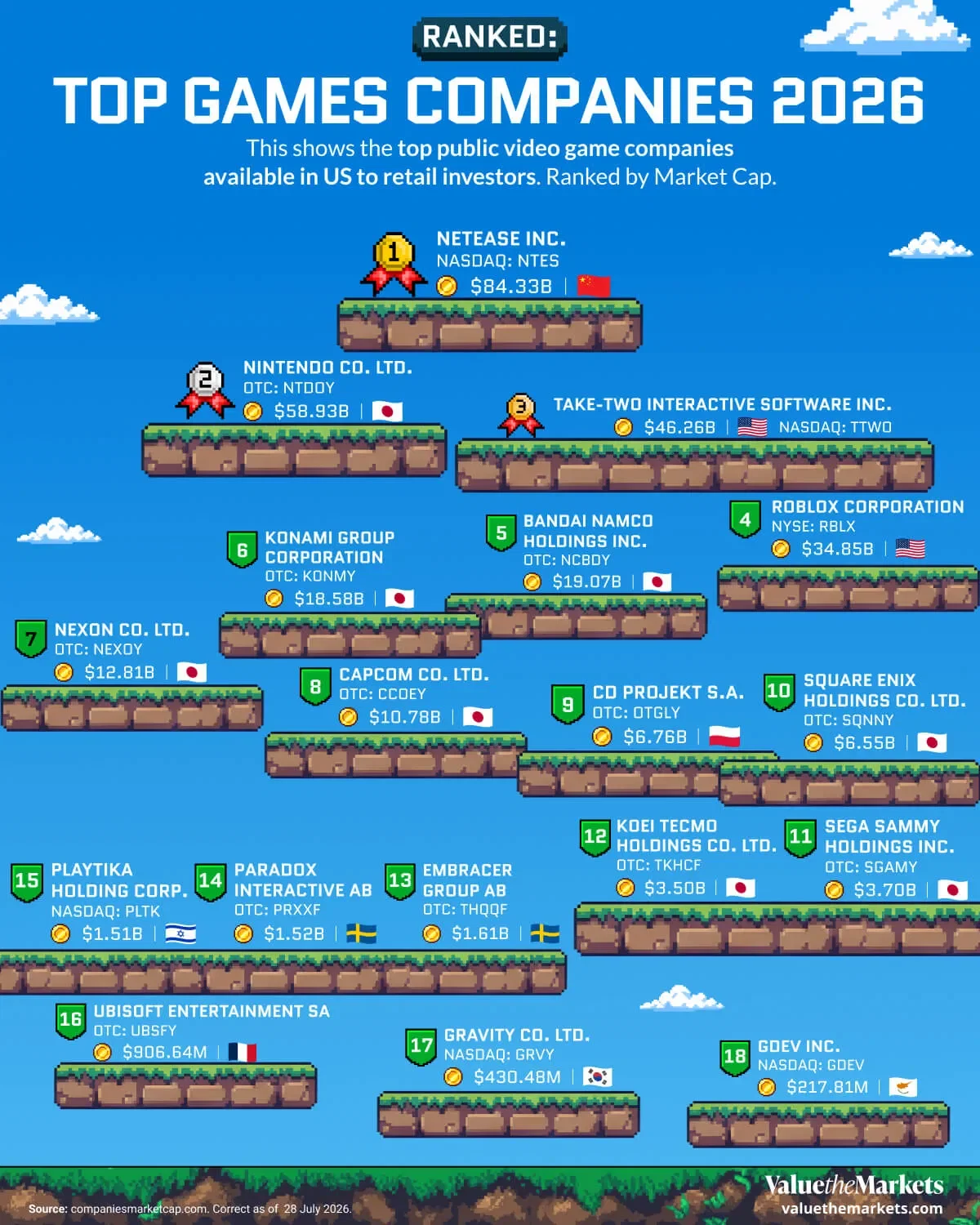
A market cap ranking makes gaming look like one sector. It isn't. See full investing data story and insights →
NetEase leads the listed pure-plays at $84.3B, roughly $25B ahead of Nintendo at $58.9B. Take-Two follows at $46.3B, then Roblox at $34.9B. Japanese studios dominate by count, with eight names on the list. China dominates by value, with one.
The order is the least interesting part. Sorted by how they earn money, these companies split into groups with almost nothing in common.
Live-service operators (NetEase, Nexon, Playtika) earn continuously after launch through in-game purchases and updates. Revenue behaves more like a subscription.
Premium publishers (CD Projekt, Capcom) sell games as one-off purchases. Earnings swing hard between a hit year and a quiet one.
Diversified publishers (Take-Two, Bandai Namco) spread revenue across franchises, platforms and sometimes non-game lines like toys and arcade machines, which smooths results.
Roblox fits none of these. It hosts games built by its own users and monetises virtual currency, putting it closer to a social network than a publisher.
Two gaming stocks can therefore move in opposite directions on the same headline. A shift in mobile spending, a delayed blockbuster and a weak console cycle each strike a different model.
There is an access catch too. Only six of the 18 trade on NASDAQ or NYSE. Every Japanese and Swedish name trades over the counter as an ADR, with thinner liquidity and lighter coverage.
And the biggest gaming operations are not on this list at all. Xbox earns billions inside Microsoft. Games run close to a third of Tencent. At Sony, games are the largest reporting segment. A pure-play screen filters all of them out by definition.
Which model each name runs on, how it behaves through a cycle, and where the hidden exposure actually sits: full breakdown in the original data story.