
Where Data Tells the Story
© Voronoi 2026. All rights reserved.

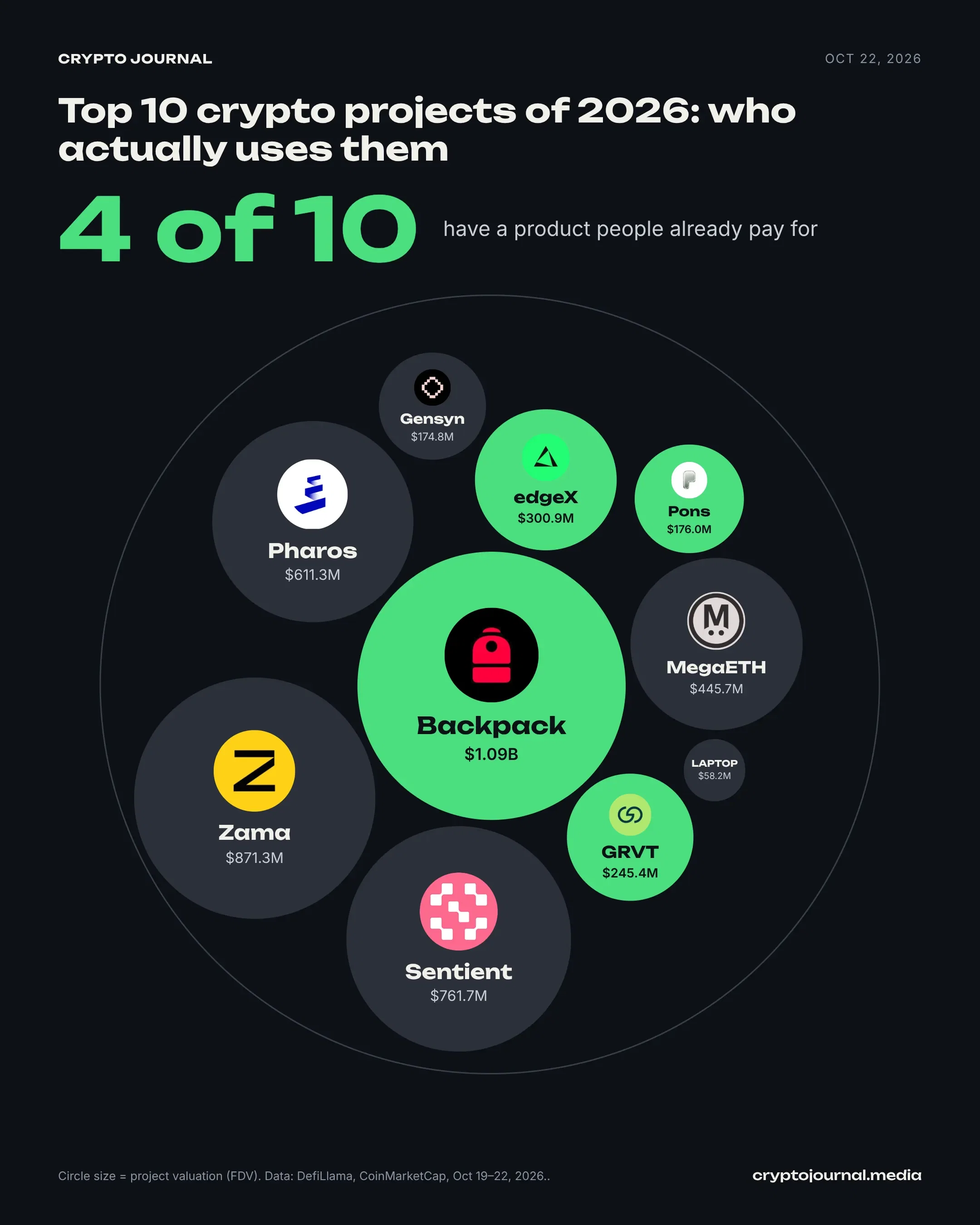
Crypto Journal reviewed the 10 most prominent tokens that first started trading between January 1 and October 22, 2026, and asked one question: do people actually use and pay for the product behind the token?
Each project was checked against on-chain and exchange data from DefiLlama as of October 19–22, 2026: trading volume, total value locked (TVL), fees and protocol revenue. Circle size in the chart shows each project's fully diluted valuation (FDV), the token price multiplied by every coin that will ever exist, as reported by CoinMarketCap on October 22, 2026.
Green circles mark projects with measurable paying demand. Exchanges edgeX and GRVT handle hundreds of millions of dollars in daily trading, and Backpack holds $588.3M in reserves. Pons, a token launchpad on Robinhood Chain, has earned $36.06M in protocol revenue, though most of its activity comes from memecoin speculation and its fees fell from $137.07M in September to $13.67M in October 1–22.
Zama and Pharos run working networks with real partners (Tether, Dfns, Ant Group alumni), but their current revenue is small compared with their valuations. MegaETH, Gensyn and Sentient show little public evidence of paying users so far. Hunter Biden's Laptop is a memecoin with no product.