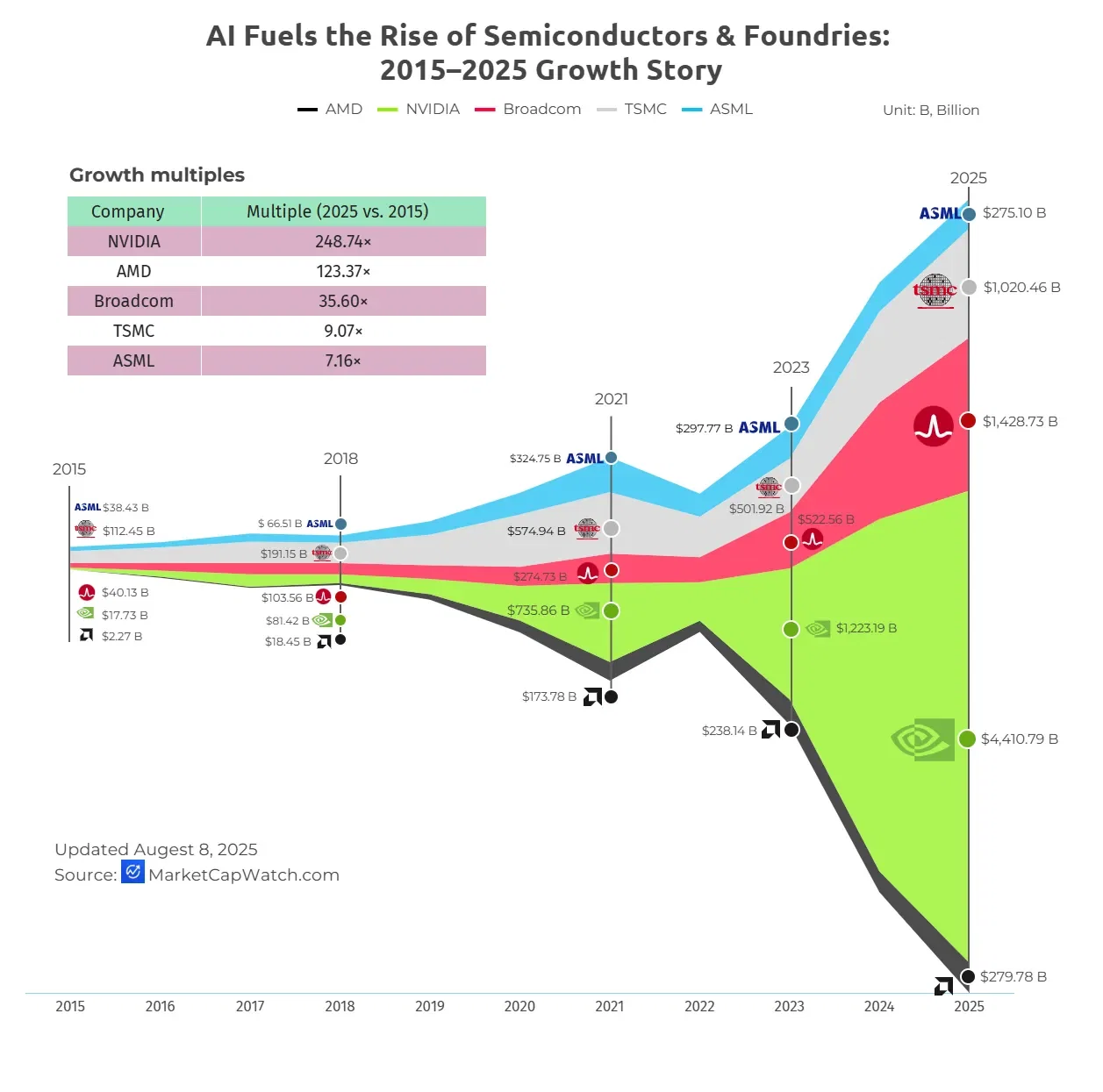
Over the past decade, the market caps of semiconductor designers and foundries have been fundamentally reshaped by AI demand and technology cycles. NVIDIA led the pack, vaulting from $17.7 B in 2015 to over $4.4 T in 2025 (a 73.6% CAGR), while AMD climbed more than 120× thanks to Ryzen and EPYC momentum. Broadcom’s acquisition-driven strategy fueled a 35× rise, and pure-play foundry leader TSMC grew nearly 9× to $1 T, underscoring the steady, essential nature of contract manufacturing. ASML’s specialized EUV tools saw its market cap expand over 7× as chipmakers raced to deploy next-generation lithography.
Analysis
- AI acceleration and cloud-scale GPU deployments drove the explosive late-cycle surge, especially for GPU-centric firms.
- Cyclical pullbacks in 2018 and 2022 highlight broader macro volatility, but the 2023–2025 rebound affirms structural tailwinds behind AI and 5G rollout.
- Foundries and equipment makers deliver smoother compounding vs. designers, offering a defensive anchor in semiconductor portfolios.
Key Takeaways
- NVIDIA’s extraordinary 248× growth cements GPUs as the linchpin of modern AI infrastructure.
- AMD’s comeback story demonstrates the power of competitive product cycles and ecosystem wins.
- TSMC and ASML remain critical “picks and shovels” plays, balancing out higher-beta chip design names.
- Long-term investors can blend high-growth AI plays with must-have manufacturing staples for both alpha and stability.