
Where Data Tells the Story
© Voronoi 2026. All rights reserved.

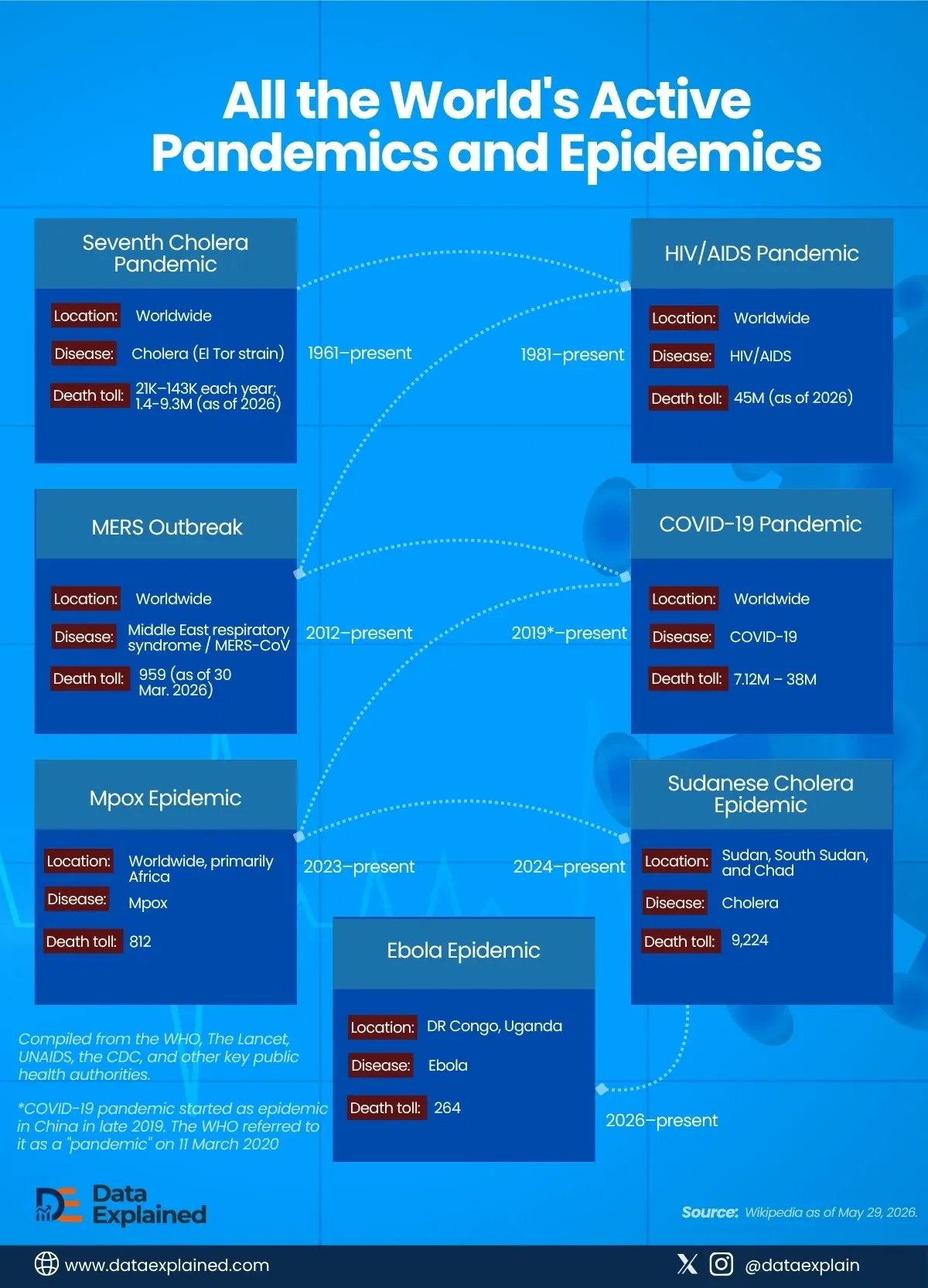
The world is currently managing seven simultaneous pandemics and epidemics.
The visualization above shows a chronological arrangement of ongoing disease outbreaks compiled from the WHO, The Lancet, UNAIDS, the CDC, and multiple other public health authorities.
It was gathered from Wikipedia as of May 29, 2026.
The 2023-2026 Mpox epidemic has recorded 812 deaths, primarily in Africa.
The WHO declared it a Public Health Emergency of International Concern for the second time in August 2024, driven by clade Ib (a more severe strain than the variant that caused the 2022 international outbreak).
The 2024-2025 Sudanese cholera epidemic has killed 9,224 people across Sudan, South Sudan, and Chad.
It is the second cholera entry in the data, a regional crisis severe enough to warrant separate classification from the background global pandemic.
The newest entry is the 2026 Ebola epidemic in the Democratic Republic of Congo and Uganda, with 264 deaths recorded.
DRC has experienced at least 14 Ebola outbreaks since the virus was first identified there in 1976. The most severe (the 2018-2020 outbreak) killed more than 3,400 people.
What about Malaria?
Malaria is not currently on the data, and it kills approximately 600,000 people annually, compared to tuberculosis, which kills approximately 1.3 million.
Those are classified as endemic rather than epidemic.
What sits in the table is the additional layer, the events that have triggered formal epidemic or pandemic classifications requiring specific emergency response.
They sit atop an endemic baseline that is itself enormous.