
Where Data Tells the Story
© Voronoi 2026. All rights reserved.
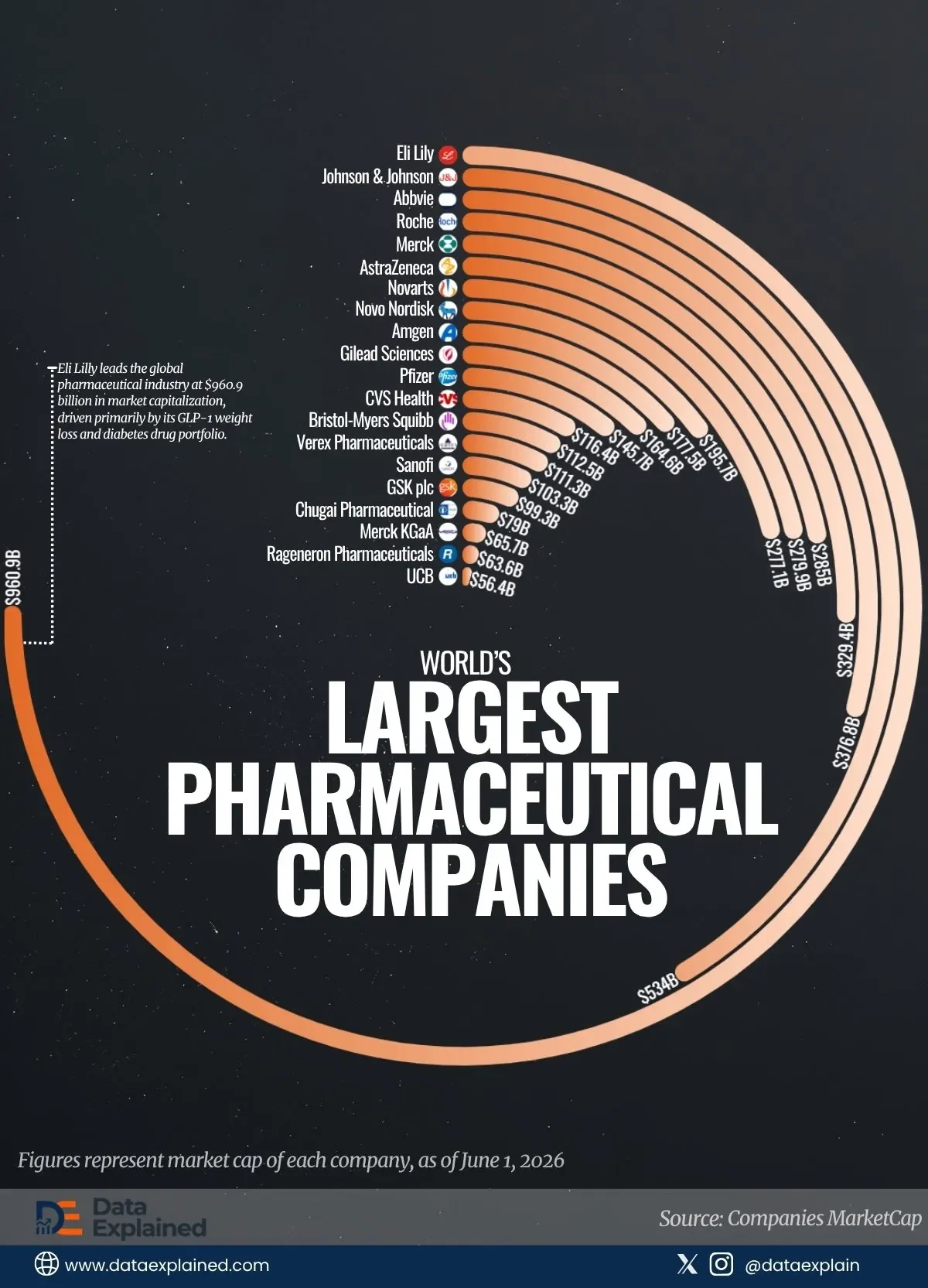
Eli Lilly now has a market capitalization of $960.9 billion, almost double Johnson & Johnson’s $534 billion. It is roughly driven by a single drug class that did not generate meaningful revenue five years ago.
The infographic above shows the top 20 largest pharma companies by market cap, as of June 1, 2026.
It comes from Companies MarketCap.
Market capitalization is the total dollar value of a company’s outstanding shares of stock. It is a quick and widely used metric to measure a company’s total size.
Tirzepatide, sold as Zepbound for obesity and Mounjaro for type 2 diabetes, is the primary engine behind Eli Lilly’s valuation.
GLP-1 drugs work by mimicking hormones that regulate blood sugar and appetite, producing sustained weight loss in clinical trials at rates that no previous drug class achieved.
Eli Lilly’s version and Novo Nordisk’s semaglutide (Ozempic, Wegovy) together define the category.
Novo Nordisk, the Danish company that pioneered insulin manufacturing in 1923, sits eighth in the table at $195.7 billion, a position driven by the same drug class.
What Happened to Pfizer?
Pfizer sits 11th at $145.7 billion.
During 2021 and 2022, as its COVID-19 vaccine generated unprecedented revenue, Pfizer’s market capitalization reached approximately $300 billion.
The company was briefly one of the most valuable corporations on earth.
Three years later, it is worth less than Amgen ($177.5 billion), Gilead Sciences ($164.6 billion), and Novo Nordisk, all of which were far less prominent during the pandemic period.
COVID vaccine revenue was extraordinary but non-recurring.
The pipeline of drugs that would justify a sustained $300 billion valuation did not materialize at the pace the market initially priced.