
Where Data Tells the Story
© Voronoi 2026. All rights reserved.

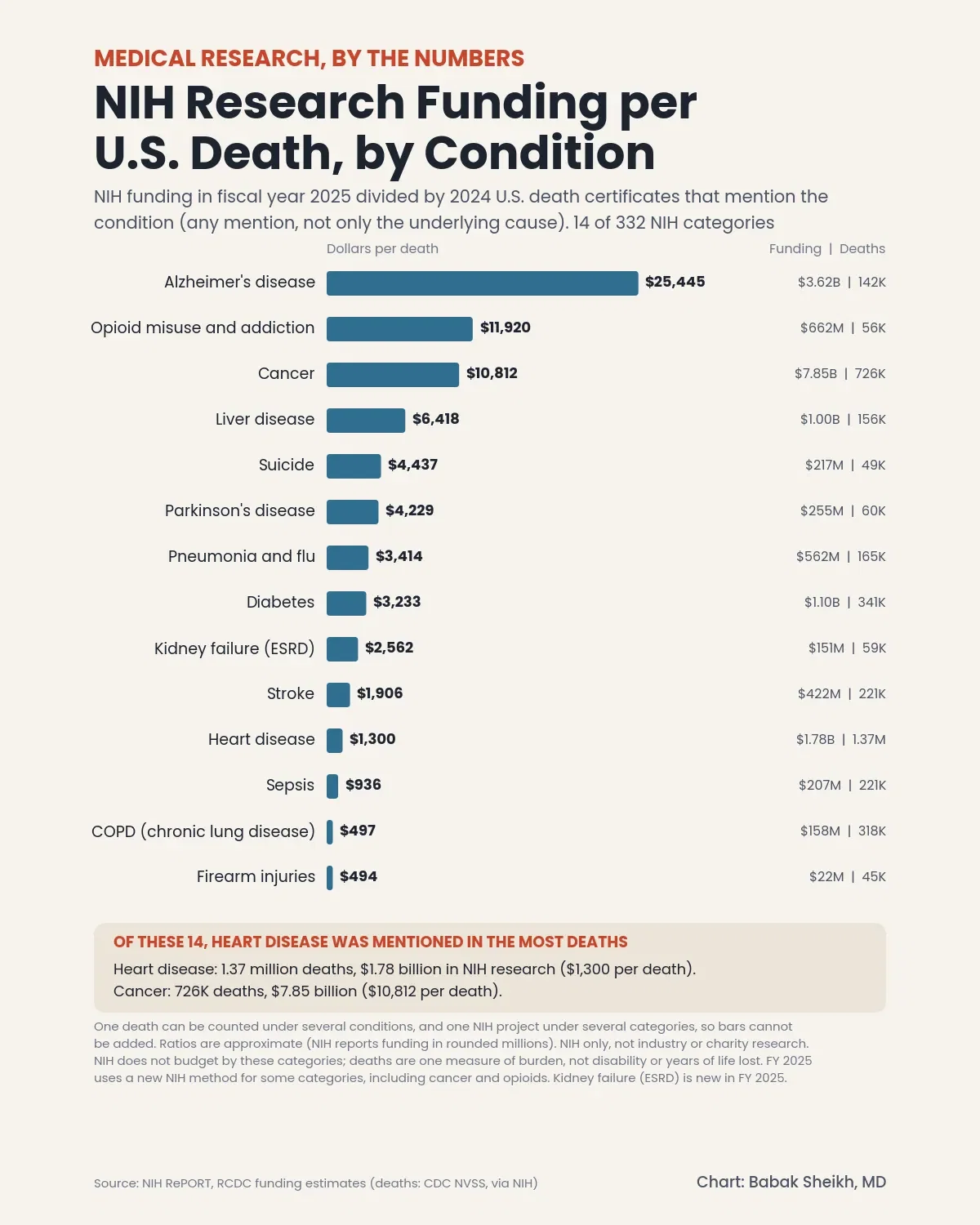
How does National Institutes of Health research funding compare with the number of Americans who die with each condition? This chart divides NIH funding for fiscal year 2025 by the number of 2024 U.S. death certificates that mention each condition, for 14 of NIH's 332 research categories.
Key Takeaways
- Alzheimer's disease had the highest ratio: $3.62 billion in NIH funding and 142,266 deaths, about $25,445 per death.
- Heart disease was mentioned in the most deaths, 1.37 million, with $1.78 billion in NIH funding, about $1,300 per death.
- Cancer was mentioned in 726,293 deaths and received $7.85 billion, about $10,812 per death.
- COPD (about $497 per death) and firearm injuries (about $494 per death) had the lowest ratios of the 14.
Note: Deaths count every death certificate that mentions the condition, not only the underlying cause, so one death can be counted under several conditions. NIH categories also overlap, because a project can count toward more than one category, so the bars cannot be added. Ratios are approximate because NIH reports funding in rounded millions. Funding is NIH only and leaves out industry, charity and other federal research. NIH does not set its budget by these categories, and deaths are only one measure of a condition's burden. NIH changed its counting method for some categories in fiscal year 2025, including cancer and opioids, and end-stage renal disease is a new category in 2025.