
Where Data Tells the Story
© Voronoi 2026. All rights reserved.

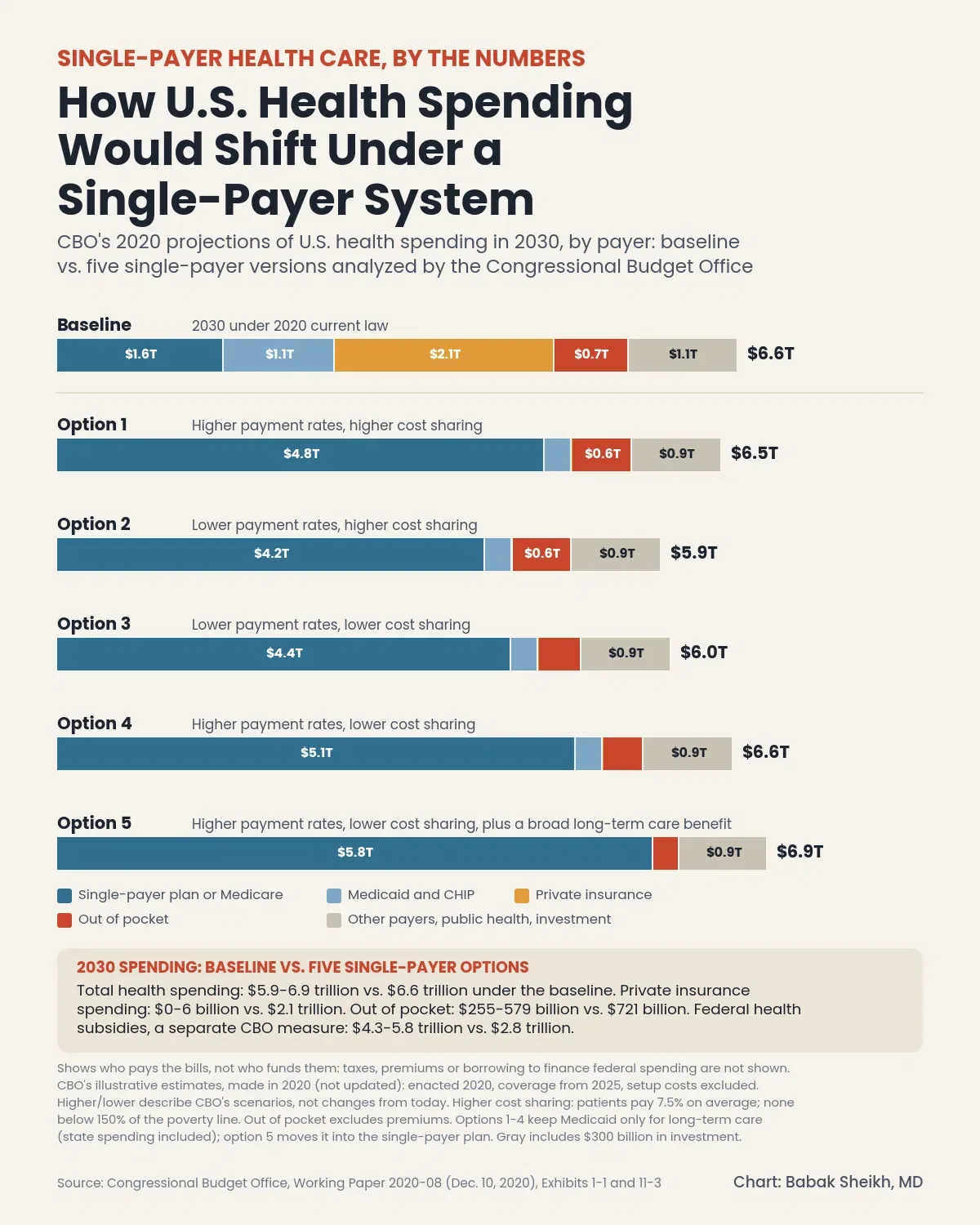
What would change if the U.S. moved to a single-payer health system, often called Medicare for All? The Congressional Budget Office (CBO) projected U.S. health spending in 2030 under current law and under five single-payer designs that differ in what doctors and hospitals are paid, what patients pay at the time of care, and whether long-term care is covered.
Key Takeaways
- Total health spending in 2030 would be $5.9 trillion to $6.9 trillion under the five designs, compared with $6.6 trillion under the baseline.
- Spending by private insurance would fall from $2.1 trillion to $6 billion or less.
- Out-of-pocket spending would fall from $721 billion to between $255 billion and $579 billion.
- Federal health subsidies, a separate CBO measure, would rise from $2.8 trillion to between $4.3 trillion and $5.8 trillion.
For comparison, actual U.S. health spending in 2024 was $5.3 trillion. Private insurance paid $1.6 trillion, Medicare $1.1 trillion, Medicaid $931.7 billion, and patients $556.6 billion out of pocket (CMS, National Health Expenditure data).
Note: The chart shows who pays the bills, not how the added federal spending would be financed (taxes, premiums or borrowing). These are CBO's illustrative estimates made in 2020 and not updated since. They assume a law enacted in 2020, coverage starting in 2025, and they exclude setup costs. Out-of-pocket spending excludes insurance premiums.