
Where Data Tells the Story
© Voronoi 2026. All rights reserved.

Heart transplant patients in the United States typically spend months waiting for a donated organ.
Meanwhile, not all organ transplants carry the same financial burden.
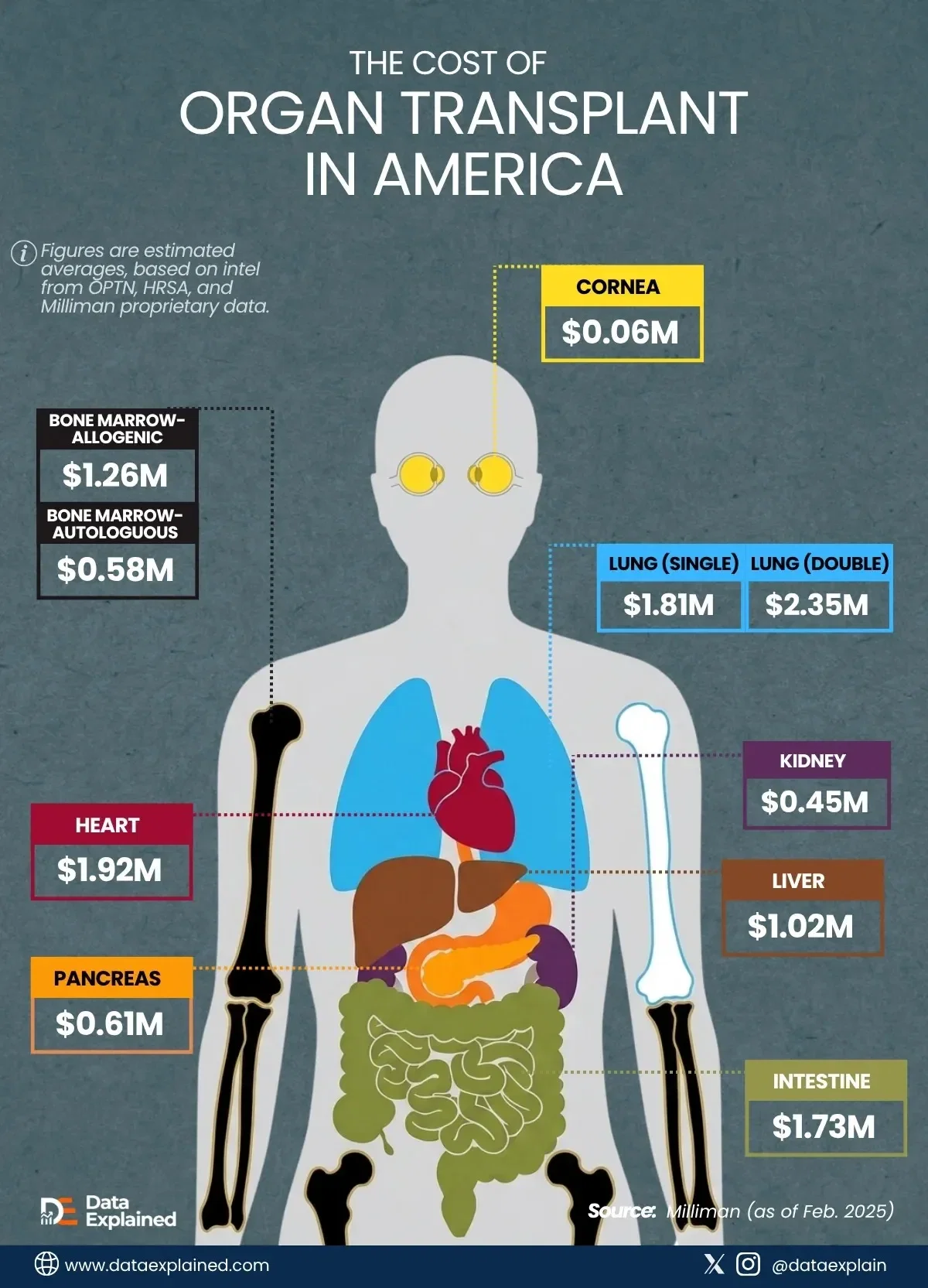
The visualization above shows the average amount charged for select organ transplantations in the U.S. as of 2025.
It is based on intel shared by healthcare consulting firm Milliman.
The data shows that the average hospital charge for a double lung transplant in the United States stands at $2.35 million, making it the most expensive transplant procedure on record.
ALSO READ: Ranked: Countries Searching Most for Mental Health Topics
Below the top tier, average hospital charges begin to fall considerably.
Allogeneic bone marrow transplants, which use stem cells from a donor, average $1.26 million, while liver transplants come in at just over $1.02 million.
Further down the list are pancreas transplants at $609,400, autologous bone marrow transplants at $577,000, and kidney transplants at $446,800.
Although these procedures remain expensive by any measure, they illustrate that transplant charges are far from uniform.
ALSO READ: Mapped: Where People Take Weight-Loss Drugs The Most in America
So, What?
Congress launched investigations into major medical centers (such as the University of Chicago Medical Center and Montefiore Medical Center in NY) after reports revealed they were transplanting organs from American donors into wealthy foreign patients who traveled to the U.S. specifically to bypass the standard queue.
For patients, the figures in this data story illustrate why insurance coverage and access to specialized transplant centers remain critical to receiving life-saving care.
For healthcare providers, insurers, and policymakers, the figures in this story offer a snapshot of where some of the greatest financial demands exist within transplant medicine.